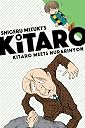
Kitaro Meets Nurarihyon
Product ID: 41698179
Desertcart purchases this item on your behalf and handles shipping, customs, and support to KUWAIT.
" Kitaro is a fun, eerie romp into Japan's supernatural world." - -School Library Journal, YALSA Great Graphic Novel for Teens The second in a seven-volume series of the best of Shigeru Mizuki's Kitaro comics, designed with a kid-friendly format and price point! Kitaro Meets Nurarihyon is the second volume in the adventures of Shigeru Mizuki's bizarre yokai boy Kitaro and his gaggle of otherworldly friends. These seven stories date from the golden age of Gegege no Kitaro , when Mizuki had perfected the balance of folklore, comedy, and horror that made Kitaro one of Japan's most beloved characters. In Kitaro Meets Nurarihyon , Kitaro and his father, Medama Oyaji, face off against one of their most powerful enemies--the self-styled Yokai Supreme Commander known as Nurarihyon. Over the course of this volume, Kitaro takes on the swamp-dwelling Sawa Kozo, the mysterious Diamond Yokai, and the sea giant called Umizato, and wages a double feature of battles against the bizarre Odoro Odoro. Finally, Kitaro journeys to hell itself in the infamous and surreal story "Hell Ride." In addition to more than 150 pages of Mizuki's all-ages monster fun, Kitaro Meets Nurarihyon includes bonus materials: "Yokai Files" that introduce Japan's folklore monsters and a "History of Kitaro" essay by the translator Zack Davisson. If you found the world of yokai fascinating in The Birth of Kitaro , you will find even more to love in Kitaro Meets Nurarihyon ! Review: Will make you want to read more... - Makes me want to read more of Shigeru Mizuki's books! Review: CAN'T PUT IT DOWN!!! - I got this book because I love cute comic stories about spirit or in this case (Yokai) and I am charmed from page 1 to 200, where I'm at. This book was so worth getting and would love to read more of Shigero's work.
| Best Sellers Rank | #538,154 in Books ( See Top 100 in Books ) #24 in Drawn & Quarterly Comic & Graphic Novels #431 in Children's Paranormal Fantasy #5,252 in Action & Adventure Manga (Books) |
| Customer Reviews | 4.7 out of 5 stars 60 Reviews |
K**S
Will make you want to read more...
Makes me want to read more of Shigeru Mizuki's books!
K**R
CAN'T PUT IT DOWN!!!
I got this book because I love cute comic stories about spirit or in this case (Yokai) and I am charmed from page 1 to 200, where I'm at. This book was so worth getting and would love to read more of Shigero's work.
E**K
The second volume of selected stories from a classic Japanese manga finally available in English...
Shigeru Mizuki remains a Japanese cultural icon largely for his work featuring "yokai." Often translated as "spirit," the concept of "yokai" typically contains much wider connotations than English words such as "spirit" or "ghost." Some yokai exist only at specific times or in certain circumstances. Others seem to enforce moral codes. Still others explain ineffable natural or psychological phenomenon, such as that random creepy feeling of being watched. More complex "yokai" take on anthropomorphic characteristics, such as seeking power or revenge or guarding treasure from theft. Some even feed on humans. Though occasionally revered as gods by people, they don't really suggest something as all-powerful or all-consuming as a deity or a supreme being. Arguably, they reflect an animistic attitude toward the natural world as not-quite-fully-material yet not-quite-fully-spiritual beings that underly and affect nearly everything. As Japan industrialized during the twentieth century, belief in "yokai" gradually diminished in urban centers, but one could apparently still hear "yokai" stories among older populations in rural areas. Mizuki, born in the late Taisho era in 1922, grew up in such an area and his elderly nanny, also known as "Nonnonba," told him traditional "yokai" stories, which he later incorporated into his immensely popular manga. Many credit Mizuki's work for keeping the traditional "yokai" alive in modern Japan. Of all Mizuki's "yokai" based manga, the series featuring the boy "Kitaro" remains one of the most popular and influential. Surprisingly, especially given the general popularity of manga in America, these classic Japanese stories didn't appear in English until after Mizuki's death in 2015. The following year, publisher Drawn and Quarterly began releasing excerpts from the "Kitaro" series, beginning with the first volume "The Birth of Kitaro," which gives his sometimes disgusting and sometimes hilarious back story that first appeared in 1966. Basically, Kitaro, born from a dying yokai couple, comes under the guardianship of one of his dead yokai father's eyes. It oozes from its slimy socket, grows tiny arms and legs and then follows and looks after Kitaro thereafter. Kitaro becomes a sort of "yokai police," receiving complaints in the "yokai mailbox" about unexplained events. His frenemy Nezumi Otoko, or "rat man," sometimes helps him but often thwarts his attempts to stop rogue yokai. Readers may wonder why Kitaro even gives Nezumi Otoko the time of day after some of his fiendish double-crosses. Narratives need tension, after all, and the very popular Nezumi does make a great foil. Though Drawn and Quarterly has done an excellent job at making this manga masterpiece finally available in English, they didn't always make it easy to determine the order of the installments. With seven volumes now available, and more apparently on the way, readers new to the series will probably know to begin with "The Birth of Kitaro" based on its title, but where to go from there? The books' covers or spines don't include any obvious numbering schemes. The second volume, "Kitaro Meets Nurarihyon," doesn't display a "2" anywhere on its cover or spine. The only hints appear in its publication date, its table of contents and some fine print on the back cover. Volume One included an introduction called "History of Kitaro, Part 1" and Volume 2 includes, appropriately, a "History of Kitaro, Part 2." The publication date appears on the copyright page of both volumes, but since these books follow traditional manga page ordering, the publication date appears in the back, but, as such, it actually appears in the front for those who don't know any better. Here, confused readers will see that Volume 1 appeared in May 2016 and Volume 2 in October 2016. Lastly, the back covers of both volumes also reference the "History of Kitaro" series by number. These clues should help people navigate correctly through the series. The publication dates likely provide the most reliable map. Volume Two includes stories with very similar form to Volume One. Most date from 1967 to 1968, but one standout dates to 1978. The first story matches Kitaro against the seemingly rich and powerful yokai Nurarihyon. A pachinko ball brings Nurarihyon and Nezumi Otoko together and Nurarihyon uses this opportunity, and some funny money, to meet Kitaro. Soon Kitaro and Nezumi find themselves buried in cement and in a particularly macabre scene, Kitaro's outstretched hand pops off when Nurarihyon tries to escape from its fervent grip. The hand takes control and a spinning time machine ends up setting things right. "Datsui Baba" finds another powerful yokai sending Kitaro to the afterlife where his father's eye, Medama-Oyaji, has to help him escape. Nezumi Otoko's gullibility and greed once again sets everything in motion. But it turns out that the old yokai woman had seen a tv show featuring an older woman with a younger man. She thought she could do the same. Interesting motivation. "Sara Kozo" sees a washed up singer inadvertently stealing a powerful yokai kappa's song. When the singer disappears after scoring a number one hit with the song, the family reaches out to Kitaro, who has to evade not only a plate attack, but gushing poison urine. Nezumi Otoko's fantastically unbearable stench helps. "Diamond Yokai" features a creepy spinning yokai, Wanyudo, whose breath turns people into solid diamond. It seems to feed on and punish greed, as Nezumi Otoko, Kitaro and some passersby find out. Nonetheless, as with Medusa, mirrors prove deadly. As Kitaro says "Yokai who use light rays really should know better than to keep mirrors around." Unfortunately, the diamonds that some want to take have a pretty grisly origin. "Umi Zato" features a yokai who tries to drag sailors to the bottom of the ocean using Funa Yurei. Seeking a vacation, the group encounters yokai instead. "Odoro Odoro" contains a rather freaky looking yokai with prehensile hair capture prey, often in the form of humans. For now, it wants to collect yokai in the spirit world, via a strange machine resembling a cement mixer, to get them out of the way. The book's final story, "Odoro Odoro Versus Vampire" runs much longer than the other stories and features the same Odoro Odoro, but this time with a Vampire sporting a slight German accent. Early on, a spirit takes control of Kitaro and Medama-Oyaji has to sort things out. He becomes a tempura snack, thanks to Nezumi Otoko, but Medama-Oyaji's small size allows him to call out to the zombie Kitaro through the Vampire's orifices. In the end, the Vampire and the Odoro Odoro meet in battle. Those familiar with Mizuki's "gekiga," or more adult-oriented manga, may find "Kitaro" a little watered down at first. These early stories conform more to the traditional action-thriller manga genre than later work such as "Showa" or "Nonnonba." They primarily entertain without really adding any layers of social commentary or history. Still, they are fun and engaging and they provide a window into Mizuki's early work. They also gave him enough popularity, independence and wealth for him to take on his more mature, and less popular, "gekiga" work later in his career. In Japan, "Kitaro" has sprouted anime television series, live-action movies and video games. Though they likely won't have a similar impact in the English-speaking world, these stories nonetheless provide an entertaining and intriguing look into Japanese popular culture, not to mention providing a fascinating glimpse into the early work of a master manga artist.
S**S
Amazing work by Shigeru Mizuki
My first experience of Kitaro after reading Mizuki's story in "Showa: A History of Japan". I was already a big Yo-kai fan from Yo-kai Watch (actually I got up to the 4th YKW movie where the Kitaro characters make an appearance shortly after I read this, coincidentally), and it is thanks to Mizuki that they became so popular in Japan. More people from the West need to read Kitaro. It's a brilliant work. And you can also watch the 1968 anime for the adaptations of these stories, which I did after reading this.
9**9
Born out of Mizuki’s imagination and creativity
To be honest with you, some of the drawings are not pretty. To a little girl, they would look hairy. However, the stories that Mizuki is trying to convey are heroic and morally good.
R**L
Great (historical) manga - beautiful drawings and stories
Nicely produced little paperback of Shigeru Mizuki's famous yokai creation Kitaro.. and his various spirit-pals. My grandson (aged 11) and I are Big Fans.. and I am introducing Kitaro to more 9-11 year old English readers as a change from modern manga and anime. There's lots of interesting historical background stuff (if you want to look for it) reflecting Mizuki's making these adventures in the 1950s and 60s. The characters are well realised, and their adventures (Kitaro usually gets his pals out of trouble) hold interesting moral themes. While there 's lots of action it doesn't dominate as in so much modern manga. Also Romance (!) is held to a minimum..useful for 10 year olds who aren't really up for it.
G**9
Mizuki's art style and humor has made me a fan of his works.
Having spotted the new Anime adaptation of Kitaro 2018 I went ahead and pretty much purchased all the Kitaro Manga available on here I have fallen in love with this character , He's so cute and It's Yokai are definitely a favourite subject of mine. Mizuki's art style and humor has made me a fan of his works. Makes me want to read them all .
Trustpilot
1 day ago
2 weeks ago