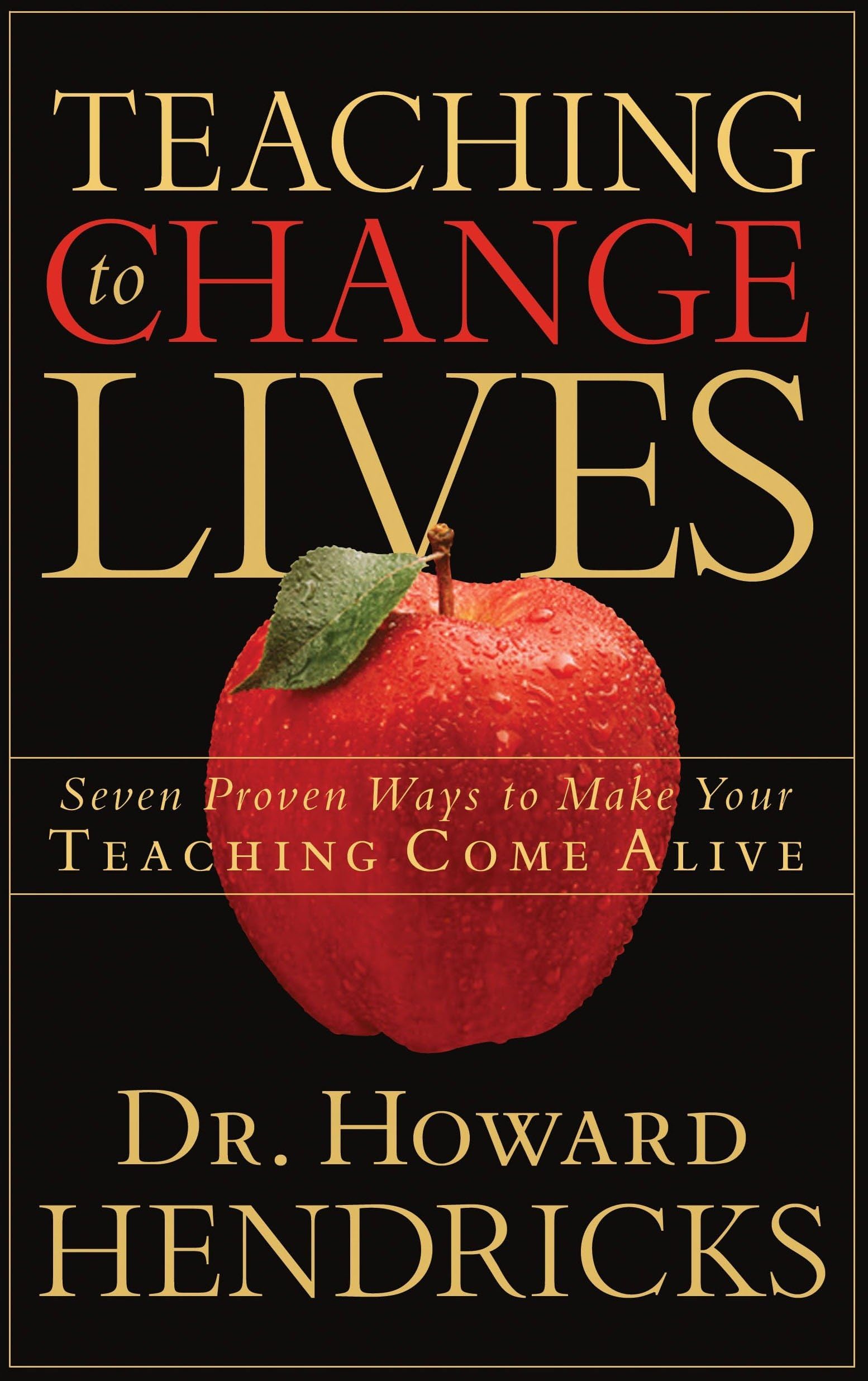
Teaching to Change Lives: Seven Proven Ways to Make Your Teaching Come Alive
Product ID: 4256800
Buy anything from 5,000+ international stores. One checkout price. No surprise fees. Join 2M+ shoppers on Desertcart.
Desertcart purchases this item on your behalf and handles shipping, customs, and support to KUWAIT.
One of the most effective and influential Christian teachers of this century reveals how all teachers -- from parents to Sunday school leaders, from pastors to professors -- can make the most of their priceless opportunity to inspire, to instruct, and to permanently impact lives for the kingdom of God. Based on seven proven, easy-to-grasp laws any teacher can apply, Howard Hendricks's classic teaching manual is a must-read for anyone who wants to teach with power and passion, excitement and excellence. Review: An accessible offering of the simple, yet profound principles for teaching to see genuine change. - Dr. Hendricks has written an incredibly accessible and applicable book on teaching. This contribution to a wide-array of books on the topic is one of the most versatile I’ve encountered. The book has direct application for preaching from behind the pulpit, Sunday school settings, small group settings, youth, children, adult, and classroom audiences. If you are looking for a distinctly practical book with the latest method or approach, this is not it. This is not, at it’s core, a how-to for sermon writing, message structure, curriculum composition, or any other step-by-step guide (there is however, a useful application section to close out the book. Here Dr. Hendricks does a practical teaching of the principles found within the book). Rather than this sort of step-by-step approach, Dr. Hendricks gives a series of principles for what constitutes good teaching. This proves to be the more helpful approach, as the reader is then able to create their own, contextualized step-by-step approach based on these principles. This will prove to build a better teacher long-term, and create a better learning environment for students. This seems to be Dr. Hendrick’s overwhelming goal in the book. It could be summarized in stating that good teaching comes from a teacher who is a earnest disciple with a profound love for their students. Dr. Hendricks goes to great lengths to talk about the depth and character of the teacher themselves. This is clearly of utmost importance to “Prof.” He is concerned first with building great teachers as he is building great lessons. The quality of the teaching can only meet the quality of the teacher. This is not to speak to being a particularly gifted communicator, though Dr. Hendricks does not diminish that. But more importantly it has to do with the character and compassion within the teacher themselves. This is Dr. Hendrick’s first Law of Teaching, and really a current that runs throughout. For the reader looking to be convicted and encouraged to look within themselves and seek to grow and conform more into the Image of Christ, this book will no doubt stimulate you to labor well to be a person worthy of the calling to teach. Dr. Hendricks quickly dissolves any excuse that “I’m just not a good teacher” or any over confidence that “I’m just a great teacher” by pointing the reader to Christ and the Truth of His Word. He writes that people’s “screaming need is to see men and women who know the living Word of God, who are constant students of that Book, and who allow it to grip them so they grow to hate what God hates and love what God loves (36).” Most readers would nod in affirmation with that statement and not see it as particularly cutting-edge … but it is revolutionary, and should be the constant refrain and motivation for all teacher’s of Truth. Hendricks’ laws could also be summarized by possessing a genuine love for students. Dr. Hendricks, through compelling and at times humorous stories, as well as helpful application points, stresses the importance of the teacher/student relationship. If the teacher loves the students, he/she will seek to know how their students learn (The Law of Education), to see them not just know more, but to change how they actually live, think, and feel (The Law of Activity), to learn how to connect with them on a thinking, feeling, and doing level (The Law of Communication), to be genuine and authentic with them in order to develop deep trust (The Law of the Heart), and to capture their imagination and wonderment to learn (The Law of Encouragement). These steps cannot be faked or easily manufactured, it takes work on the part of the teacher to learn, study, and connect with students. Dr. Hendricks again convicts and encourages readers to ask honestly: “Do you love your students?” Again, not a cutting edge approach, but an approach that when practiced, will lead to heartfelt and captivating teaching. This formula does not simply produce polished sermons or lesson plans. It produces change. Change in the heart of the teacher and the learner. I would encourage readers to take a deep breath before reading this book. This is not filled with silver bullets. It is filled with the wisdom of a long and faithful teaching career. The type of soul-level wisdom that does not microwave teachers, but rather molds them. I would put it in the hands of a new or aspiring teacher and tell them to revisit these principles with great regularity throughout their career. It is a winsome reminder of the foundational and first things – those things that we are all too prone to drift from. If there is a knock on this book, it is that perhaps it is too dictated by the framework of the acrostic T-E-A-C-H-E-R that make up the names of the 7 laws. It is helpful for the memory of the laws and provides an effective framework. There may, however, be times that the reader thinks to themselves, “I feel that this point fit just as well under Law X three chapters earlier.” However, this in no way disrupts the flow or power of the writing. In fact, it is likely good to be reminded of the cohesiveness of the overall message of the book. Pick it up, be challenged, be encouraged, and be reminded of both the weight and privilege of the task to steward the Truth of God’s Word to others. As Dr. Hendricks writes, there is no greater thrill or fulfillment in realizing that God is using you as a vehicle for His truth to transform others. Add this book to your library and reference it often! Review: Teaching principles enhanced by personal relationships and practical application. - In this book, Prof Hendricks decorates seven teaching principles from the late 1800s by adding a “people over principles” icing and serving slices of practical, usable advice for teachers. He wrote as he must have spoken: warm, authentic, and unpredictable. From the frequent, good-natured grousing one can discern a possible motivation for this writing: a sad dissatisfaction with class delivery, sermons, and Bible studies. But following his own advice, no criticism was left lonely of a remedy. If, like me, you lament that you never met Prof in person, this book will give you a sense of sharing a slice of cake and coffee with him.

| Best Sellers Rank | #18,921 in Books ( See Top 100 in Books ) #5 in Christian Preaching (Books) #119 in Instruction Methods #229 in Education Workbooks (Books) |
| Customer Reviews | 4.8 out of 5 stars 933 Reviews |
J**E
An accessible offering of the simple, yet profound principles for teaching to see genuine change.
Dr. Hendricks has written an incredibly accessible and applicable book on teaching. This contribution to a wide-array of books on the topic is one of the most versatile I’ve encountered. The book has direct application for preaching from behind the pulpit, Sunday school settings, small group settings, youth, children, adult, and classroom audiences. If you are looking for a distinctly practical book with the latest method or approach, this is not it. This is not, at it’s core, a how-to for sermon writing, message structure, curriculum composition, or any other step-by-step guide (there is however, a useful application section to close out the book. Here Dr. Hendricks does a practical teaching of the principles found within the book). Rather than this sort of step-by-step approach, Dr. Hendricks gives a series of principles for what constitutes good teaching. This proves to be the more helpful approach, as the reader is then able to create their own, contextualized step-by-step approach based on these principles. This will prove to build a better teacher long-term, and create a better learning environment for students. This seems to be Dr. Hendrick’s overwhelming goal in the book. It could be summarized in stating that good teaching comes from a teacher who is a earnest disciple with a profound love for their students. Dr. Hendricks goes to great lengths to talk about the depth and character of the teacher themselves. This is clearly of utmost importance to “Prof.” He is concerned first with building great teachers as he is building great lessons. The quality of the teaching can only meet the quality of the teacher. This is not to speak to being a particularly gifted communicator, though Dr. Hendricks does not diminish that. But more importantly it has to do with the character and compassion within the teacher themselves. This is Dr. Hendrick’s first Law of Teaching, and really a current that runs throughout. For the reader looking to be convicted and encouraged to look within themselves and seek to grow and conform more into the Image of Christ, this book will no doubt stimulate you to labor well to be a person worthy of the calling to teach. Dr. Hendricks quickly dissolves any excuse that “I’m just not a good teacher” or any over confidence that “I’m just a great teacher” by pointing the reader to Christ and the Truth of His Word. He writes that people’s “screaming need is to see men and women who know the living Word of God, who are constant students of that Book, and who allow it to grip them so they grow to hate what God hates and love what God loves (36).” Most readers would nod in affirmation with that statement and not see it as particularly cutting-edge … but it is revolutionary, and should be the constant refrain and motivation for all teacher’s of Truth. Hendricks’ laws could also be summarized by possessing a genuine love for students. Dr. Hendricks, through compelling and at times humorous stories, as well as helpful application points, stresses the importance of the teacher/student relationship. If the teacher loves the students, he/she will seek to know how their students learn (The Law of Education), to see them not just know more, but to change how they actually live, think, and feel (The Law of Activity), to learn how to connect with them on a thinking, feeling, and doing level (The Law of Communication), to be genuine and authentic with them in order to develop deep trust (The Law of the Heart), and to capture their imagination and wonderment to learn (The Law of Encouragement). These steps cannot be faked or easily manufactured, it takes work on the part of the teacher to learn, study, and connect with students. Dr. Hendricks again convicts and encourages readers to ask honestly: “Do you love your students?” Again, not a cutting edge approach, but an approach that when practiced, will lead to heartfelt and captivating teaching. This formula does not simply produce polished sermons or lesson plans. It produces change. Change in the heart of the teacher and the learner. I would encourage readers to take a deep breath before reading this book. This is not filled with silver bullets. It is filled with the wisdom of a long and faithful teaching career. The type of soul-level wisdom that does not microwave teachers, but rather molds them. I would put it in the hands of a new or aspiring teacher and tell them to revisit these principles with great regularity throughout their career. It is a winsome reminder of the foundational and first things – those things that we are all too prone to drift from. If there is a knock on this book, it is that perhaps it is too dictated by the framework of the acrostic T-E-A-C-H-E-R that make up the names of the 7 laws. It is helpful for the memory of the laws and provides an effective framework. There may, however, be times that the reader thinks to themselves, “I feel that this point fit just as well under Law X three chapters earlier.” However, this in no way disrupts the flow or power of the writing. In fact, it is likely good to be reminded of the cohesiveness of the overall message of the book. Pick it up, be challenged, be encouraged, and be reminded of both the weight and privilege of the task to steward the Truth of God’s Word to others. As Dr. Hendricks writes, there is no greater thrill or fulfillment in realizing that God is using you as a vehicle for His truth to transform others. Add this book to your library and reference it often!
C**R
Teaching principles enhanced by personal relationships and practical application.
In this book, Prof Hendricks decorates seven teaching principles from the late 1800s by adding a “people over principles” icing and serving slices of practical, usable advice for teachers. He wrote as he must have spoken: warm, authentic, and unpredictable. From the frequent, good-natured grousing one can discern a possible motivation for this writing: a sad dissatisfaction with class delivery, sermons, and Bible studies. But following his own advice, no criticism was left lonely of a remedy. If, like me, you lament that you never met Prof in person, this book will give you a sense of sharing a slice of cake and coffee with him.
B**K
A Great Read
As we prepare to become a teacher, The Law of the Teacher principal, is critical to understand "If you stop growing today, you stop teaching tomorrow." A teacher should always ask themselves "How can I improve?" As we began a new day we must strive to never stop learning, for that is how we grow in our faith. Continually growing in faith as we become more mature as a Christian is where we need to strive. As we grown in faith than we can help others grow. Also, we must remember; Teacher's must be faithful, available, teachable, and a high level of confidence. Education is the way people learn determines how we teach. The teacher is primarily a stimulator and motivator. The success of your desire and calling as an effective teacher depends not on your knowledge of these principal laws, but on you as a person, and most strategically on your openness to God's power in your life. We need to focus on what God has called us to do. As you allow Him to transform and renew our minds, we will then be ready to fulfill His purpose for us. We must be willing to allow God to change us so we can truly make an impact on others. The willingness, the commitment is a big step toward becoming a successful teacher. In order to strengthen our faith we must make a commitment to change and develop as Jesus did. We need to grow in wisdom to increase intellectual development, grow in stature - physical development, seek favor with God to increase spiritual development, and find favor with others to increase social and emotional development. Motivated students do better in school. Not necessarily because they feel they have to be the best, but because they are trying their best. A motivated student is likely to choose tasks that are challenging, begin tasks without having to be prodded, shows serious effort and concentration, they have a positive attitude toward learning, and they stick with tasks until successful completion. A teacher has a large role to play in whether or not a child will be motivated to do their best. They can create an encouraging environment. The Law of Education principal is "How people learn determines how you teach." A teacher must have clear objectives in teaching. Expect the child to succeed and their chances for success improve greatly. Students are usually aware of how their teacher thinks of them and they often tailor their actions to those views. It is very important to have high expectations and communicate them to your students. It is equally important to base your expectations on a student as an individual who has strengths and weaknesses like all individuals. Speaking kindly but honestly with the student about where they think their interests and abilities are. The activity in which the learner is involved must be meaningful. Practice makes perfect, experience is the best teacher and we learn by doing. Learning may become drudgery to a student if he only see's it from a desk. When your class reads a book together, afterwards rent the video and watch it as a family. Expanding a student's point of view; by taking them to something that doesn't fit with their typical likes. This gives them a more freedom of learning something new. Hands on teaching is an excellent activity for students. The Law of Activity principal means "Maximum learning is always the result of maximum involvement." Activities need to provide direction, applies function and application, ones that have a planned purpose, activities that has the process as well as the product, and realistic activity that include problem solving situations. Communication is the reason for our existence as teachers. Building relationships through communication is essential. Communication skills for teachers are as important as their knowledge of a particular subject which they teach. It is only through communication skills that a teacher can introduce creative and effective solutions to the problems of the student. A teacher that has excellent communication skills can enhance the learning process. In preparing a subject to teach, preparation of the subject needs structure and needs to be able to reach all students. The Law of Communication principal is "To truly impart information requires the building of bridges" between teacher and student. The most effective communication has three key components: intellect - thought factor, emotion - feeling factor and volition - excitement element. If we are committed to the truth of the Word of God, then His word must be reflected in our values. A teacher needs a compassionate heart, so they can effectively address the student in a calm, fair and loving manner. Compassion means that the teacher must use loving judgment to discern how to handle a situation. Compassion is remembering that no one is perfect and is sympathizing with a situation. Students feel accepted when a teacher doesn't criticize them in the classroom. Compassion does not hold a grudge or expect perfection. Teachers need to be the best confidants and encouragers to their students. Students are impressionable, and a tenderhearted teacher can have a valuable impact on a student. The Law of the Heart principal means "Teaching that impacts is not head to head, but heart to heart." Encouragement works hand in hand with motivation. A teacher's journey is also a human one. We have to be in order to build a connection with the student. Students need encouragement and they want to build a connection. Encouragement is one of the greatest things a teacher can give. When we put our hearts into others, we lead them to achieve greater things. Encouragement boosts self esteem and shows a student we care. A teacher needs to be available in the hard times, teach students to believe in themselves, and show love as Jesus Christ loved us. The Law of Encouragement principal states "Teaching tends to be most effective when the learner is properly motivated." The key to creating the perfect teachers plan is to maintain an accurate balance of structure and creativity. In creating lesson plans that have a mixture of fun and creativity will make a lasting impression with the concepts you are teaching. The Law of Readiness principal is "The teaching-learning process will be most effective when both student and teacher are adequately prepared." This is what I learned from this book I would recommend this book to any one who is a teacher and would say that in its 150 pages is an easy yet very good read.
E**N
... group of people and realized you were not very good at it
If you have ever found yourself teaching a group of people and realized you were not very good at it, this book is for you. This was my condition recently, and I began a journey to grow in the art of teaching. “Teaching to Change Lives: Seven Proven Ways to Make Your Teaching Come Alive,” is just the book to begin the journey to becoming a better teacher. However, you may be a seasoned teacher who can glean from decades of experience as well. Written by Dr. Howard G. Hendricks (1924-2013), who taught for more than sixty years at Dallas Theological Seminary. He impacted millions worldwide and directly taught over 10,000 Seminary students. Bruce Wilkinson, founder of Walk Thru the Bible, said this of Dr. Hendricks’s teaching ability: “The fact is, he was not so much teaching a course as he was ministering to his students.” By way of disclaimer, the book is written from a distinctly Christian perspective. Teaching to Change Lives is broken down to seven laws to learn from and adapt to improve your teaching style and form. I will give a summary of the seven laws and summarize my review in the end. 1. The Law of the Teacher “The Law of the Teacher, simply stated, is this: If you stop growing today, you stop teaching tomorrow.” Dr. Hendricks makes it clear that to be a good teacher you must always be looking to improve. The reasonable question that arises is how do I improve? The Christian teacher is encouraged by the words in Luke 6:40b “Everyone who is well trained will be like his teacher.” Although the books focus in in teaching, this chapter encourages us to be well rounded in our growth. Every area of our lives influences how we teach. 2. The Law of Education “The way people learn determines how you teach. This is the Law of Education.” Joan Milton Gregory explains, “True teaching is not that which gives knowledge, but that which stimulates pupils to gain it.” Dr. Hendricks unveils the heart of the teacher by saying that “teachers can’t be focused on what they do, but on what their students are doing.” Our selfish nature tends to focus on our results and how we are being perceived. On a personal note, I was encouraged to get excited when someone I teach learns a new truth instead of reminding them I had learned that lesson years ago. 3. The Law of Activity “The Law of Activity tells us that maximum learning is always the result of maximum involvement.” The author gives us three ways to learn while doing: • Well-guided practice makes perfect • Properly evaluated experience is the best teacher • We learn by doing the right things We do not want those we teach to just know the right information but to act on the information in transformational ways. 4. The Law of Communication “The Law of Communication compels that the very process: To truly impart information requires the building of bridges.” Our communication involves three components: thought, feeling, and action. Hendricks sums up an excellent communicator as someone who “know something thoroughly, feels it deeply, and are doing it consistently.” The reader is encouraged to enjoy life and allow that enjoyment to rub off on those around us. 5. The Law of the Heart “Teaching that impacts is not head to head, but heart to heart. That is the Law of the Heart.” As teachers, our character is going to give students confidence that what we have to say has value. It can be said that the greatest communicators have the biggest heart. It is not just information transfer but a head and heart transfer that enables students to want to learn from us. This can be summed up as "credibility precedes communication." 6. The Law of Encouragement “The Law of Encouragement is this: Teaching tends to be most effective when the learner is properly motivated.” Dr. Hendricks points out two levels of motivation that push students: extrinsic and intrinsic motivation. Extrinsic motivation is what motivates us from the outside. Intrinsic motivation comes from the inside. He concludes that “Your task in all extrinsic motivation is to trigger intrinsic motivation.” In as much as we are able, our goal as teachers should be” exposing students to real-life experiences” that force the tension between knowing and doing. 7. The Law of Readiness “The Law of Readiness is this: The teaching-learning process will be most effective when both student and teacher are adequately prepared.” This places responsibility on both parties in the educational environment. If a teacher is not preparing, then the students will either recognize this and “check out” mentally from the class. Likewise, if the students are not prepared to learn, it limits the teacher's ability to transfer knowledge and application. Finally, we must not fall into a rut when teaching others. As Hendricks points out “The higher your predictability, the lower your impact.” Summary In Teaching to Change Lives you will find a great foundation to build on a teaching ministry. However, it is not to be the end all for those in the teaching ministry. It is a wonderful place to start the journey. This book should often be used to turn our gaze inward and evaluate where we are at varying times in the teaching cycle. It is my desire to look over these sections as a devotion to God as well as an honest evaluation of where I stand as I attempt to take these laws to heart. I would highly recommend this to anyone who teaches; from the Sunday School teacher to the pulpit of a Senior Pastor.
J**S
Good Introductory Resource
As a future pastor/teacher and current sports coach, teaching has been an integral part of my life. I've been involved in teaching others since my first coaching job at age 13 and have been trained collegiately on teaching methods and on how to teach Biblically. I'm also always looking at ways to be a better teacher. When it came to teaching the Bible, every professor and scholar I read or learned under all pointed to the same name as their inspiration: Howard Hendricks. Even though I read Teaching to Change Lives for a class on how to teach Biblically (CHMN 387 from LUO), it quickly became one of those textbooks that will find its greatest use outside the classroom. Within evangelical circles, Howard Hendricks is synonymous with "Christian education" and Teaching to Change Lives gives the reader a brief overview of why. Nothing about Hendrick's teaching is all that revolutionary. In fact, Hendrick's model is based off the very methods and principles Jesus' used to teach. Such principles are divided into seven chapters to form the acronym TEACHER: The law of the Teacher - If you stop growing today, you stop teaching tomorrow. Hendrick's core premise is that teachers must never stop learning. Stagnant water stinks meaning a teacher should be vibrant, full of life, and always learning. The law of Education - The way people learn determines how you teach. This is an important premise because it puts the responsibility on the teacher to teach, not on the learner to learn. That is, each person learns differently, but it should be the teacher who adapts to learning style rather than the student trying to adapt to teaching style. The law of Activity - Christian education should impact people, transform them, and produce tangible results. Christianity is the most revolutionary force on the planet and yet is often the institution most resistant to change. The law of Communication - More than just speaking, Hendricks lays forth the case that Christian teachers must form relational bridges that provide weight to their teaching. The law of the Heart - Teaching must involve more than one's intellect, but affect intellect, emotion, and volition. It is one personality transformed by the power of supernatural grace reaching out to effect in others the same. The law of Encouragement - Teaching tends to be most effective if the learner is properly motivated. That is, the smartest person in the world not given reasons for learning something will learn less than the average person with a passion for the subject. The law of Readiness - Be prepared to teach and prepare your learners to learn. More than just bringing in doughnuts to Sunday School, preparation requires working to develop lesson plans and class assignments. Overall, these seven principles are ones that I've gone over time and time again, both in class and out. It's definitely positively affected how I teach. Definitely recommended for anyone in any sort of leadership position and a must-have for any church library.
J**J
Written from the Heart a review by Scott Jeffrey
As followers of Jesus Christ, we are called to be teachers. We are called to be teachers just by the very nature of our lifelong desire for sanctification, and of attaining Christ-likeness. Christ was a great teacher, a master teacher; ergo, as Christians we are called to be great teachers and to strive to become master teachers. In addition, we are called to be teachers because Jesus commanded us to be teachers. In the Great Commission Jesus commanded His followers to "go and make disciples" and to "teach" them to observe all of the ways of God. When Christ spoke this command to His disciples two thousand years ago He was speaking to us in the twenty first century with equal fervor. We are to be teachers, and although we all have been blessed with different degrees of skill and levels of giftedness, we all in kind share a common responsibility: we are accountable to God to be the best teachers we can be. In other words, make the best use of what we've been given. That's where Howard Hendricks' Teaching to Change Lives comes in. I strongly recommend this book to every Christian, not only those who teach or preach vocationally. First-it's an easy read. And I'm sure that's exactly how Hendricks' intended it to be. Secondly, it's a quick read. It's only 150 pages long. I read the entire book in two or three hours on one snowy Iowa afternoon. In brief, Hendricks structures the book around "7 Laws" for a teacher to follow which he packages neatly in 7 concise but inspirational chapters. Chapter one zeros in on the "Law of the Teacher," and speaks to what Stephen Covey would refer to as "Sharpening the Saw." In this chapter, Hendricks emphasizes God's intention to use all of His followers as teaching instruments and stresses God's desire for His instruments to be sharpened, and cleansed and properly maintained to be a more effective tool in His hands. Hendricks instructs his readers on all of the aspects of self-improvement including the mental, physical and spiritual dynamics that make up every individual. Chapter two entitled "The Law of Education" breaks the traditional view of the stereotypical teacher who primarily dumps content on the class, and instead paints the teacher as a stimulator...a cheerleader of sorts who motivates and excites his students in much the same way as a great coach motivates his team to win games. Chapter three "The Law of Activity" revolves around Hendricks' premise that maximum learning is always the result of maximum involvement. Hendricks sites an old Chinese proverb that best sums up this chapter: I hear and I forget. I see and I remember. I do and I understand. Hendricks improves on this by adding...I understand...I change. Learning hasn't occurred unless there is change at some level. "The Law of Communication" is the title of chapter four. This chapter stresses the significance of the teacher/student relationship and the role that communication plays in the learning process. Chapter 5 speaks to the passion a teacher must feel to be an effective educator. It is aptly named the "The Law of the Heart," and here Hendricks does a masterful job encouraging teachers to become a person of impact in the lives of their students...to know them, to earn the right to be heard, and to teach from the heart with conviction and passion. Chapters 6 and Chapter 7 speak to the laws of encouragement and readiness. The former law asserts that teaching is most effective when the student is properly motivated and the latter addresses both teacher and student preparedness-the educator's preparation to teach and the student's preparation to learn. What I found so amazing about Hendricks' book, is that as you read through the pages of this educational masterpiece, you can actually feel Hendricks personality and love and passion for teaching radiating from the pages. Hendricks even finishes his guide to become better teachers with chapter by chapter lesson plans for real life application. I highly recommend this book as a must read and reread for all who aspire to be teachers. I know that I have been personally blessed by Teaching to Change Lives and I'm a richer man and a better teacher for having read it.
A**R
Teachers wanting to make a difference need to pick up this book!
“Teaching to Change Lives” was a required reading for a class I’m taking. Honestly, the book is worth the entire cost of the class. Dr. Howard Hendricks is an extremely engaging, entertaining, and practical author. As he walked through his seven laws of teaching: The Law of the Teacher, The Law of the Education, The Law of the Activity, The Law of the Communication, The Law of the Heart, The Law of Encouragement, and The Law of Readiness I was blown away by how practical this book was. Every chapter had something that I can take and immediately apply to my teaching tactics. Here are some of my favorite thoughts from each chapter: The Law of the Teacher: The first words of this chapter caught my attention and convicted my heart, “The effective teacher always teaches from the overflow of a full life.” That was just the beginning of the chapter and it continued to get better from there. The Law of the Education: In the middle of the chapter Dr. Hendricks gives 3 different goals in educating. Goal #1: Teach people how to think. Goal #2: Teach people how to learn. Goal #3: Teach people how to work. Hendricks also talks about the importance of a teacher being a good listener in this chapter. The Law of Activity: “Christian education today is entirely too passive. And that’s incongruous, because Christianity is the most revolutionary force on the planet. It changes people.” If teaching were only telling we’d all be brilliant, but it’s much, much more. The Law of Communication: Communication is no piece of cake. If you have a healthy respect for this, you’ll pray more intelligently, you’ll study and work harder, and you’ll learn to trust God on a deeper level. Hendricks says, “We rely too heavily on words alone. We’re convinced that if we tell people the right thing, it will automatically solve their problems.” The Law of the Heart: It’s the simplest thing in the world to take someone on a head trip, but getting to their heart is much more difficult. “No one cares what you know until they know that you care.” The Law of Encouragement: Figuring out how to properly motivate our students is something we have to do if we are going to teach for real life change. You will enjoy this chapter where Dr. Hendricks tells stories of encouraging students to be stretched by realizing they may not know as much as they think they do. The Law of Readiness: The higher your predictability (of your lesson) the lower your impact. But, the lower your predictability the higher your impact. This is not about compromising content, but changing methodology.) Again, I can not recommend this book highly enough. If you are a teacher who wants to make a difference pick up “Teaching to Change Lives” today.
P**S
Excellent!
As a person who does not find enjoyment in reading, I had very low expectations for this book. I thought it would be one that I would skim read chapter by chapter just to get the gist of what the book was trying to relay to me. I was wrong. This book exceeded my expectations by far! Once I started reading I did not want to put the book down unless it was to tell somebody the wise words I had just read. This book truly challenges those who are wanting to teach and those who are students as well. One line from the book that really challenges teachers is when Hendricks asks if we keep the people in our class feeling comfortable, or do we disturb their equilibrium so that they are saying, I've got to study God's Word more and think more; I've got to try this out in real life. Another excellent line that goes along with wanting your students to be hungry is when Hendricks talks about the quote "you can lead a horse to water, but you can't make him drink," to which a man replied, "but you can feed him salt." We need to ask ourselves if we are doing these things when we are teaching. Are we helping to make our students thirsty for the Word of God, or simply regurgitating what we know, and hoping that they can glean from that. One quote that I have now shared with at least five people is one that I feel is really relevant to our churches. Hendricks states, "As a result, the average listener in evangelical churches is not excited by the truth-he's embalmed by it. The educational program in the churches is often an insult to people's intelligence. We're giving them wilted cut flowers instead of teaching them how to grow by means of God's word, which is alive!" As teachers in the church, we need to encourage and motivate people to grow, it is not as easy as giving our students the information we know, because they will not take that to heart, it has to be out of their own volition. The book really challenged me as a student because it showed how the majority of learning is the responsibility of the student. As a college student it is easy to do the minimum of work required to pass a class, but the challenge provided is that as a student I should be eager to gain as much knowledge as possible. Hendricks shares a story of how a student eagerly came wanting to know how much work he needed to do to please Hendricks, to which Hendricks replied, as ever much as he felt he needed to. Many times as students we look at doing work as something that will please a professor to get us a good grade, but we need to do it to reap as much as we possibly can. This book was such a great book that led me to really examine the way I learn and teach and to see how improvements can be made. I definitely would recommend this book to everyone, because everyone is a teacher and a student in their own way. Hendricks has many great applicable principles that would be helpful to all. I thoroughly enjoyed this book.
G**A
Excellent
This is a book you will want to read and re read.Timeless principles brought to life.It stretches ones imagination and builds one up to be a better teacher.
R**A
great book with great insights
I personally really like this book. It’s easy to understand and also super practical. It points out many blind spots people often have during teaching. I really think this book is not only for the teachers but for everyone who wants to make an impact on others in biblical way. Highly recommended this book to everyone.
S**R
Five Stars
The book was in very good condition.
A**R
Great book
Amazing book
S**M
Satisfied
Same on time and was the correct book. Brand new.
Trustpilot
3 weeks ago
1 month ago