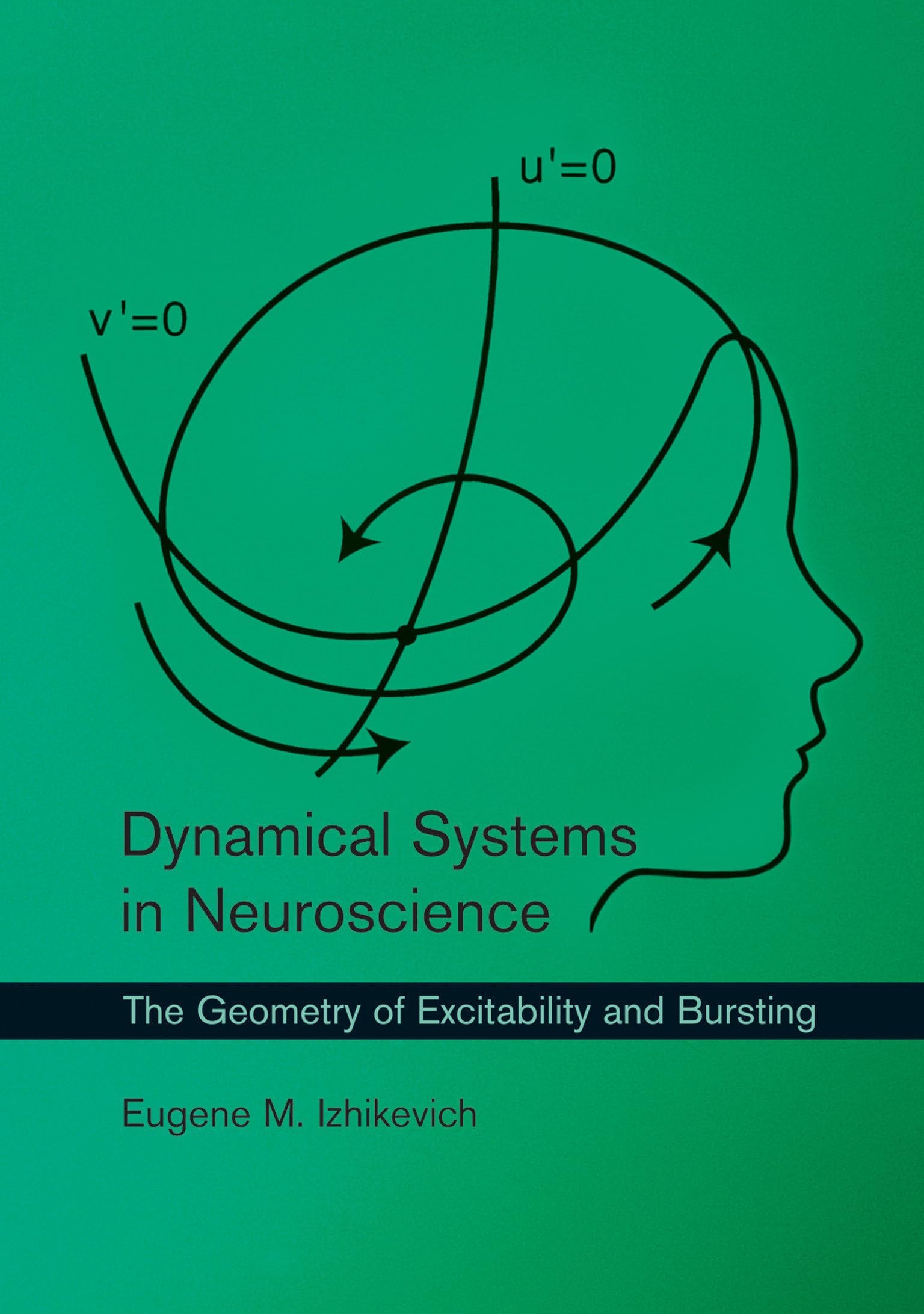

Dynamical Systems in Neuroscience: The Geometry of Excitability and Bursting (Computational Neuroscience Series)
Product ID: 495392039
Buy anything from 5,000+ international stores. One checkout price. No surprise fees. Join 2M+ shoppers on Desertcart.
Desertcart purchases this item on your behalf and handles shipping, customs, and support to KUWAIT.
Dynamical Systems in Neuroscience: The Geometry of Excitability and Bursting (Computational Neuroscience Series) : Izhikevich, Eugene M. M: desertcart.co.uk: Books Review: Five Stars - Good Review: I won't take any more stars because the book's content is great. Nevertheless, its printing quality (toner and paper) left me very disappointed. Firstly, the cover came with colour strokes; the printer was running low on ink and nothing was done about it. Secondly, the material feels cheap; I don't discourage recycled paper, but it feels as if my own finger's sweat will torn it apart. Lastly, it came curled; I don't know their storage strategy but it's clearly faulty.
| Best Sellers Rank | 412,941 in Books ( See Top 100 in Books ) 751 in Neurology 2,680 in Medical Education (Books) 7,099 in Medicine & Nursing |
| Customer reviews | 4.6 4.6 out of 5 stars (56) |
| Dimensions | 17.78 x 2.64 x 25.4 cm |
| Edition | 24383rd |
| ISBN-10 | 0262514206 |
| ISBN-13 | 978-0262514200 |
| Item weight | 839 g |
| Language | English |
| Print length | 458 pages |
| Publication date | 15 Feb. 2010 |
| Publisher | MIT Press |
| Reading age | 18 years and up |
A**R
Five Stars
Good
G**Z
I won't take any more stars because the book's content is great. Nevertheless, its printing quality (toner and paper) left me very disappointed. Firstly, the cover came with colour strokes; the printer was running low on ink and nothing was done about it. Secondly, the material feels cheap; I don't discourage recycled paper, but it feels as if my own finger's sweat will torn it apart. Lastly, it came curled; I don't know their storage strategy but it's clearly faulty.
S**A
The author's incessant focus on providing geometrical insight into the mathematics is the most astonishing feature of this book. I cannot imagine a better introduction to quantitative and qualitative understanding of the dynamics of individual neurons. I read this book cover to cover (including ch10 which is online on the author's website) and it never got boring. This book gives you "the big picture" about neuron dynamics. The author also does an exquisite job at classifying different neuron models and showing "what really matters" about them. And at every step, information is provided about how to reproduce the figures (which is easy with MATLAB, Mathematica, or similar tools) so that you can verify your understanding and play around. There are tons of examples of specific neuron recordings and explanations in terms of the models being discussed. The preface and ch1 are available on the author's website [...] As a point of reference, Dayan & Abbott "Theoretical Neuroscience" has broader and deeper coverage of "computational neuroscience" than Izhikevich, but does not have the same kind of deep qualitative geometrical insight into neuron dynamics. I would consider it as a next step after reading this book. As a rule of thumb, if you are uncomfortable with the idea of using MATLAB, Mathematica, or a similar tool to plot a vector field or integrate a system of ODE, you will probably not benefit from the quantitative side of this book. But the book may still be useful for developing qualitative understanding.
C**N
The author has done an extraordinary ordering work about neuron behaviour models and has a great capability to explain complex topics with simple words. Moreover, despite the Nonlinear dynamics is a hard subject, the author guides with your hand to understand from the fundamentals to the advanced concepts. The book doesn't include networks chapters, but just some paragraphs. It is not about simulations, although it proposes matlab scripts downloadable and very clear way to set up a simulation. Remarkable: you can also use this book to just learn quite well nonlinear dynamics from zero.
G**H
This book will teach you the dynamics of neurons, how to model the dynamics of neurons, complex systems modeling and how our understanding of the spiking neural systems came. This is a prize in every way. The book is engaging and easy to follow - well to some extent given the advanced topic the author is engaging the readers with. I am impressed of the ease the author applies non linear dynamical systems theory modeling techniques at ease in order to come up with a neural model that the author Izhikevich evolves throughout the chapters of the book, with clear schematics in every chapter which visually explain the modeling as well. Superb indeed. The subject overall is not an easy topic to attack or explain but Izhikevich is up for the challenge.
V**E
This is a very good introductory book for the analysis of neurons from the perspective of dynamical systems. It is very well written, and introduces very well the various mathematical concepts. Exercises at the end of the chapters are also useful. The informations about complex neuronal networks, insetad, is very limited and the interested reader should use other references (I got the impression that dynamic systems perspective is useful when treating one, maximum two neurons; with small networks the story probably becomes too complex with this approach).
Trustpilot
1 week ago
3 weeks ago