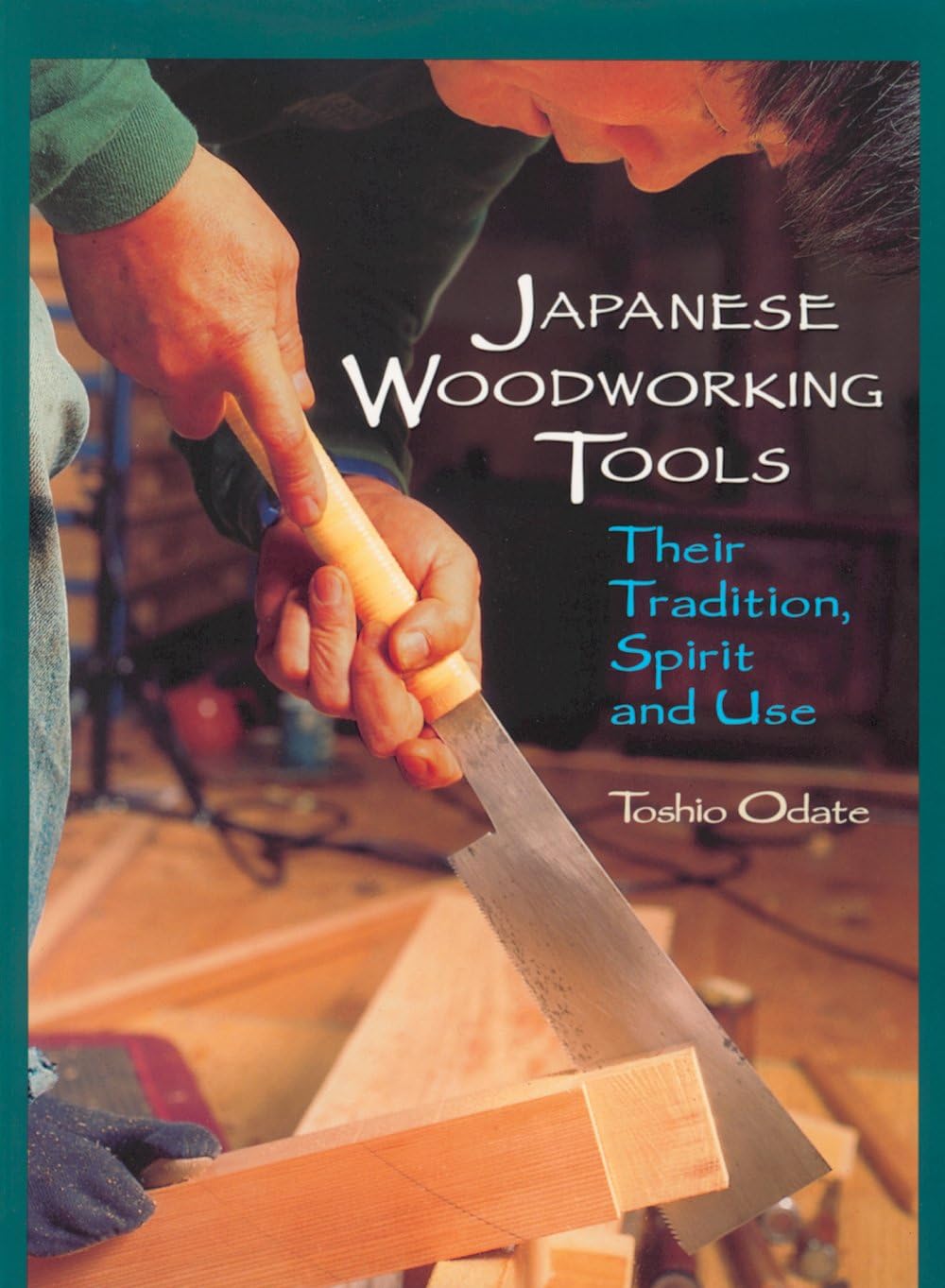
Japanese Woodworking Tools: Their Tradition, Spirit and Use
Product ID: 5525492
Buy anything from 5,000+ international stores. One checkout price. No surprise fees. Join 2M+ shoppers on Desertcart.
Desertcart purchases this item on your behalf and handles shipping, customs, and support to KUWAIT.
The classic work on the tools and spirit of the Japanese master craftsman. In Japan, a woodworker spends years learning to use his tools with great speed and skill. Only after he has proved his mastery can he proudly call himself a shokunin , a master craftsman. Japanese Woodworking Tools brings the traditions and training of the shokunin to the Western world. Calling on his own apprenticeship as a tategu-shi (sliding-door maker), and on 40 years of woodworking experience, Toshio Odate here offers a complete guide to Japanese tools: thin saws that cut on the pull stroke, laminated chisels with hollowed backs, marking tools, waterstones, axes, hammers, and almost 50 different planes. Odate shows shows how each tool works, how it should be cared for and how it is meant to be used. He also shares stories and reminiscences that help bring home the traditions and spirit associated with each tool. Whether you're a curious beginner or an adventurous professional, Japanese Woodworking Tools will show you a whole new world of exciting craftsmanship. Review: Great book on the topic of Japanese woodworking tools - Gem of a book. Odate the author pours a lifetime of knowledge into this book about a rather arcane topic--traditional Japanese woodworking tools. But he goes farther than just discussing the types of tools and their applications, but offers many personal anecdotes about his journey as a shokunin from his days as an apprentice (circa WW2 and its aftermath). Odate tries to convey to the English-reader the traditional Japanese craftsman's sense of obligation to himself, to his tools, to the smiths who pour their skill into forging the tools, to his master, to his craft, to his work, and to his community. Without this understanding, the proper reverence and care for the tools is not possible. It's deeply Japanese, but also universal to any craftsman anywhere who learned his craft the hard way, finds honor in his work and takes pride in his skill, and has cherished tools whose value cannot be measured with money. The black and white photos leave a lot to be desired as others have pointed out, but that's a very minor complaint. The simple line work illustrations are beautiful, the writing is engaging and insightful, and the organization is intuitive, and there's a wealth of information provided. Not that there's many English language books available on the topic to choose from, but this is a must have for folks interested in Japanese woodworking. Keep in mind this isn't a book about building boats or tansu cabinetry or timber joinery for temples or kites--there's other books on those topics and Odate himself has another book about building Shoji screens, his specialty. For any complaints that this book doesn't discuss Japanese joinery or residential framing, that's not a fair criticism of the book which really does explicitly focus on Japanese tools and their care. Review: This book is about a way of life - This book is much more than a owner's manual for Japanese tools. The author, Toshio Odate, grew up with a father that was a woodworker and he apprenticed with his father. The author shares many of his experiences; the unique methods of teaching are really quite different than American methods. For example, as an apprentice, there is no formal instruction--the apprentice must learn by observing the master while the apprentice is working--and woe be upon any apprentice that takes his attention away from his work. How one 'learns' in this situation is beyond me but apparently it works. A couple of other examples: Odate-san left some stones freeze one evening during the winter which cracked them. That warranted a substantial beating. Odate-san saved his extra money for a year and purchased a quality hand plane which is master promptly confiscated and he never saw it again. Apparently, because Odate-san was stil an apprentice, he was not worthy of quality tools and would never be allowed to see this tool, which he saved for for over a year, again. I can't comprehend why breaking Odate-san's heart was a good way to teach him woodworking skills, but he seems to be over the hurt inflicted by that episode. And now he is a master woodworker that is reaping substantial royalties from the books he wrote. So, that system seems to work. The author provides many details regarding the use of Japanese tools. There really isn't much else you need to know. Also, the drawings are very good but a few more photos (in color) would be nice. The section regarding sharpening could be expanded with some additional information and techniques, such as hollow grinding, the use of sandpaper and the benefits of synthetic stones.
| Best Sellers Rank | #72,127 in Books ( See Top 100 in Books ) #2 in Woodworking Tools (Books) #31 in Carpentry #48 in Woodworking Projects (Books) |
| Customer Reviews | 4.7 out of 5 stars 451 Reviews |
M**N
Great book on the topic of Japanese woodworking tools
Gem of a book. Odate the author pours a lifetime of knowledge into this book about a rather arcane topic--traditional Japanese woodworking tools. But he goes farther than just discussing the types of tools and their applications, but offers many personal anecdotes about his journey as a shokunin from his days as an apprentice (circa WW2 and its aftermath). Odate tries to convey to the English-reader the traditional Japanese craftsman's sense of obligation to himself, to his tools, to the smiths who pour their skill into forging the tools, to his master, to his craft, to his work, and to his community. Without this understanding, the proper reverence and care for the tools is not possible. It's deeply Japanese, but also universal to any craftsman anywhere who learned his craft the hard way, finds honor in his work and takes pride in his skill, and has cherished tools whose value cannot be measured with money. The black and white photos leave a lot to be desired as others have pointed out, but that's a very minor complaint. The simple line work illustrations are beautiful, the writing is engaging and insightful, and the organization is intuitive, and there's a wealth of information provided. Not that there's many English language books available on the topic to choose from, but this is a must have for folks interested in Japanese woodworking. Keep in mind this isn't a book about building boats or tansu cabinetry or timber joinery for temples or kites--there's other books on those topics and Odate himself has another book about building Shoji screens, his specialty. For any complaints that this book doesn't discuss Japanese joinery or residential framing, that's not a fair criticism of the book which really does explicitly focus on Japanese tools and their care.
D**N
This book is about a way of life
This book is much more than a owner's manual for Japanese tools. The author, Toshio Odate, grew up with a father that was a woodworker and he apprenticed with his father. The author shares many of his experiences; the unique methods of teaching are really quite different than American methods. For example, as an apprentice, there is no formal instruction--the apprentice must learn by observing the master while the apprentice is working--and woe be upon any apprentice that takes his attention away from his work. How one 'learns' in this situation is beyond me but apparently it works. A couple of other examples: Odate-san left some stones freeze one evening during the winter which cracked them. That warranted a substantial beating. Odate-san saved his extra money for a year and purchased a quality hand plane which is master promptly confiscated and he never saw it again. Apparently, because Odate-san was stil an apprentice, he was not worthy of quality tools and would never be allowed to see this tool, which he saved for for over a year, again. I can't comprehend why breaking Odate-san's heart was a good way to teach him woodworking skills, but he seems to be over the hurt inflicted by that episode. And now he is a master woodworker that is reaping substantial royalties from the books he wrote. So, that system seems to work. The author provides many details regarding the use of Japanese tools. There really isn't much else you need to know. Also, the drawings are very good but a few more photos (in color) would be nice. The section regarding sharpening could be expanded with some additional information and techniques, such as hollow grinding, the use of sandpaper and the benefits of synthetic stones.
R**N
Great Book
This is an excellent introduction to Japanese tools. I really love this book. This is really about Shokunin, craftsmen or artisan in the literal sense. More correctly, a Shokunin means not only having technical skill but implies an attitude and social consciousness. The qualities are encompassed in the word but are seldom written. "The Shokunin demonstrates knowledge of tools and skill with them, the ability to create beauty and the capacity to work with incredible speed. The value of an object is dependent on a subtle combination of skill and speed; this is what the apprentices master and collegues teach, and this is what the Shokunin believes. One without the other is not Shokunin." "The Shokunin has a social obligation to work his best for the general welfare of the people. This obligation is both spiritual and material, in that no matter what it is, if society requires it, the Shokunin's responsibility is to fulfill the requirement." Prior to moving to the US, the author was a Shokunin and was raised in a family who passed the art to him. The passionate description of their relationship with their tools, and the proper care is really inspiring. So this is more than just a book about the different tools and their use and care. Odate's passion and reverence for this art is felt on every page. If you are interested in Japanese architecture or are a craftsman, I highly recommend it.
A**R
Awesome book!
Whether you have decades of experience or haven’t even seen a tool in real life, I recommend this book. I have over 12 years in the construction industry and now teach construction classes. This book is about the author’s life as a carpenter and the tools he used or were used when he was working. It talks about how to use them, how to care for them and how to respect them. It’s a great read and I think you would enjoy it!
M**E
Still one of the best..
If you are looking for information on the sometimes mystifying topic of Japanese carpentry tools, this book written in the 80's could be really useful.Odate does a great job of categorizing the different kinds of tools ,including the more exotic items like keshiki (gauges) and sumitisubo (ink line) with really extensive drawings, and tips for do-it-yourself maintenance, like chisel and saw re- handling.His insights into the Japanese craftsman's attitude toward workmanship and their traditional tools is unique. Still, the photos are muddy and small, and some of the explanations are just puzzling. He doesn't cover any of the amazing joinery that can be done (and has) with these refined,and yet basic tools. The book could really use an update to fix these problems, but since there aren't a lot of books around on this topic, its' still the best thing going ,in English.
J**D
Great book for the beginner/novice getting interested in Japanese joinery and woodworking.
Just getting into woodworking and specifically Japanese style woodworking. Wanted a nice book on the types of tools commonly used by Japanese carpenters, and this I feel is one of the books you need if you are interested. It has a pretty good description of the tools and what they are used for. The pictures are a bit dated, but they do a good job for the novice or beginner. For me, any information is greatly appreciated, this book is great.
D**A
great book, fast shipping
great book, fast shipping
P**D
It's so popular because it's so informative!
This is a great book for woodworkers. If you're a wood nerd looking for the definitive manual on Japanese wood tools in English, this book is worth every penny.
Y**M
Unique !
Livre unique riche en détails. J'ai l'impression d'avoir rencontré un ébéniste japonais.
J**Y
The being of japanese tools.
Just love this book. I have learned so mutch about the spirits of the tools, just love it. It's so well written and the way Toshio talks about his tools is so full of admiration. If you love the history of tools you must read this book, it's now one of my favorites in my collection.
B**N
Information is great but older book only black and white photos
Very interesting book to read more than woodworking
K**N
Good read
Like the book and the details but will try out some of the details provided.
M**B
Tradizionale
Davvero un buon libro, ampiamente illustrato con disegni "vecchio stile". Formato generoso, ben impaginato. Sono molto soddisfatto.
Trustpilot
2 weeks ago
2 weeks ago