🚀 Cut the cord, not the experience — wireless PCVR at warp speed!
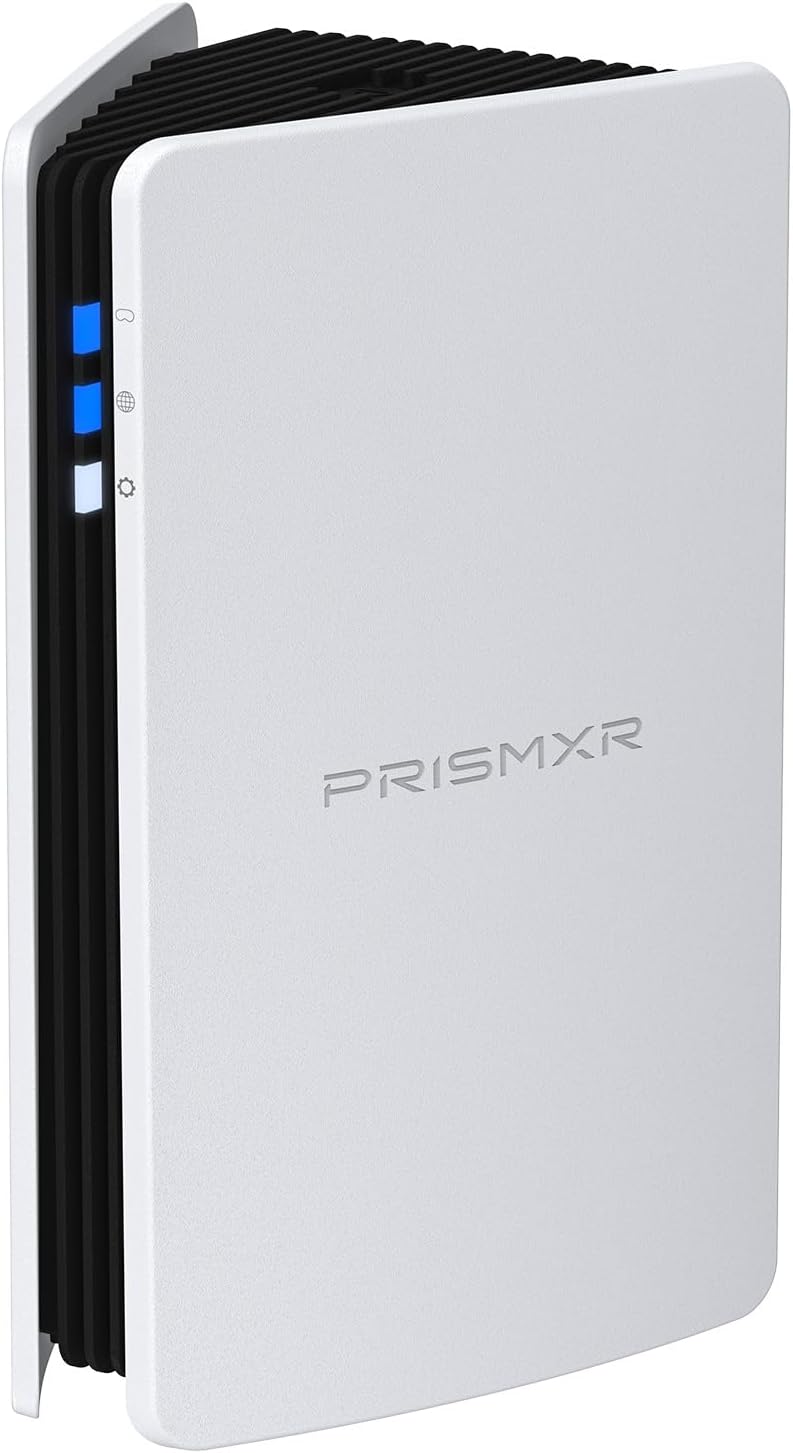
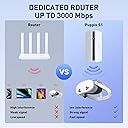
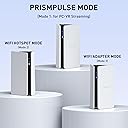
The PRISMXR Puppis S1 is a compact, high-performance AX3000 Wi-Fi 6 router designed exclusively for wireless PC-VR streaming. Featuring a powerful 1.3GHz dual-core chipset and PrismPulse Mode, it creates a dedicated, ultra-stable connection between your gaming PC and VR headsets like Meta Quest 3/3S/2 and Pico 4. With speeds up to 3000 Mbps, advanced beamforming, and a user-friendly PrismXR Desktop app for diagnostics and optimization, Puppis S1 eliminates lag and interference for a premium wireless VR experience. Easy Bluetooth setup and broad compatibility make it the must-have upgrade for serious PCVR enthusiasts.


| ASIN | B0CFDL5Y7F |
| Antenna Location | Gaming |
| Best Sellers Rank | #2,153 in Video Games ( See Top 100 in Video Games ) #36 in Standalone Virtual Reality Accessories |
| Brand | PRISMXR |
| Built-In Media | QSG |
| Color | White |
| Compatible Devices | Compatible with Meta Quest 3/2/3S/Pro, Compatible with PICO 4/Ultra |
| Connectivity Technology | Wi-Fi |
| Controller Type | App Control |
| Coverage | Home/Office |
| Customer Reviews | 4.2 out of 5 stars 1,066 Reviews |
| Data Transfer Rate | 2402 Megabits Per Second |
| Frequency | 5 GHz |
| Frequency Band Class | Dual-Band |
| Global Trade Identification Number | 00749752208134 |
| Has Internet Connectivity | Yes |
| Is Electric | Yes |
| Is Modem Compatible | No |
| LAN Port Bandwidth | 11000 Mbps |
| Manufacturer | PRISMXR PTE LTD |
| Maximum Upstream Data Transfer Rate | 2402 Megabits Per Second |
| Model Name | Puppis S1 |
| Model Number | Puppis S1 |
| Number of Antennas | 1 |
| Number of Ports | 5 |
| Operating System | Windows 10 |
| Other Special Features of the Product | Access Point Mode |
| Router Network Type | Wi-Fi |
| Security Protocol | WPA2-PSK, WPA3 |
| Special Feature | Access Point Mode |
| UPC | 749752208134 |
| Voltage | 18 Volts |
| Warranty Description | 18 Months |
| Wireless Communication Standard | 802.11ax |
| Wireless Compability | 802.11ax |
R**B
Wow, why didn’t I know about this 3 years ago when I started wireless PCVR?!?
My wireless PCVR journey has been a long one. Starting with a basic wifi 5 router and wondering why people even PCVR at all because of all the lag, stuttering, and pixelated screens. Fast forward to today, upgraded router, wired PC connection, etc. My PCVR gaming experience today is leap years ahead of where it was but it was still a long bumpy road with dozens upon dozens of hours of troubleshooting every little component, driver and wifi setting imaginable. That last big hurdle (troubleshooting network/wifi settings, drivers, etc) could have been sped up if I had incorporated the PrismXR Puppis S1 into my setup a long time ago! What the Puppis S1 provides to you is a dedicated WIFI connection that is WIRED to your PC via a USB-C cable. Think of it as using a Link cable from your headset directly to your PC, but without the need for the physical cable connected to your headset. Being a dedicated connection means that your WIFI connection to your PC is not encumbered by all of the other WIFI traffic in your house. This means you have a dedicated WIFI connection for your headset and then a dedicated USB-C cable to your PC. That results in a very stable, lag-free connection which helps keep your wireless PCVR gaming experience running buttery smooth and stable. But not every PC setup is optimized for wireless PCVR and that’s where the PrismXR Desktop app comes into play. With a click of a button, the app scans through dozens of different settings and metrics to determine if there are any issues or potential issues that would cause your wireless VR gaming experience to suffer. After the scan, the app will highlight issues and recommend potential fixes. Of the ones I saw, the instructions to fix were fairly clear to understand if you have just a little bit of PC or networking experience. And some options even have a simple “Fix” button to click. The Desktop app also has a few other tabs to diagnose and help you troubleshoot issues. For example, it shows a diagram of your setup (PC, headset, Puppis S1 and how they’re linked together). If any link has an issue, it will be highlighted on the diagram. Another helpful feature is a wifi channel scan tool that scans your wifi environment and highlights what routers are using which channels (including your neighbors which were interfering with mine!). And from there, it recommends available channels that won’t conflict with other wifi hotspots and allows you to switch the Puppis S1 to another channel. The range of the Puppis S1 seems comparable to my other Wifi5/6e mesh nodes in my house. For example, I am receiving a medium strength signal from where the Puppis S1 is located to my living room (down a hallway 30 feet, hard right turn, opens up into the living room 40 feet — with the hard right turn being the issue for most wifi connections). If you play wireless PCVR a lot, I would highly recommend adding the Puppis S1 to your setup. Beyond just the dedicated gaming experience, it also turns your PC into a wireless access point to connect to the rest of your network. It’s a good investment for having the best wireless PCVR gaming experience in my opinion.
V**!
THE best way to wirelessly connect your quest 3 to your gaming PC!
This thing really works great. I have to say once you figure it out., which is not really all that hard although I have to say you really will have to get virtual desktop to make it work as good as it can. I can be 2530 feet away with the door closed to the bathroom sitting on the toilet and it runs half-life Alex just about as good as it does when I’m sitting 5 feet away from my gaming PC.. however it did take just a little bit of tweaking some things you have to kind of set up your firewall and stuff and it’s kind of like I don’t know. It’s a little bit confusing for somebody who doesn’t have much knowledge about local area and network stuff or about like how to set up Wi-Fi stuff and what all that garbage means about the different kinds of security and how to route things and all that stuff but once you figure out the fact that all you need to do is plug it into the back of the computer two of your USB 3.0 slots or whatever, and that it is essentially a Wi-Fi six router, with a 5G capable direct to your quest three headset ultra fast high bandwidth channel essentially for Wi-Fi, and that it is only for connecting your gaming, PCs, visual output, and stuff like that to your quest three headset, it’s pretty easy to use. You have to use on your quest three by the way, cause this was confusing to me at first, you have to connect the quest three Wi-Fi connection to the device, and it can be a little bit hickey sometimes in settings and stuff in your computer get changed without you knowing it or like when you download something that changes things, otherwise it’s a freaking fantastic device. I mean it works amazingly well for the price. I got it on sale and I am very happy with it., and by the way, it’s very small. It’s only about the size of like two fists on top of each other., I assumed it would be the same size as my charter cable a little Wi-Fi tower, but it’s like half that size or less, very compact! All in all I would say this is the best way to play PCVR on the quest three, save for a direct link cable. And it’s worth the price( especially when it’s on a big sale and goes down a good $15 or more I price! All in all I give it a 5/5 stars!
B**E
A must have for anyone interested in wireless pcvr
I’ll start by saying that I used this with a pico 4 ultra and already tried wireless pcvr. My current router for wifi isn’t bad, I even set up a mesh near my pc to see if that would help. While performance was decent, I’d still get the occasional stutter only present from the network and it would slow down the more people were home. Decided to just go for it and boy am I impressed. Any of those previously mentioned stutters? Gone, it’s just as stable as using a physical link cable. And I swear it’s more responsive. Super easy to setup, just plug in the two usb cables, download the program, and connect your headset to the designated WiFi it send out. Really, it’s the main reason I went for it, because the lite version and a regular router seem to require an Ethernet cable from the home router. You can set it up by using your phone, but I found the app pretty unresponsive and awful. The program on pc is all I’d recommend you use and it’s pretty useful. Oh, and fun thing I found out about it, you technically don’t need to be connected to any wifi for it to work with a headset. I know it should work, it’s a glorified router after all, but I was expecting it to use the home wifi to send signals, so color me surprised when it worked. Would be a great choice for anyone with poor connectivity.
K**I
The Best PCVR Solution for the Quest
Edit: The Prism was working great for about a month. Now it will not connect to the internet via internet sharing and it is unreliable when using the Quest 3. When in a VR session I get a shaking in the headset for about 15 seconds and the link seems to drop out and freezes. I have reset the Prism and tested my internet sharing on my PC with another device. The Prism is a no go now for PCVR. I recommend buying a real router and skipping this low quality device. The Prism XR is the best PCVR solution for the Quest. I have had all three versions of the Quest. I’ve had the official link cable, aftermarket link cables, the VR AirBridge, and a number of different routers. I’ve tried Airlink with Oculus Debug Tool, Quest Link, Airlink, and Virtual Desktop through the years trying to find the best solution for PCVR in the Quest. I finally got tired of messing with my latest router which is dedicated to PCVR only and bought the Prism XR. One caveat with the Prism XR is that you won’t want to use it as an internet WiFi router. The Prism XR excels at being a wireless PCVR router and should be dedicated to just that. Your Quest should be the only client connected to the Prism XR. You need to have an existing WiFi or Ethernet connection for internet to get the best results with the Prism XR. View the purchase of the Prism XR as a VR accessory. The Prism XR paired with Virtual desktop is without a doubt the most reliable and offers the best visual fidelity of any other option for PCVR with the Quest. The Prism XR is very compact, easy to set up, and doesn’t even need an ethernet port. It uses two USB ports and you can just share your internet from your existing WiFi or Ethernet connection.
N**H
Phone app is gone, but still works with PC desktop app so far. Works well with my Quest 3
-This is older, but still seems to work. Using for my Quest 3 headset, and it's working well so far, allowing me to run games without judder issues from PC (Tested games like Beat Saber that need fast movement). -It took a bit to get it fully working, and it kept disconnecting from the PC, but rebooting the PC fixed it for me, and it' shad a good connection so far. -One thing to note, the phone app is gone. Searching the Google play store, it tells you the prismxr app does not work for newer Android, and so you can't even download it. Fortunately, the PC desktop app does work. However, this makes me feel this likely has no real support, since the Android app isn't being maintained. But it's fairly cheap, so hoping it lasts until the Steam Frame is out.
B**Z
Amazing Device
It’s been a while, so thought I should finally leave a review. I had a dream that I could stream games from my desktop to my Steam Deck. I also have a Quest 3. In my search, I found this and, while it isn’t advertised as such, it is a huge boost for streaming any kind of gaming over your local network. I was trying to troubleshoot why my stream quality was lacking, either stuttering or getting hit with bursts of higher pings.. I upgraded my PC, which helped, but even with really great specs, I’d still have some minor stuttering. Enter this thing.. it’s night and day. Literally zero lag. I am blown away by this and it makes me so happy to finally be able to stream games to my Steam Deck at super high quality. The quality is the same for streaming to my Quest as well. So, I’d highly recommend. I can play any type of game, without any kind of delay or lag. I played through the entirety of STALKER 2 on ultra and it was if I was playing it right on my desktop, except I was on another floor of my house on the couch. The only thing to note is it’s not a straight forward setup. It requires a little manual tinkering with your Ethernet adapters. So be sure to read every line of the installation instructions. I missed a step and assumed the software was busted… but after retrying the setup, I realized I had missed an important step. So, follow all the directions and you should be golden.
H**E
Streaming Link Air Bridge
I was able to make the switch to wireless virtual reality by using this device to replace the standard VR Air Link connection. The experience was nothing short of transformative. In a matter of minutes, I was completely submerged in a world of unfettered discovery, and the process of setting up was painless. I was able to devote my whole attention to my virtual travels since the router was compatible with both the Meta Quest 3 and Quest 2 accessories. This enabled me to have a connection that was completely smooth. The technology known as WiFi6 ensures a connection that is always dependable, reduces the amount of latency experienced, and makes virtual reality (VR) more enjoyable. Regardless of whether I was participating in fast-paced action games or exploring wide virtual landscapes, the wifi connection remained consistent, which contributed to an overall improvement in the gaming experience. My ability to turn, twist, and move without the fear of being entangled was made possible by the fact that I was no longer restricted by wires. At the time, my virtual reality experiences were impeded by wires, yet it provided a sense of materiality to those encounters.
A**M
A perfect solution to a wired problem.
I bought this with the sole intent of transmitting wirelessly to a new Quest 3 headset. The instructions are likely translated into English and written backwards so you'll want to start towards the last step in the process where it directs you to download an app on the PC side. After I realized what I was missing in the overly long setup and troubleshooting process to get it to link up and do its thing, the app was literally a few clicks and 'done'. I was deep into the weeds of my wifi settings and on the PC side looking at creating a 'bridge' and more, all for nothing. This dedicated router took care of it all, again once i realized what was needed. I'd mark it down a star for backwards instructions but the unit itself has been great. I really like that I can have a home wifi router wifi 5 etc. transmitting to my PC, and delivering more than adequate download speeds, while this unit plugs in between the PC itself and the Quest. Apparently, all traffic going out for like game saves etc. is viewed as traveling on top of the more consequential data that involves talking to the headset. Without setting things up correctly, both routers will compete and cause a bottleneck and the top 'blue light' on this device will be red or something. Ultimately showing things aren't connected right. This is where the aforementioned PC app gets downloaded from the Google play store and installed. Suddenly, it just looks at your setup, identifies the new router, configures it for you and the lights are all on like they should be, and the headset has a few internal settings to configure after that. As I play a few feet away from the router, I can't speculate on how it would be across the house or with walls in between, but I've had zero issues with it transmitting, via the much required "Virtual Desktop" and its PC companion which you grab from within the headset itself. It costs around $20. This is a necessary app to make the streaming of PC games out of Steam possible. All without any cabling. My home router is another room.
Trustpilot
3 weeks ago
2 weeks ago