We remain fully operational. Our teams are working around the clock to ensure your deliveries continue safely.

DOWNLOAD THE APP


Copyright © 2025 Desertcart Holdings Limited
DOWNLOAD THE APP
Buy anything from 5,000+ international stores. One checkout price. No surprise fees. Join 2M+ shoppers on Desertcart.
Desertcart purchases this item on your behalf and handles shipping, customs, and support to KUWAIT.
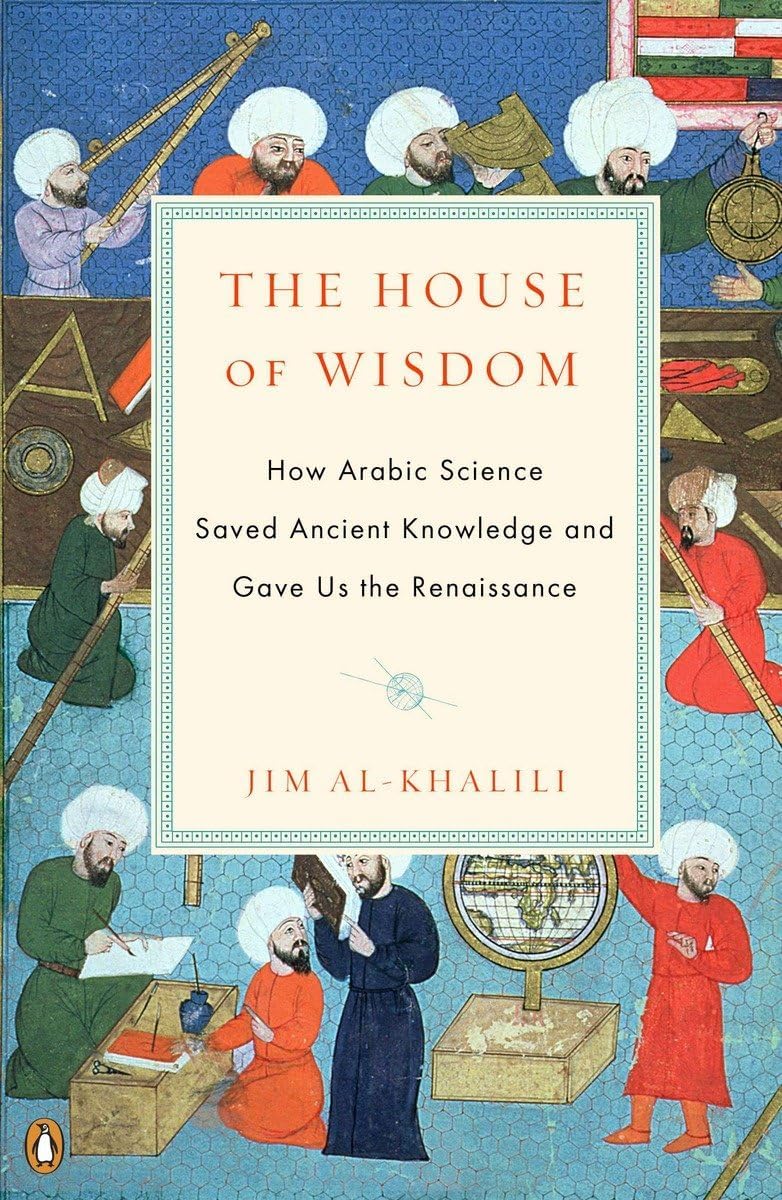
🌟 Rediscover the Renaissance’s secret catalyst — Arabic science unleashed!
‘The House of Wisdom’ by Jim Al-Khalili is a compelling exploration of how Arabic science preserved and expanded ancient knowledge, fueling the Renaissance and shaping modern science. Combining rigorous research with engaging storytelling, it highlights the multicultural scholars behind groundbreaking discoveries and examines the complex historical forces that influenced the rise and fall of this golden scientific era.
| Best Sellers Rank | 733,870 in Books ( See Top 100 in Books ) 1,282 in Religious History of Islam 1,593 in History of Science (Books) 15,954 in World History (Books) |
| Customer reviews | 4.5 4.5 out of 5 stars (215) |
| Dimensions | 14 x 2.41 x 21.29 cm |
| Edition | Illustrated |
| ISBN-10 | 0143120565 |
| ISBN-13 | 978-0143120568 |
| Item weight | 1.05 kg |
| Language | English |
| Print length | 352 pages |
| Publication date | 27 Mar. 2012 |
| Publisher | Penguin Books |
R**R
The roots of the modern age are fascinating.
“The House of Wisdom - How Arabic Science Saved Ancient Knowledge and Gave is the Renaissance”, Jim Al-Khalili. 2010, Penquin Books, ISBN: 978-0-14-312056-8, paperback 25th September 2025 - I have been a “student”: of, reader and follower of Jim Alkhalili for many years, heard many lectures (next on particle physics in a couple of weeks); he has the great gift of being able to take complex issues, pare them down their essentials in order to explain them to a wider audience - scientists and non-scientist. This book is different. It is history, science, philosophy and, in some places, autobiographical. Born in Iraq, he left at the end of his teenage years in 1979, a turbulent period for the country. He has not been back since but this book takes readers back to the Bar al-Shari district of Baghdad, 762 CE when he begins to show the depths of Arabic civilisation and Arabic science. He explains “Arabic science” to mean science written in Arabic, the language of the area but spoken and written by people of the time. It was the Arabic language which united the work he considers, the work of Persians, Jews, Christians and Arabs. “Many of the great scientists of the golden age were, not Arabs but Persians, even though they wrote all their work in Arabic, the official language of the empire.” (P 49) At this point, he takes readers on a fascinating, personal journey, his family origins and the complexity of understanding the country. In detailed, well-written research, he examines discoveries and discovers, illustrates the depths, range and complexities of Arabic science through the ages in a convincing way which many readers will find illuminating. Chapter Twelve, “The Prince and Pauper” is a fascinating examination of some very complex geometry and the uses to which it was put, together which some more philosophical questions: 1. What was the justification for insisting that the heavenly bodies had neither levity nor gravity and that their orbits were perfectly circular around the earth? In other words, why do they no fall towards the earth or float away from it. 3. Do the sun’s rays have material substances? If, not, how do they transmit warmth to us?” (P 174) The chapter on Andalusia and the growth of Cordoba will fascinate readers who have been to modern Andalusia. Plate ten shows an easily illustration of surgical instruments (similar to those I saw in Karnak, Egypt). One of these instruments is the syringe: “When there occurs an ulcer in the bladder or there is a clot of blood or a deposit of puss on it, you may wish to insert into it lotions and medication; this is done with the help of an instrument called a syringe. It is made of silver or ivory, hollow, with a long fine tube, fine as a probe … The hollow part containing the plunger is exactly the size to be closed by it, so that any liquid is drawn up with it you pull it up; and when you press it down, it is driven in a jet.” (P 199) In the final chapters ”Declines amd Renaissance” and “Science and Islam Today”, he explores some of the complexities of change as Arabic science meets the “modern” world. There is the fascinating insight into the meeting of calligraphy and the burgeoning printing press, two cultures, one ancient, established, retaining old skills, the other, young, breaking new ground, establishing new skills. Calligraphy had been an art form as well as a means of writing limited editions but the printing press had abandoned the art form in favour of standardised, mass production. Al-Khalili (or, as he points out in chapter four, adding the definite article “Al” makes it “the Kalhilis”) have a long history in Iraq. The Professor does not dwell too long on this but in this text his roots are clear, a scientist and a man. The chapters - Translation, Alchemist, Big Science, Numbers, Algebra, The Philosopher, Medic, Physicist and others - examine the rich and, for many, unknown history of Arabic science and show how modern science emerged and benefitted from it in so may different ways. Recommended.
D**K
A crucial issue obscured.
Jim Al-Khalili is a brilliant and gifted scientist and communicator. Indeed I regard his TV documentaries on a variety of scientific subjects to be outstanding. With regard Arabic science his own Middle Eastern background gives him a valuable perspective which is both refreshing and challenging, giving valuable insight into the scientific contribution that Islamic scholars contributed to the making of the modern world. But at the heart of this story is the issue of why after such a brilliant start it all faltered. In seeking to provide an explanation Jim Al-Khalili also falters. The watershed period seems to be the twelfth century. From a list of 72 great Islamic scholars provided almost half were from the two centuries immediately after the Arab conquests and only ten lived after the twelfth century. So why was this? The authoritative work of Nobel prizewinning physicist Steven Weinberg, in 'To Explain the World; The Discovery of Modern Science' leaves us in no doubt that the key figure is that of the theologian and philosopher al- Ghazali (born 1058) whom Jim Al-Khalili mentions only in passing. Understanding not only the man but the issue at the heart of the controversy which he represents is essential as it would also be replayed a century later in the universities of medieval Europe (particularly Paris and involving the clash between Thomas Aquinas and Bonaventure, Dominicans and Franciscans)but with a very different outcome, and consequently different future history. As Weinberg notes, the issue was over the possibility of a Natural Order: "Other religions, such as Christianity and Judaism, also admit the possibil;ity of mirtacles, departures from the natural order, but here we see that al-Ghazali denied the significance of any natural order whatsoever." Al-Ghazali's attack on science took the form of 'occasionalism' - the doctrine that whatever happens is a singular occasion, governed not by any laws of nature but directly by the will of God. And he went further, denouncing those who thought otherwise to be like alcoholics (also forbidden by Islam) with dangerous and pernicious minds. This hostility culminated in al-Ghazali’s famous denunciation in his Incoherence of the Philosophers. This was a full-on broadside against “The heretics of our times” who “have been deceived by the exaggerations made by the followers of these philosophers” (Socrates, Hippocrates, Plato, Aristotle, etc.), so that “their excellent intelligence justifies their bold attempts to discover the Hidden Things by deductive methods; and … they repudiated the authority of religious laws.” For al-Ghazali this was blasphemous, implying as it did restrictions to God’s omnipotence; for since God could do whatever he wanted, there was really no such thing as a ‘natural’ order. Neither was there any point in imagining the existence of ‘laws’ that needed investigating, for everything depended on the divine will. Such ‘consequentialism’ was devastating to the development of such concepts as natural order or scientific thinking. Purely scientific speculation was at best unnecessary. Such intolerance became the norm. One indication of the growing hostility to science came in 1013, when the fanatical Almoravids from North Africa (think Isis or Boko-Haram) destroyed the great library and palace at Medinat al-Zahra outside Cordoba, one of the greatest centres of Islamic scholarship. Later, in 1194 the ulama (religious scholars) of Cordoba, burned all the medical and scientific books they could find. In the very year books were being torched in Cordoba, jihadists at the other end of the Islamic world entered India under the direction of Sultan Muhammad of Ghor – celebrated as Jahanzos or ‘World Burner’ – where they systematically destroyed the greatest seat of learning in Asia, the Buddhist Mahavihara or ‘Great Monastery’ at Nalanda. It was burnt to the ground and contemporary observers reported that for a period of months the smoke from burning manuscripts hung like a pall over the low hills of Bengal. So much for learning that was not based on the Qur'an. In other words, whatever one may think of the concept of ‘Islamic science’, the evidence clearly shows that it was frustrated and ultimately overwhelmed by the zealots of Islam itself, which became increasingly intolerant of learning based on reason and empirical analysis: No voices or movements like those in Europe proved capable of challenging ‘orthodoxy’; and as a result Islam never progressed in its thinking as did the Christian culture of Europe, particularly after the sixteenth century. This evaluation of the consequences of al'Ghazali had been previously discussed by the celebrated French philosopher Etienne Gilson in his great work 'The Unity of Philosophical Experience' (1937) in which the implications of certain philosophical and theological assumptions are shown to be the same, regardless of time and place. Assumptions that religious fundamentalists of all faiths still make whilst trying to deny the consequences.
J**W
Very satisfied
Item arrived in excellent condition and as described.
A**R
Simply brilliant
I had always understood from my school history lessons that the boom in scientific knowledge came from the age of enlightenment, the Renaissance. This one book blows that idea right out of the water and fills in what happened for about 1500 years before that when the West was in the Dark Ages. Jim Al Khalili is a good writer and his words flow effortlessly off the page - a very easy read. I was left with the impression that our history lessons need to be updated to include this information. I was always left with a feeling that something was missing and now I know what it was. I cannot recommend this book highly enough.
A**R
The Knowledge
This promises to be a fascinating Read,a follow up to Pathfinders,his previous book on the same subject.
K**A
The language is easy. This book encouraged me to take interest in ...
This was my first encounter with that period in science hystory. I found it well narrated, thourough and objective. The language is easy. This book encouraged me to take interest in similar fields more deeply.
J**1
Brilliant read
For all those of us who were taught the Renaissance began in Italy in the 15th Century, this is a must to read. It made me realize how much of history given to us in Europe and the West is intensely Eurocentric, with an emphasis that civilization as we understand it, began around the Mediterranean (Ancient Egypt and Greece). This book opens up a much wider view of the development of knowledge, which has shaped the world we know today.
J**E
Livro muito bom e chegou em perfeito estafo e antes do prazo.
N**T
This is a great exposition in the style of "a discourse designed to convey information and explain what is difficult to understand." AL-Khalili has produced a very clearly written and fascinating mental journey through the long history of Arabic science, in a style of writing that is modern. He is very helpful in understanding the system of naming individuals, and abbreviating the names where possible. The span of time considered emphasized the early Abbasid Empire in Baghdad, and its great interest in the advances in science in about 700 AD. The great library created in Baghdad's "House of Wisdom" contained translations of Greek philosophy and science into Arabic. This rich literature was an important step in the eventual re-translation from Arabic to help fuel the European Renaissance. There is a helpful "Glossary of Scientists" section at the end of the book, if you need to briefly refresh your knowledge about a particular scientist. The later disastrous invasion by the Mongols led to the destruction of the House of Wisdom in Baghdad. It was through the additional interest in books by the Almoravids in Cordoba, Spain, that their extensive translation work preserved much of the Greek and Arabic knowledge that could help fuel the European Renaissance. Arabic numerals replaced Roman numerals, and helped algebra profoundly! Many other advances were incorporated from Arabic science. However the style of writing in Arabic was not easily adapted to the early printing presses, so each Arabic book had to be copied by hand. Major advances in medicine are mentioned in Al-Khalili,`s presentation. Additional important items in medicine that could also have been included are: the Arabic collaboration with Nestorian Christians, Persians, and Jews, particularly in Baghdad and Cairo, where the importance of the Pharmacy was developed. Techniques of distillation, crystallization, preparation of solutions, sublimation, and reduction were used to standardize medicines. Arabic physicians practiced anesthesia, with a sponge soaked in a drug. A beautiful pictorial supplement to these events is in "Medicine, An Illustrated History", by Albert S. Lyons and R.J. Petrucelli II, in the book numbered ISBN 0-8109-8080-0.
W**D
Lot's of knowledge about the great Arabic science..
N**E
I had to read this for my class on the making of the islamic world, the book itself is quite technical when talking about the development of science and mathematics, but it gives a new perspective and contrasts western ideology!
A**S
Besides including biographies of early Arabic scientists, British-Iraqi physicist and author Jim al-Khalili shows how individual Arabic geniuses and polymaths eagerly sought Ancient Greek texts on science, encouraged by the leaders of Middle-Eastern empires to do so. Libraries and universities were built, experimentation was funded, brilliant students were encouraged, and ideas were freely discussed. While Europe was in the dark ages, culture, technological advancement and education flourished in the Middle East. However, it all stopped in the fifteenth century. Islam no longer could tolerate the ideas of science which clearly were contradicting the religious ideas in the Qur'an. Luckily, through the Arabic conquest of Spain in the twelfth century, Europe finally got their hands on translated Ancient Greek and Arabic books written by brilliant Near East and Indian scientists, astronomers and mathematicians shortly before Islamist religious fundamentalists began to destroy and burn their superb educated legacy of centuries. Without question, the Western World would not exist as it does without the discoveries of these brilliant Arabic men who were nurtured by literate Middle-Eastern empires and early Greek science. Then religious Islamic fundamentalism shut down any education, philosophies and scientific studies which conflict with the Qur'an. The continuing disputes of hardliner fundamentalists and Islamic dictators over which religious Islamic sects and tribes should be allowed to live or die because they each consider their Islamic neighbors' differing local flavors of understanding the Qur'an as heresy punishable with death continues to occupy hardline theocratic Islamic and Arabic countries to this day. Sad. 'The House of Wisdom' is a history of Arabic science and so it has sections about math since Arabic, Persian and Indian scientists and mathematicians invented entire new maths. There are huge academic sections in the back of the book: notes, a glossary of hundreds of famous Arabic scientists, and an index. Before maintaining stories in the Qur'an became more important than encouraging brilliant educated scientists, it is clear thousands of Near East scientists studied astronomy, medicine, chemistry, biology, the natural sciences, and architecture, which created a formerly vibrant society in the Middle-East. The world owes these Arabic and Persian men much.
Trustpilot
2 months ago
5 days ago