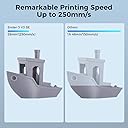
🚀 Print your ideas into reality—no interruptions, just creations!
The Official Creality Ender 3 is a fully open-source 3D printer boasting an 8.66x8.66x9.84 inch build volume, designed for beginners and pros alike. It features a resume printing function that safeguards your projects from power outages, an advanced extruder for smooth, quiet operation, and a safety-certified power supply that heats the bed to 100°C in just 5 minutes. With a DIY assembly process that enhances hands-on skills and a vast community for support, the Ender 3 offers an affordable, reliable entry into 3D printing with endless customization potential.


| ASIN | B07BR3F9N6 |
| Best Sellers Rank | #16,086 in Industrial & Scientific ( See Top 100 in Industrial & Scientific ) #32 in 3D Printers |
| Customer Reviews | 4.1 4.1 out of 5 stars (16,283) |
| Date First Available | March 27, 2018 |
| Is Discontinued By Manufacturer | No |
| Item Weight | 15.43 pounds |
| Item model number | Ender 3 |
| Manufacturer | Creality 3D |
| Product Dimensions | 16.14 x 16.54 x 18.31 inches |
L**Z
Amazing printer!
The Ender 3 marked my entry into the 3D-printing world, and I love it! The 3D printer has been a godsend! If you're also newbie and searching for advice, here's my brief take on the Ender 3. It's awesome! The Ender 3 arrives in pieces that you must assemble. Since it is essentially a robot, assembly can seem overwhelming at first, but if you take it one step at a time, you'll be printing in no time. I found the printed instructions accompanying the unit to be more sizzle than steak, but, fortunately there are several videos on YouTube that make assembly a breeze. Believe it or not, assembling the unit yourself is beneficial because it familiarizes you with the device. It will allow you to easily make the minor adjustments that 3D printers often require. My wife and I have found that 3D printing comes with somewhat of a steep learning curve, but it's fun. YouTube and websites such as "all3DP dot com" have proven themselves to be life savers. The most common adjustments you'll make while 3D printing is "bed leveling." In truth, though, you're not actually "leveling" the print bed, but rather you're ensuring that the print nozzle is uniformly distanced from the bed (the print surface) on all its 4 corners. The nozzle needs to be super close, too. ...not about an inch or two away from the print bed, but rather it needs to be no further than the thickness of a piece of paper. Crazy, huh? When my wife and I printed a test file provided by Creality (the manufacturer), we frankly sat mesmerized at the unit's precision. It was like staring into a campfire and getting lost in the flames. The nozzle just zipped back and forth across the print bed leaving tiny bits of corn-based "plastic" one layer at a time, and eventually (over time) created a cat/dog thingy. In search of more things to print, we settled on two websites with tons of 3D-printable files that are very often free to download. The websites are "thingiverse dot com" and "cults3d dot com". The latter site takes longer to load, but seems to have more options. Creality has one too, but I haven't really checked it out yet. It's important to note that the files you download from such websites are *.stl files, whereas the Ender 3 needs *.gcode files. To make the file conversion, we downloaded a piece of software called Cura. It appears to be the best (free) software on the market for "slicing" 3D files into *.gcode files. That too has a steep learning curve, complete with complicated settings. But fortunately there are lots of tutorials online along with settings you can copy from experts. I mostly rely on "all3DP dot com" for that. After a while, we decided to invent our own designs and then print them into existence. In my opinion, the cat's meow -- the best and easiest 3D design application -- is Fusion360. It has a limited free version for students and schools, but otherwise it's quite pricey. My wife then found free, open-sourced design software called FreeCAD. We love it, and haven't turned back since. The filament we prefer is PLA. In our experience, PLA produces little to no fumes and it's guilt-free because it's corn-based and biodegradable. It should be noted, though, that not all PLA is created equally. This is primarily because (according to what I've read) pigments affect the PLA in different ways. So, when I order PLA from Amazon, I always look for the PLA with the most and highest reviews. Then, I refer upon their temperature recommendations. Overall, we absolutely love the Ender 3. At under $200, it's extremely affordable, and the process of printing things into existence can be (in my experience) somehow transformative. And if you find yourself confused about something, take my advice by not wasting time by trying to figure it out for yourself. Just refer to the experts on any of the websites I mentioned so, later on, you can focus on things that really matter...like design. Note: the bearing on a little fan went out. So, I reached out to Comgrow, they got back to me immediately, and now a new fan is on the way. No fuss no muss. Finally, at the risk of getting to personal, I'm a disabled veteran who benefits from focusing on tangible things. The process of 3D printing has proven itself to be such a godsend in that regard, that I think the VA should seriously explore ways of getting more vets 3D printing. I hope this helped newbies like me. Happy printing!
D**W
Very addictive!
I have been thinking about buying a 3d printer for a little over a year. They have been pricy so I've not stepped into this arena, especially with so much information to wade through. So I bought this printer on a whim with a "lighting deal." First, I read other reviews and found YouTube for assembling the printer. The instructions help a little with the videos, but this is really the only negative. It's well made and simple to assemble so it made for a fun afternoon. Next thing to know is that I didn't know nearly enough. Once it's assembled, you have to level it. Luckily there's a ton of videos on this, and the assembly videos will go through that as well. It's not hard, but something I never thought of. I also got the auto leveler and installed it a few days later. That's a whole different thing that is amazing once you figure it out. Another thing i didn't realize is the print bed. This printer comes with one, obviously, and it does a good job. Keeping the bed level is hugely important for your prints. Also keeping it clean. It's never really clean though. I watched a ton of videos about using alcohol to clean it but that can actually be too harsh. Soap and water seems to be the go to across forums. Using some other adhesive is fair game as well. I didn't realize how much damage I did and bought a glass bed for my prints. Glass was amazing! It actually struggled to get prints to release. But the alcohol was too much and had already started to ruin my new bed. So, just soap and water should get you through most issues (and don't be afraid of the glass bed, it is pretty nice) Now, your filament absorbs water. I also didn't realize this and thought the various filament storage and dryer were just frivolous. They are, and they aren't. I have silica beads, and a vacuum sealer, so I don't strictly speaking need one of those. Also, my oven has a dehydration setting. However, it's nice to just have one on hand and not take up the kitchen or extra electricity from having the oven on. So, need one, no, but I'm not mad that my bundle came with one. Most of the rest of your questions can be Googled. But also, read forums, not just the popular videos and articles (it's how I've ruined two print bed). Everyone loves discussing the slicer (print configuration software basically) settings ands getting the most out of each print. I'm personally looking forward to learning to build my own designs, but don't feel like you have to. My kids love me printing endless frogs and cats for them to display and show off. My nephew likes the toys I've managed so far. Above I've mentioned things I've learned and wish I knew more about ahead of time. However I haven't really talked about the printer itself. It's been great. There's no real instructions because each print is a little different. You need to experiment to see what works best with everything. That may not be for everyone. But you can create surprisingly large prints with great detail with this printer. It's been smooth! It's worth noting that 3d printers can be loud, but it's not very. If say it's more quiet then most dot matrix printers. I can sit by it printing and work on other projects, or leave the room and I can't really hear it. So if you're wanting to break into this as a hobby, this is an excellent printer to start with. It's a little older so there's tons of help out there for it and it's been reliable. Replacement parts are not expensive, nor are upgrades. TLDR: This is a good printer and I'm happy with my purchase.
P**C
I really gotta give props to Creality for making this printer so affordable and (relatively) easy to set up and use. Since getting it I learned a <ton> of stuff about 3D printing (both by being forced to do it and trying to troubleshoot all the different issues :P) It's a great printer for the price, not sure what else I can say. Initial assembly was relatively easy and took around an hour. Then I realised I haven't done it properly so I had to re-assemble parts I assembled before (another 1h). Then a couple of days later I realised the frame is not straight... So I disassembled and re-levelled the whole thing from scratch (another 2h or so) Then i've done it yet again a couple of days later to straighten the gantry :P Unfortunately factory pre-assembled parts were not perfectly assembled. The bed is not perfectly even either, seems a bit warped but oh well the glass bed upgrade is too expensive. Usage is straightforward after assembly, there's an amazing amount of 3D-printable improvements to the Ender 3, tons of guides and information readily available. SD card slot is a great addition but you'll probably want to move to an Octoprint setup for ease of use and to flash a more recent Marlin firmware. Unfortunately the Pause feature has bugged out multiple times on me on the original firmware (just freezes printer in place, ruining prints) but at least the power-loss recovery works fine (once it freezes just shut it off and back on and it will give you an option to resume). No such issues with the custom-built Marlin fw. Worth noting is that my unit came with a 4.2.2 32-bit motherboard, an extruder guide enforced with metal and adjustable tension. Attached amount of filament was almost enough to print the sample doggy figure - you can clearly see where the filament ran out ;( Overall it's a fun learning experience but if you're expecting to just "buy, print and forget" - this might be the best choice for you as it has no auto bed levelling and other features present in more expensive printers (unless you upgrade it yourself) Definitely watch one or two assembly videos to get an idea of what to look out for during assembly, it will save you time in the longer run
O**R
L'imprimante qui m'a été livrée avait un défaut de taille : son plateau chauffant ne pouvait pas être mis à niveau : il y avait toujours quoi que l'on fasse, et même en plaçant une plaque de verre de 4mm sur le plateau, un coin qui restait désespérément plus bas, de plusieurs mm, que les 3 autres coins. Avec 2 molettes de réglage (sur les 4 présentes sous le plateau) qui finissaient par sortir de leur vis en fin de procédure de réglage. Imaginez donc un plateau de travers, qui finit par ne tenir que sur 2 vis… C’est là-dessus que je me suis efforcé d’imprimer pendant plusieurs mois. Du coup, impossible d'imprimer sur plus d'un quart de la surface du plateau, parfois un tiers avec un peu de chance, pour des modèles de pas plus de 2 cm d'épaisseur. J'ai passé de longs mois à essayer de régler ce souci, avec l'aide de nombreuses personnes expérimentées, vérifié toutes les pièces une à une, tout démonté, tout remonté, tout calibré, acheté des pièces détachées pour essayer de régler le problème en remplaçant ou complétant certaines pièces : rien à faire. Problème d'autant plus gênant qu'il n'était visiblement pas très commenté sur le Net. En désespoir de cause, j'ai fait appel au vendeur. Après plusieurs semaines d'échanges par mail, malgré le fait qu'il m'ait demandé mail après mail de grosso modo tout démonter pièce par pièce (et bien sûr de photographier voire filmer chaque étape pour lui envoyer), et quelques demandes pour le moins hasardeuses, parfois sans lien apparent avec le problème, voire contradictoires (un coup le problème viendrait du fait que telle pièce est trop haute, plus tard le problème viendrait du fait qu'elle est trop basse. Plus tard encore cela viendrait d'une autre pièce. etc...), il a fini par en déduire que le problème viendrait d'une pièce qui n'avait visiblement aucun soucis apparent. Et me l'a remplacé, ce qui a, à ma grande surprise, résolu le soucis rencontré, alors même que personne n'avait pu identifier ni même envisager que le problème pourrait venir de là (barre de l'axe des Y à peine, mais alors à peine voilée). Il m'a également remplacé sans soucis un moteur qui avait lâché. Si j'ai été un peu refroidi par cette première expérience en impression 3D sur un imprimante défectueuse, j'ai été agréablement surpris par la qualité du SAV. Chose assez rare pour être signalé et qui justifie amplement mon appréciation à 5 étoiles en complément de la qualité de l'imprimante elle-même. Ce vendeur a une très bonne communication, répond assez rapidement, est réactif quand il s'agit d'envoyer une pièce de rechange lorsque nécessaire (qui met toutefois un peu de temps à arriver mais bon, cela reste ici normal). S'agissant de l'imprimante, c'est une imprimante : - de grande qualité, - moyennement bruyante, - facile à calibrer (dès lors qu'elle n'a pas de soucis de conception d'usine comme celui que j'ai rencontré), - assez compacte avec malgré tout une surface d'impression très appréciable, - qui rend des impressions très précises, - qui imprime sans soucis du PLA, du PETG, du flexible, du bois, ... - son plateau chauffant chauffe rapidement. Si votre imprimante souffre d'un plateau chauffant légèrement en creux en son centre, l'installation d'une plaque de verre Creality (vendue séparément) sur le plateau chauffant résouds ce soucis, et offre un gain d'adhésion et de facilité à décoller les impressions. En conclusion, de toutes les imprimantes du marché à ce jour dans cette gamme de prix, c'est celle que je rachèterai sans hésiter une seconde si la mienne devait me lâcher complètement. D'autres offrent des "gadgets" en plus (détecteur de fin de filament, BLtouch, etc...), mais ont visiblement en contre-partie une moins bonne qualité d'impression. Je préfère pour ma part si nécessaire avoir une imprimante qui imprime le mieux possible de base, quitte à acheter séparément ces compléments ultérieurement. (Si mon commentaire vous a aidé, n'hésitez pas à le dire en cliquant sur le bouton "UTILE" ci-dessous)
L**.
Hatte einen Hephestos von BQ mit nachgerüstetem Heizbett für den mehrfachen Preis. Jetzt ist die Elektronik defekt und es gibt keinen Ersatz. Der Creality Ender 3 ist recht schnell aufgebaut und betriebsbereit. Die Bedienerführung ist intuitiv aufgebaut und die Druckplatte kann dann einfach mittels Stellschrauben und einem Zigarettenpapierchen nivelliert werden. Wenn es ganz genau sein soll, montiere ich eine Messuhr an den Extruder und fahre das Druckbett ab. In ein paar Minuten sind Heizbett und Extruder auf Temperatur und der Druck kann beginnen. Am besten geht die 3D Drucksoftware von CURA. Einmal das Set-Up für den Drucker konfiguriert, verschiedene Modi für PLA, ABS und Nylon sind vorkonfiguriert. Die meisten Drucke mache ich mit PLA. Das Material lässt sich einfach und gut drucken, ob dünn- oder dickwandig, Die Druckzeit ist je nach Auflösung mehr oder sehr lang. Einfache Funktionsmodelle können durchaus mit 0,4 Schichtdicke und 30% Füllung sehr ansehnlich gedruckt werden. Prüfkörper zeigen sehr gute Toleranzen hinsichtlich aller drei Achsen. Abweichungen sind < 0,2mm. der Einfluss von der Extrudertemperatur und Heizbettemperatur sind dabei nicht unerheblich. Nachteilig ist der Feeder welcher das Filament über ein sehr langes PA-Rohr zum Extruder schickt. Die Speicherkarte für die Druckdaten geht nur sehr fummelig in den Slot. Leider bringe ich den Drucker nicht an das Netzwerk. Creality bietet zwar einen Hub an, dieser läuft aber offensichtlich nur über die Cloud. Wer will das? Ebenso habe ich eine beschichtete Glasplatte auf das Heizbett montiert. Es ist grundsätzlich empfehlenswert mit den Druckparameter zu experimentieren. Im Ergebnis sind Oberfläche, Schwund der Bauteile und ggf. deren Stabilität zu beurteilen und durch Veränderung der Druckparameter zu optimieren. Für den Anfänger ist der Creality Ender 3 zu empfehlen da: + bestes Preis-Leistungsverhältnis + einfacher Aufbau auch für den wenig versierten Laien + günstige Druckkosten bei Verwendung von PLA + Bauteile haften sehr gut an der beschichteten Glasplatte , nicht so gut auf der originalen Folie Grundsätzlich sei angemerkt, dass die wenigsten private Anwender über vernünftige CAD-Systeme verfügen um selbst komplexe OBJ-Dateien zu generieren. Für diese User gibt es im Netz jedoch eine Unzahl von kostenlosen Modellen zu den unterschiedlichsten Themen, siehe unter thingiverse(dot)com. Eine Empfehlung von mir: bitte mit einfachen Bauteilen starten und experimentieren sonst ist der Frust schnell zu groß Stand Juni 2021: Habe jetzt ca. 3 kg PLA und 0,5kg ABS ohne Störung oder Defekte erfolgreich gedruckt.
F**O
A Ender 3 Pro é uma impressora surpreendente capaz de fazer impressões em alto detalhe de uma maneira incrível, entretanto impressão 3D segue sendo algo um tanto complexo. A montagem é rapida e leva em torno de uma hora, o cartão micro sd incluído vem com um vídeo mostrando como montar e com um manual bem completo, porém em inglês. Incluí também alguns exemplos e um software de slicing. O que mais agrada na Ender 3 Pro é sua comunidade ativa, com muitas opções de ajustes, upgrades e ajudas online, o que facilitou muito iniciar as impressões. Estou feliz com a compra, e achei o preço aceitável para o Brasil. O envio foi rápido e a entrega também.
A**N
The box arrived pre-dented inside another amazon box, meaning it was dented before placed inside, luckily due to insane overengineering of the packaging everything was in perfect order inside the box. Took 1/2 an hour to confirm all the parts were there, then another 1.5 hours to assemble, there were some discrepancies between the manual and the online video, but nothing major. I assembled purely by sight and everything came together perfectly level. Leveling manually is a bit annoying and lead to a couple of failed prints, but once I got the hang of it things started coming out great. I've had some issues with more advanced items like interrupting the print to add in a magnet causing weak points and the prints would fail about 1cm up from the magnet, pretty sure I can work that out by tweaking the temperature and perhaps shifting the resume layers down a fraction of a millimeter to improve bonding though. The base print speed is rather slow, 50mm/s but I intentionally purchased the base model with the plan to upgrade the main components piece by piece after the next couple of months for the learning experience. My one complaint is that the stock build plate that comes with it tends to stick to the prints like superglue, good for larger bulky prints, but terrible for thinner prints that fall apart when scrapped. So I replaced it earlier than originally planned with a PEI sheet which releases the print as the plate cools. Creality emailed me the day before it arrived, preemptively offering support with setup and use, I never ended up needing it, but it's nice to know it's there if I did. Overall super happy with the purchase, can't wait to supercharge this puppy. Overall, super happy with the purchase.
Trustpilot
2 weeks ago
1 month ago