Buy anything from 5,000+ international stores. One checkout price. No surprise fees. Join 2M+ shoppers on Desertcart.
Desertcart purchases this item on your behalf and handles shipping, customs, and support to KUWAIT.
🔌 Power up smarter, not harder — stay charged, stay ahead!
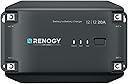
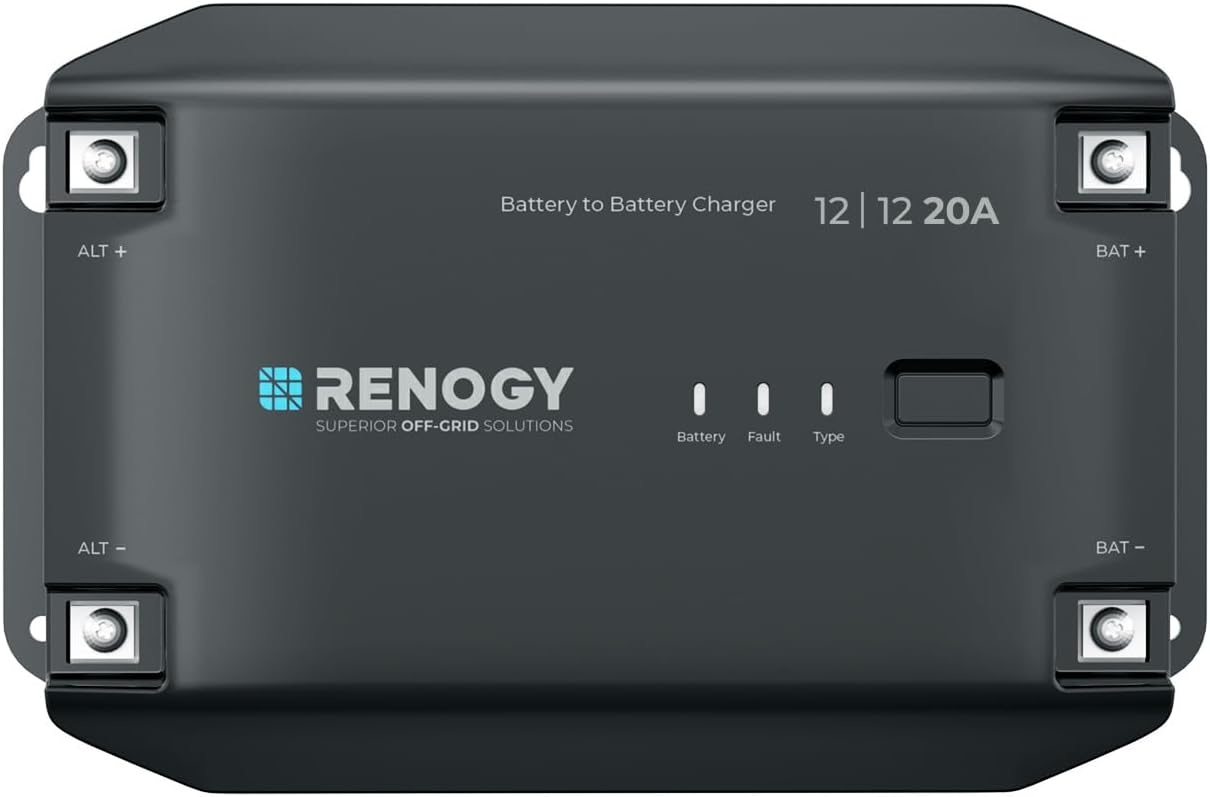
The Renogy DC to DC Charger 12V 20A is a versatile, multi-stage battery charger designed for LiFePO4, AGM, Gel, and Flooded batteries. Engineered for vehicles, RVs, boats, and marine use, it features smart alternator detection to prevent battery drain, a compact wall-mount design with enhanced safety, and Bluetooth compatibility for remote monitoring and control. With advanced protections and intelligent battery activation, it ensures reliable, efficient charging in demanding environments.


| ASIN | B0DQP87ZRK |
| Best Sellers Rank | #17,371 in Automotive ( See Top 100 in Automotive ) #100 in Battery Chargers |
| Customer Reviews | 4.1 4.1 out of 5 stars (1,106) |
| Date First Available | December 17, 2024 |
| Item Weight | 3.3 pounds |
| Item model number | RBC20D1U |
| Manufacturer | Renogy |
| Product Dimensions | 2.3 x 9.31 x 5.17 inches |
D**I
Thought there was a parasitic load. I was wrong.
Updated review - I made a mistake. I have a parasitic load on my system but it's not this DC DC charger. I pulled the charger out of the system and still had the same discharging of my batteries I was attributing to this charger. Adding the charger back into the system and no detectable difference to this discharge rate. This charger works great and it's easy to set up and modify the charging parameters through the app; which I really appreciate. Easy to set it up so it keeps my LiFePO4 house batteries at ~80% while my boat sits during the week. ---- old review ---- Charger works as advertised but there is a much larger than anticipated parasitic load when not charging. I estimate it to be about 1 amp. Drained a 100Ah AGM dual purpose battery from 12.7 to 12.0V in ~48 hours. Anyone else experiencing this? Is there a fix (softwear or otherwise)? This charger isn't useful for marine applications where there are often days to weeks between motor use with this magnitude parasitic load.
A**N
Read instructions! :-)
This charger is for my pickup bed/camper and charges a lithium battery. The power supply is isolated from the starter battery. This charger is set up to isolate itself from the starter battery. I didn’t read carefully about the two wires that appeared to be optional. They’re described in the manual and one is required. When the charger wouldn’t charge and I read instructions more carefully, I discovered the unit required connection with one of those little wires to a power source only on when the ignition was on. I made a wire, plugged it in the appropriate slot (requires a very small blade screwdriver) and connected it to the already isolated positive power wire input to the charger. Started the engine and the battery said it was charging at 20 amps. Perfect! The second little wire allows you to charge at 10 amps. I’m adding rocker switches to these wires so I can turn them on or off easily. There is a warning about using this charger around flammable fumes so I want to easily turn it off when hauling fuel.
C**T
UPDATE: Two defective units in a row and I'm out all the installation fees.
UPDATE: I would love to say this a great charger, however I have received two of them and neither of them worked correctly. The first one was DOA when I received it. It cost me $200 to have it installed, only to have my installer tell me it was not working correctly, and pull it out. I sent that back to Amazon, but was out the $200 installation fee. Stupidly, I bought a second one because I like the company. I again paid $200 to have this installed in my RV under the passenger seat where apparently it needs to go. This one worked, so I was happy with it. It worked well, in fact, for all of three days into my vacation, then I noticed on my battery monitor that there was no charge whatsoever coming from my alternator. On vacation, 2000 miles from home, I had to drive two hours to an RV place to have this unit taken out. Removal and reconnection of my old wiring cost me $220 this time. Now I am up to $620 in installation and removal fees. I drove the rest of my vacation with the straight alternator and was fine. When I returned I called Amazon and they agreed to take back the unit even though it was past the 30 days. They said they would charge a restocking fee but that the fee would be waived once they received the unit. They now refuse to refund the 45.00 restocking fee because the unit is not in re-sellable condition, to which I can only say, Of Course not! The long and short of it is that it cost me $665 to try to make this work and as much as I like the company, it doesn't. The units I got were defective and I would not order this again from them.
L**A
Good value, works as expected
Read some bad reviews on this but have ran Renogy DC/DC for years (get new ones when I upgrade or change vehicles) and never had one problem.
J**.
Works well, missing some parameter adjustments to make it better.
Update 1/5/23: Renogy support reached out to me to follow up on my review below. The bluetooth issues I mentioned were likely due to my old phone (I had an iPhone X at the time). I recently upgraded to the latest iPhone 14, and no longer have any issues. After several months of use, the charger appears to now correctly disconnect after shutting the engine down. I don't really know what changed (update, different battery voltages, etc), but this appears to no longer be an issue for me. I did end up installing a high amp disconnect switch on the starter battery connection (something everyone should probably do as a backup), so I can manually disconnect it if I don't want charging to happen in either direction. Renogy support was fantastic, thank you Daniel for all your help. I'm adding a star to my overall review as a result. If the cut-in/cut-out voltages were able to be customized, this would easily be a 5 star product. -------------------------------------------- Original Review: Pros: Setup is pretty easy, anderson connectors are nice to work with. No need for a signal wire if you have a traditional alternator, so wiring is super straightforward. Bi-directional charging works well, kept my house lithiums charged while driving, and my starter battery is always topped up now since I have access to shore power, solar, or generator depending on situation. Cons: $500 is way too high for what you get, Renogy app is clunky and requires weird workarounds to reconnect bluetooth, the cut-in/cut out voltages are not optimized for lithium house batteries (even on lithium mode). I'll try and elaborate on the cons mentioned above: The charging logic for maintaining the starter battery is not ideal if you have house lithiums. Per Renogy's manual: "The auxiliary battery will charge the starter battery only when the voltage of the auxiliary battery is greater than 12.7V". This is ok if your house batteries are AGM/Flooded with lower resting voltages, but for lithiums 12.7V is really low, and I don't really want it to continue pulling energy from the house batteries in that state. Unfortunately, this isn't one of the parameters you can adjust in Renogy's app either. The equivalent Sterling charger (BB1240) has this level set at 13.5V when you have a lithium setup which seems like a much more reasonable cutoff to me. My actual testing confirmed that this was the case, it continued to charge the starter battery from the house batteries even when the voltages hit 12.9/12.8. Also, the house battery charging cut-in happens when the starter battery hits 13.5V+ (after a 15 second delay). This works great, the 15 second delay lets energy spikes that come from starting your engine settle before engaging the charger, and 13.5V is a good starting measure. However once charging starts, the cut-off voltage for charging your house batteries from the alternator/starter battery is (again) 12.7V, and it is another parameter that you can't change. I find that when we shut our sprinter down, the starter battery tends to stay around 12.8V or 12.9V for a while resting. This, unfortunately, leaves the rego in charge mode, and it will continue to attempt charging your house batteries directly from the starter battery. I noticed this because I went back and hit the main disconnect switch for our house batteries, and the rego continued to power the whole system for a while using just the starter battery 😬. So, if you plan on installing this I would recommend a high-amp disconnect switch on the input side. I found the Renogy DC Home app clunky to work with too. Bluetooth would disconnect the second I let the screen dim, and it would not reconnect to the dc/dc charger until I navigated all the way back to the main screen and hit refresh. Renogy, if you are listening, this would be SO MUCH MORE USEFUL If we could tweak the cut-in/cut-out voltages in user mode to better match our setup (or at least tweak them to actually match the battery type you have selected).
A**R
Exactly what I needed
Does exactly what I got it for! Install is very simple. I like the terminal design, very secure connections for my wire lugs. Not all lugs will fit in here, but I have found that most 4awg lugs that I purchased in a kit from another Amazon seller have fit perfectly in this device. When others haven't fit, I've been able to cut to size. I noticed that manu reviewers say it runs hot. Mine is definitely warm to the touch when charging at 60a, but I wouldn't say it is hot and I certainly wouldn't worry about the heat generated from the device creating a fire or burn hazard. I've run run this baby now daily for about 1 week and am very happy with this product. I would purchase again and highly recommend this unit!
C**R
seems efficient
I installed these units to charge the 2x 600ah battery bank(s) shown above. My instalation draws power from a 250 amp engine alternator. The charging units have primary input and output hookups of solid metal with machine screws to secure the wires. They also have 2x additional wire inputs. One wire input activates the unit, it will not charge untill voltage is applied to the "D+" terminal. This allows it to fuction as a battery isolator relay, whereby it wont charge untill its told to by the activation wire. It also has a second activation wire for a 50% power mode. This knocks the charging amperage down to 30 amps, and I highly reccomend wireing this lead to a toggle switch. I installed 2x units and found that a 250 amp alternator cannot power more than one of these at idle engine speed. At highway speed and higher rpm, I can run both units at 60 amps. but at night time with all lights on in the RV, I can only run one at 60 amps and the other at 50% power without overdrawing the alternator. The installation instructions indicate that they "may draw upto" 90 amps, but upon installation i havnt seen more than 65 amps. I installed 2 of these units which is kinda crazy, i did it by isolating two battery banks with a giant diode array, in the form of a battery isolator diode set installed "upside down" on the negative terminal side. but take note that a 250 amp alternator can barely power both of them when tacked ontop of the other electrical load for the RV. Installing one unit with a common 130-150 amp alternator it would be advised to install the amperage reduction function to avoid overtaxing the alternator at low engine rpm. The units have internal cooling cans that SUCK AIR from the electrical input side, and EXPEL AIR on the electrical output side. This information is only apparent AFTER installation, so ill include it here. 2 gauge cable worked fine. to install the activation leads, unscrew the tiny screw above the wiring opening, insert the wire, then tighten the screw. This information is not included in the instructions so i include it here. Since you will probibly wire the activation lead to turn the unit on whenever the engine is running, advise installing an interupt switch for that lead, or a giant battery disconnect switch for the voltage input as I did.
T**R
Works great, some of the interface is a little funky
I've used this almost a year now and pretty happy. I use the custom settings to charge a 400 AH lithium battery bank. Pros: - Easy to install - Seems to work reliably - Runs cool - Connections are Anderson PP75 “Powerpoles” which I liked and are way better than typical screw terminals Cons: - The software, as typical for Renogy, makes little sense. The Bluetooth app screens are somewhat nonsensical and frustrating - but - it does work for the basics, at least on my iPhone - Big giant external rotating selection switch makes me afraid I will nudge it by accident. I may pour epoxy on it. - Missing some important settings - Missing a way to disable reverse charging for some circumstances (so I just thrown the breaker I installed) - Big and Heavy Overall I have to give it 5 stars. It works, and Renogy for now has the ONLY bidirectional DC-DC charger which is the big attraction for me.
Trustpilot
1 week ago
1 week ago