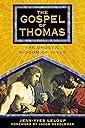
Gospel Of Thomas
Product ID: 77819874
Desertcart purchases this item on your behalf and handles shipping, customs, and support to KUWAIT.
A new translation and analysis of the gospel that records the actual words of Jesus• Explores the gnostic significance of Jesus's teachings recorded in this gospel• Explains the true nature of the new man whose coming Jesus envisioned • Translated and interpreted by the author of the bestselling The Gospel of Mary Magdalene and The Gospel of PhilipOne of the cache of codices and manuscripts discovered in Nag Hammadi, the Gospel of Thomas, unlike the canonical gospels, does not contain a narrative recording Christ's life and prophecies. Instead it is a collection of his teachings--what he actually said. These 114 logia, or sayings, were collected by Judas Didymus Thomas, whom some claim to be Jesus's closest disciple. No sooner was this gospel uncovered from the sands of Upper Egypt than scholars and theologians began to bury it anew in a host of conflicting interpretations and polemics. While some say it is a hodgepodge from the canonical gospels, for others it is the source text from which all the gospel writers drew their material and inspiration. In this new translation of the Gospel of Thomas, Jean-Yves Leloup shows that the Jesus recorded by the "infinitely skeptical and infinitely believing" Thomas has much in common with gnostics of non-dualistic schools. Like them, Jesus preaches the coming of a new man, the genesis of the man of knowledge. In this gospel, Jesus describes a journey from limited to unlimited consciousness. The Jesus of Thomas invites us to drink deeply from the well of knowledge that lies within, not so that we may become good Christians but so we may attain the self-knowledge that will make each of us, too, a Christ. Review: Amazing. - This is a fascinating work concerning human life and its truths of compassion and wisdom. It's a must read for every seeker. Review: The true sayings of Jesus Christ?? - Possibly the oldest gospel about the words of Jesus. All other gospels we read in new Testament dates after the pagan emperor Constantine did his infamous editing, deleting and mixing up of fables to the scriptures. Go for it. Good translation and commentary.


| Best Sellers Rank | #117,460 in Books ( See Top 100 in Books ) #322 in Mysticism (Books) #538 in Occult & Paranormal #773 in Mental & Spiritual Healing |
| Customer Reviews | 4.7 out of 5 stars 1,309 Reviews |
L**E
Amazing.
This is a fascinating work concerning human life and its truths of compassion and wisdom. It's a must read for every seeker.
G**A
The true sayings of Jesus Christ??
Possibly the oldest gospel about the words of Jesus. All other gospels we read in new Testament dates after the pagan emperor Constantine did his infamous editing, deleting and mixing up of fables to the scriptures. Go for it. Good translation and commentary.
M**I
Recommended
Jesus knew what the Upanishads taught about humanity. It's non-duality (Advaita)
A**E
Very useful edition of the Gospel of Thomas, with some hit-and-miss commentary
The Gospel of Thomas is the book that didn’t quite make the cut into the New Testament canon. It seems to be close to Q, the hypothesized source for Mark, Matthew, and Luke; as a collection of aphorisms and not a coherent narrative, it’s understandable why one might exclude it on literary grounds. In addition, Thomas sometimes leans in the direction of greater mysticism (or gnosticism), though I think that can easily be exaggerated. It's also more hopeful than some guilt-focused western traditions. This book includes several parts that will be more or less interesting to you depending on what brings you here. The foreword by Jack Needleman and the introduction from the editor and translator, Jean-Yves LeLoup, are pretty conventional introductions to the Gospel of Thomas in the context of other gospels. Next comes the text in Coptic, with a facing translation into English. These 50 pages will only be useful for those who read Coptic or who have begun to study it. (I am not among that group.) After that comes the logia, each a section of text in the Gospel of Thomas. Each is about a paragraph or so long. LeLoup provides references to canonical scripture for comparison and further study. For example, in Logion 3 he refers to Matt 24:26-27, Mark 13:5-7; Luke 17:21; Deut 30: 11-14; and Rom 10:6-8. These cross-references are valuable indeed as a study guide. Each logion comes with LeLoup’s commentary. Some of his commentaries are insightful, while I think others miss the mark. They reflect his own spiritualism (and gnosticism) more than a scholarly exegesis. As a result, he tends to exaggerate the difference between Thomas and the synoptic gospels. You can judge those questions for yourself. In its perspective, Thomas differs from the synoptic gospels less than John does. Because it’s a bit older than the others, I found many of its logia providing a striking glimpse into why the disciples found Jesus a compelling teacher. The Gospel of Thomas offers a fresh perspective on Jesus, and the most compelling (and most nearly “orthodox”) of the Nag Hammadi texts.
S**N
Essential read for everyone
Don't try and rush this, just allow each Logion to gently settle. This has totally transformed my faith. I would definitely recommend, am buying a copy for my son. I know he will love it too
A**R
Good read. Wake up!
Good gnostic knowledge. Read to discover!
E**G
A MUST have book
This version of the Gospel of Thomas is excellent. From what I have discovered about this gospel, Thomas is source material for the Synoptic gospels. It was compiled prior to the death of Jame the Just (the brother of Jesus) in 62 CE, earlier than Mark (65-70 CE). This collection of 114 logia (sayings) served as an outline and resource, not a narrative, for the writers of the Synoptic gospels. Scholars knew this gospel existed because of the Oxyrhynchus Papyri found in Egypt the late 19th century. These papyri contained only portions of sayings. However, thankfully in 1945 the complete gospel was discovered as part of the Nag Hammadi Library. If you think you have never read this gospel, you are wrong; 62% of Thomas is found in Matthew and Luke, where 14% is used in Mark. John does not contain any of the sayings from Thomas. I use Thomas weekly in my Sunday School class. Much more than just a curiosity, the Gospel of Thomas is the closest to the original teachings of Jesus than anything else. This edition also contains insightful commentary by Jean-Yves Leloup to help you understand some of the more esoteric sayings. If you are serious about you broadening your spiritual knowledge of God and your knowledge of New Testament scripture, you NEED this book.
T**Y
Great
I love this book I'm not the most intelligent person when it comes to books like this I find some things hard to understand but I've been really understanding it and enjoying it
Trustpilot
2 months ago
1 day ago