The Making of a Story: A Norton Guide to Creative Writing
Product ID: 8248963
Buy anything from 5,000+ international stores. One checkout price. No surprise fees. Join 2M+ shoppers on Desertcart.
Desertcart purchases this item on your behalf and handles shipping, customs, and support to KUWAIT.
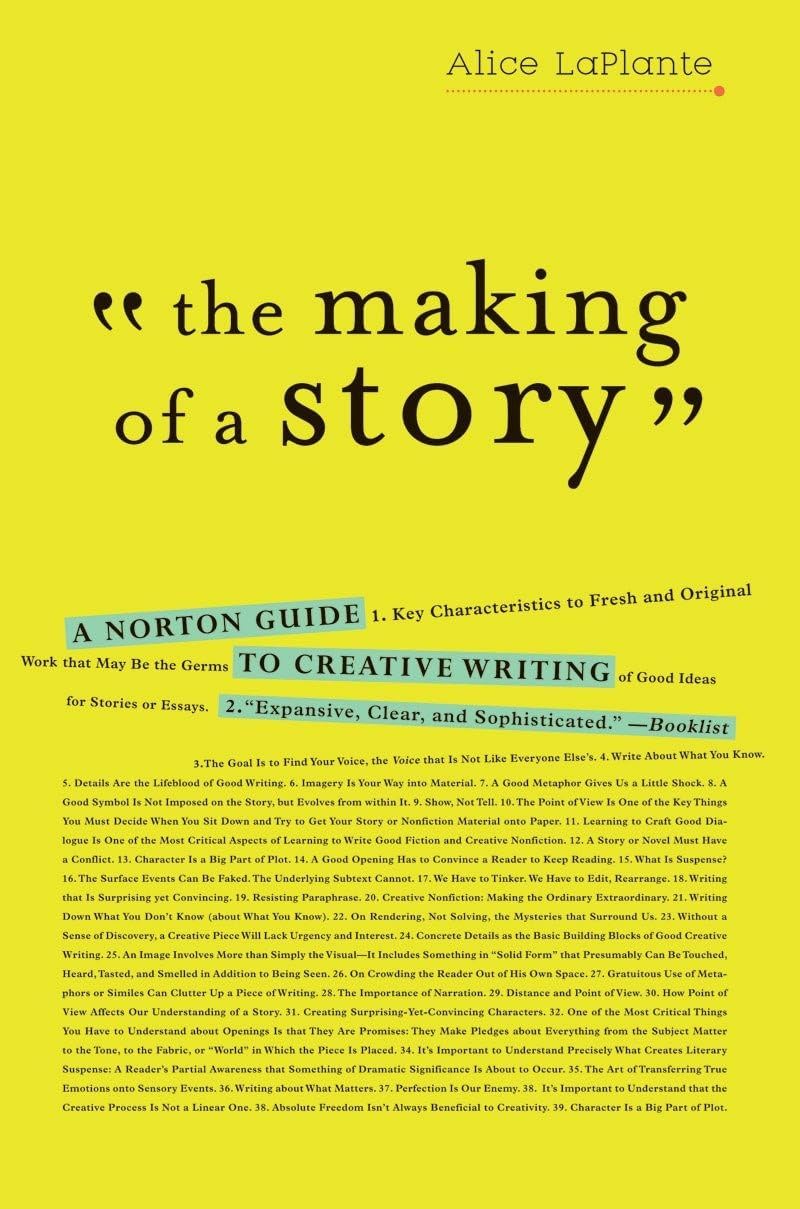
The Making of a Story: A Norton Guide to Creative Writing [LaPlante, Alice] on desertcart.com. *FREE* shipping on qualifying offers. The Making of a Story: A Norton Guide to Creative Writing Review: Worth tenfold its price to the consumer, immeasurably valuable to the writer - Because I'm busy I shop at desertcart. In fact, I shop almost exclusively online, though mostly at desertcart, and books comprise a fair percentage of my purchases. I guess it's been thirteen, fourteen years now that cyberspace has freed my time from harm's way where the ravages of everyday errands erode one's gossamer vision of life and eventually become the hat rack of dreams awaiting to be vested and taken on a stroll. I'm still busy, only my time is invested on the playground of my passions. I've read a number of extraordinary books over the years, too many to name, but you know the titles, as you've read them, too. By word of mouth--by desertcart ratings--the magic of their stories became widely known, pulling in readers from diverse corners of the world. Immersed in their pages, I've laughed and cried among other things, though no response was casually lent to the work in my hands. The inner critic who reads over my shoulder demands authenticity, searches and savors the artistry when it's found, and I, the recreational reader, must be wrestled from the critic's grasp to escape into a character's skin and experience his or her emotional plight. In Kite Runner, for example, the critic didn't stand a chance. I'll have to reread the book because my inner critic travels a path with emotional potential equal to the surrender yielding to an author's magic. Still, all the same, not once have I rated a book. It strikes me suddenly as selfish. But no, I stand by my disinclination. You see, I've never felt the need to rate the pages that have passed through my hands, as you already knew. You beat me to the book and were a part of the cognoscenti whose reviews brought it to my attention. However. Perhaps I have beaten you to "the making of a story". The book has won my willingness to diverge from my obsessions if only to say, this is one you do not want to miss. Not if you're a student of writing, a teacher of writing, a critic.... Not if you are a writer. For two decades, I have been all three of these and in some fashion I will remain all three for the duration of my life. And though forever a student of writing, it has been eons since I have purchased a book on the craft. "the making of a story" is a large volume--a resource to turn to, right? Well yes, it is that. I will return again and again to thumb through the pages and pick and choose according to timely interests. By the look of the volume, that's all I assumed I'd ever do. The assumption was made upfront at the time of purchase, something I didn't intend in the first place, as the classics from back in the day when I took up the craft equipped me with the tools, a rather defined set of tactics--wielding active voice, strong verbs, detail, showing verses telling, avoiding wordiness, the rhythm of the written word and the imitation of speech, parallel expression and pattern variation, usage, style, originality, imagery, editing--that transform correct writing into captivating snapshots of life. But I had in my hands a copy of Alice LaPlante's book. No, I didn't dribble away my time at a brick and mortar (sorry Borders). I attended the San Francisco Writer's Conference and waiting to meet with an editor, I visited the book table. Again, I didn't intend to purchase the book. I simply picked it up. I'm a writer, which is to say I'm curious. I picked up nearly every book on the table and rustled each of their pages in quick survey. What sold me on Ms. LaPlante's book was a heading, a single heading. That's all I read, the bold print line that said, Write what you know about what you don't know. Hunh? The angle started spinning plates in my head, one of them saying that if there are just a few similar nuggets in this text, which is 1¾ inches thick, then I've struck gold. Since I had to fly home, I didn't buy the book on the spot. I wrote down the name, went to my meeting, and returning home, now seated at my computer, I clicked on the blue "e". Good old desertcart delivered "the making of a story" to my door a few days later. Again, I flipped through it, thinking, Voila! I found a nice addition to my reference library, and decided that I'd set aside my novel and read a bit before tucking it away on its shelf. That was a week ago, and like a good novel, I can't put the book down. Can you imagine? An instructional book? A reference? And you can't drag yourself away? Unheard of! I write about ten hours a day. As I'm trying to finish a novel, I'm at my keyboard seven days a week. I haven't put a dent in Ms. LaPlante's book, but I can tell you that it's already made its way to my pages. Just moments ago, I was showing what a character saw when, instead, I "showed" by describing what he heard. Yes, I knew to draw from all the senses, but Ms. LaPlante raised what I knew to a new level. I am certain my writing will follow. This book is a rare find. Whatever stage in your writing career, you will profit immeasurably from the insights, examples, and inspiration contained in its 650-plus pages. Enjoy! The Making of a Story: A Norton Guide to Creative Writing Review: Single best craft books I’ve read. Stellar! - I have an entire bookcase full of craft books, and this is the best of them. Every chapter teems with insight. The exercises are true tools that shape and flex skills to develop the reader’s talents, not trite gimmicky tasks intended to show how clever the author is. LaPlante wisely chose to sandwich the exercises in each chapter between instruction and example stories, so the reader works on their own voice without mimicking others. I wish this had been the text during my creative writing program in college, but I’m awfully glad to have found it eventually. I’ll never let it go.
| Best Sellers Rank | #170,099 in Books ( See Top 100 in Books ) #131 in Words, Language & Grammar Reference #187 in Fiction Writing Reference (Books) #240 in Writing Skill Reference (Books) |
| Customer Reviews | 4.6 out of 5 stars 710 Reviews |
M**R
Worth tenfold its price to the consumer, immeasurably valuable to the writer
Because I'm busy I shop at Amazon. In fact, I shop almost exclusively online, though mostly at Amazon, and books comprise a fair percentage of my purchases. I guess it's been thirteen, fourteen years now that cyberspace has freed my time from harm's way where the ravages of everyday errands erode one's gossamer vision of life and eventually become the hat rack of dreams awaiting to be vested and taken on a stroll. I'm still busy, only my time is invested on the playground of my passions. I've read a number of extraordinary books over the years, too many to name, but you know the titles, as you've read them, too. By word of mouth--by Amazon ratings--the magic of their stories became widely known, pulling in readers from diverse corners of the world. Immersed in their pages, I've laughed and cried among other things, though no response was casually lent to the work in my hands. The inner critic who reads over my shoulder demands authenticity, searches and savors the artistry when it's found, and I, the recreational reader, must be wrestled from the critic's grasp to escape into a character's skin and experience his or her emotional plight. In Kite Runner, for example, the critic didn't stand a chance. I'll have to reread the book because my inner critic travels a path with emotional potential equal to the surrender yielding to an author's magic. Still, all the same, not once have I rated a book. It strikes me suddenly as selfish. But no, I stand by my disinclination. You see, I've never felt the need to rate the pages that have passed through my hands, as you already knew. You beat me to the book and were a part of the cognoscenti whose reviews brought it to my attention. However. Perhaps I have beaten you to "the making of a story". The book has won my willingness to diverge from my obsessions if only to say, this is one you do not want to miss. Not if you're a student of writing, a teacher of writing, a critic.... Not if you are a writer. For two decades, I have been all three of these and in some fashion I will remain all three for the duration of my life. And though forever a student of writing, it has been eons since I have purchased a book on the craft. "the making of a story" is a large volume--a resource to turn to, right? Well yes, it is that. I will return again and again to thumb through the pages and pick and choose according to timely interests. By the look of the volume, that's all I assumed I'd ever do. The assumption was made upfront at the time of purchase, something I didn't intend in the first place, as the classics from back in the day when I took up the craft equipped me with the tools, a rather defined set of tactics--wielding active voice, strong verbs, detail, showing verses telling, avoiding wordiness, the rhythm of the written word and the imitation of speech, parallel expression and pattern variation, usage, style, originality, imagery, editing--that transform correct writing into captivating snapshots of life. But I had in my hands a copy of Alice LaPlante's book. No, I didn't dribble away my time at a brick and mortar (sorry Borders). I attended the San Francisco Writer's Conference and waiting to meet with an editor, I visited the book table. Again, I didn't intend to purchase the book. I simply picked it up. I'm a writer, which is to say I'm curious. I picked up nearly every book on the table and rustled each of their pages in quick survey. What sold me on Ms. LaPlante's book was a heading, a single heading. That's all I read, the bold print line that said, Write what you know about what you don't know. Hunh? The angle started spinning plates in my head, one of them saying that if there are just a few similar nuggets in this text, which is 1¾ inches thick, then I've struck gold. Since I had to fly home, I didn't buy the book on the spot. I wrote down the name, went to my meeting, and returning home, now seated at my computer, I clicked on the blue "e". Good old Amazon delivered "the making of a story" to my door a few days later. Again, I flipped through it, thinking, Voila! I found a nice addition to my reference library, and decided that I'd set aside my novel and read a bit before tucking it away on its shelf. That was a week ago, and like a good novel, I can't put the book down. Can you imagine? An instructional book? A reference? And you can't drag yourself away? Unheard of! I write about ten hours a day. As I'm trying to finish a novel, I'm at my keyboard seven days a week. I haven't put a dent in Ms. LaPlante's book, but I can tell you that it's already made its way to my pages. Just moments ago, I was showing what a character saw when, instead, I "showed" by describing what he heard. Yes, I knew to draw from all the senses, but Ms. LaPlante raised what I knew to a new level. I am certain my writing will follow. This book is a rare find. Whatever stage in your writing career, you will profit immeasurably from the insights, examples, and inspiration contained in its 650-plus pages. Enjoy! The Making of a Story: A Norton Guide to Creative Writing
K**Y
Single best craft books I’ve read. Stellar!
I have an entire bookcase full of craft books, and this is the best of them. Every chapter teems with insight. The exercises are true tools that shape and flex skills to develop the reader’s talents, not trite gimmicky tasks intended to show how clever the author is. LaPlante wisely chose to sandwich the exercises in each chapter between instruction and example stories, so the reader works on their own voice without mimicking others. I wish this had been the text during my creative writing program in college, but I’m awfully glad to have found it eventually. I’ll never let it go.
D**R
Truly exceptional MFA style resource.
The reason I love this book is Alice backs all her lessons up with examples of great writing. If you want to be a great writer, or even just a published writer, you must be willing to put in the hours studying and pouring through the work of great writers and deconstructing why their work is so successful. Otherwise you are only spinning your wheels and building your foundation on your own work, ensuring it will never get any better. I remember going to the University of Kentucky basketball camp when I was in 8th grade. One of the lessons I still learn from today was when a former UK point guard said, "Practice against people who beat your ass. Then you will keep getting better. If you're the best on the court, you aren't learning, they are." The principle is the same here. The amazing thing about this is that Alice undoubtedly had to pay a lot to have all of that work in the book. This is why most writing manuals are full of the opinions and axioms you've heard from nearly every writing manual out there. The authors don't have to go through the hard work of reprinting the work of others and can just grab the money the book will generate. When you fill your manual full of great work, you share the wealth with all of them and spend a lot of time attaining the rights to reprint. What does this tell us about this book? It tells us that Alice LaPlante is more interested in helping writers improve and reach their goals than making as much money as possible. I respect her immensely for this. This manual, if you will take the advice to heart and pour through and not only skim the examples will absolutely make you a better writer. I have no doubt. Highly recommended.
A**R
A Broadcaster's Perspective on LaPlante's Masterclass
Alice LaPlante's The Making of a Story – Where Visual and Written Storytelling Converge As someone with a professional background in visual storytelling—holding both a degree in broadcasting and a master's in strategic communication—I approached Alice LaPlante's *The Making of a Story* with a unique perspective. While I'm relatively new to writing fiction, I was struck by how profoundly LaPlante's principles aligned with techniques I've used throughout my career in nonfiction visual narratives. This 677-page guide is structured brilliantly as a complete creative writing course, with each chapter following a three-part rhythm: craft lecture, hands-on exercises, and exemplary readings. This methodical approach transforms abstract concepts into concrete techniques—something I've always valued in my own visual work. Just as I teach documentary students to move from theory to practice, LaPlante ensures readers don't just understand principles intellectually but can apply them immediately. What resonated most deeply with me was LaPlante's nuanced take on "showing and telling." In broadcasting, I've always known that the perfect balance between direct narration and visual demonstration is essential—too much "telling" creates detachment, while exclusive "showing" can leave viewers without necessary context. LaPlante articulates this balance with remarkable clarity, liberating writers from the oversimplified "show, don't tell" commandment that has confused beginners for generations. Her examples from ZZ Packer and Flannery O'Connor demonstrate precisely the kind of narrative calibration I strive for in my own visual work. The chapter on "The Gift of Not Knowing" profoundly articulated something I've experienced but never fully named in my own creative process. As a visual storyteller, I often discover my most compelling narratives while in production, not during pre-planning. LaPlante validates this approach to writing—embracing uncertainty as creative opportunity—which felt like permission to transfer my exploratory approach from camera to keyboard. Perhaps most illuminating was how LaPlante helped me consciously recognize my own storytelling methodology. In my broadcasting work, I've always focused on "framing topics in the smallest way possible to allow viewers to see the big picture"—finding the precise angle that reveals larger truths through specific moments. LaPlante's guidance on selecting details, building scenes, and creating meaningful windows into characters' lives parallels this approach perfectly. She provided vocabulary for techniques I've instinctively used but hadn't formally articulated. Her insights on pacing particularly resonated with my filmmaking experience. Just as documentaries require careful rhythm between intense moments and reflective pauses, LaPlante demonstrates how written narratives demand similar attention to tempo and emphasis. Her breakdown of how to create narrative tension through strategic information release mirrored techniques I've used in editing visual stories. If the book has limitations, they lie in LaPlante's occasionally traditional literary aesthetics. Writers exploring experimental forms or multimedia storytelling might need supplementary guidance. Additionally, some chapters covering both fiction and creative nonfiction occasionally sacrifice depth for breadth. Nevertheless, this remains an exceptional resource for writers coming from other storytelling disciplines. LaPlante expertly illuminates the creator-mechanism-audience relationship that forms the backbone of all effective communication. She reminds us that regardless of medium, we are creators selecting precise mechanisms and content to reach audiences in intended ways. For storytellers transitioning between mediums as I am, or for anyone seeking to strengthen their narrative foundations, *The Making of a Story* offers invaluable guidance. LaPlante has created that rare instructional text which doesn't merely inform—it transforms practice. Through her wisdom, I've not only gained tools for fiction writing but also new insights into the visual storytelling I've practiced for years. Complemented by books like Anne Lamott's *Bird by Bird* for creative resilience and Renni Browne's *Self-Editing for Fiction Writers* for revision techniques, LaPlante's guide creates a complete toolkit for the developing writer. But start here—particularly if you're translating storytelling skills from another medium. LaPlante will help you recognize what you already intuitively know while providing concrete paths to where you want to go.
D**R
A Thoughtful and Considered Anthology
Alice LaPlante's "the making of a story": A Norton Guide to Creative Writing is a substantial book for creative writers. At 677 pages, this book offers writers a reference book worthy of consideration. Chapters include: Chapter 1: The Basics Chapter 2: Writing as Discovery Chapter 3: Concrete Details as the Basic Building Blocks of Good Creative Writing Chapter 4: Defining the Short Story Chapter 5: The Importance of Narration Chapter 6: Introduction to Point of View Chapter 7: How Understanding Point of View Affects Our Understanding of a Story Chapter 8: Crafting Effective Dialogue Chapter 9: Figuring Out What Happens Next Chapter 10: Creating Surprising Yet Convincing Characters Chapter 11: Beginning Your Story, Novel, or Nonfiction Piece Chapter 12: The Art of Transferring True Emotions into Sensory Events Chapter 13: On Revision Chapter 14: Some Final Thoughts on Creative Nonfiction Each chapter is divided into three sections: The first is focused on some specific element of writing (see list above). The second section focuses on writing exercises. The third, titled, "Reading as a Writer" provides short stories for the writer to consider. In this volume, the short stories include: "On Keeping a Notebook" by Joan Didion; "The Things They Carried" by Tim O'Brien; "Brownies" by ZZ Packer; "The Lady with the Little Dog" by Anton Chekhov; and "The Swimmer" by John Cheever among them. While LaPlante's book is not the only book out there on creative writing, this book is helpful for a beginner or someone in search of a reference guide to review parts of what makes a good story. The exercises are helpful and the short stories are varied and sensitively chosen. While the stories will not appeal to all persons, LaPlante selects provocative stories with difficult themes and encourages good reading to bring about careful and considered writing.
C**L
Exactly what I was looking for
I think this is used in a college level writing class somewhere; I think I’d really love to take that class. This is fantastic guidance on what a story is and how to make one yourself that really sings. The author is clearly talented themselves; it is a manual, but reads as insightful and entertaining. It has been true throughout my life that the more I learn about something — the more I peer into its technical specifics and the precise mechanisms by which it works — the less enchanted I am with the actual product of that work. It’s been true for everything from math and engineering to high art. This book has been a really wonderful break from that, and the medium maintains it’s magic for me even as I pick it apart. My best guess is it’s because we are looking into something as bottomless as the human experience. Sensationalism aside, it’s a great great book and I’d recommend to anyone trying to write or appreciate the writing of others more.
K**N
One of the best creative writing guides I've ever read
Although it checks in at a pretty hefty size (677 pages), Alice LaPlante's 'The Making of a Story' has hardly a wasted word in its entirety. Each chapter deals with a separate aspect of writing (primarily covering character-driven fiction, but also creative non-fiction), including high-level concepts such as the true meaning and goal of writing as an art form, but also more rudimentary aspects of writing, such as characterization, dialogue, and point of view. Of course, this isn't the first, and certainly not the last, book to cover this material. Classics of the genre include Sol Stein's 'Stein on Writing', John Gardner's 'The Art of Fiction', EM Forster's 'The Aspects of the Novel', and many others (Stephen King's 'On Writing' comes to mind). 'The Making of a Story' stands up to all these works, and in many ways eclipses them, particularly with respect to accessibility. Where Gardner, Stein, and Forster are prone to esoteric pontification, LaPlante prefers the practical; this only enhances the value of what she has to say. Each chapter concludes with a few writing exercises that reinforce the chapter's material, and these exercises are followed by one or two pieces of published writing that further illustrate the topic. These examples, unlike those of Gardner or Stein, are excellent examples, and include a wide range of authors, from ZZ Packer and Denis Johnson to Chekov and Tim O'Brien. The net effect of the three-part form chapters (her narrative, then exercises, then published writing) combine to create an immensely useful guide. I consider it one of the best (if not THE best) books I've read on creative writing.
T**T
Ideal for a writer enthusiast!
Perfect Gift for my wife: “The Making of a Story - A Norton Guide to Creative Writing” by Alice Laplante. THIS IS DEFINITELY ONE OF MY ‘GO-TO’ BOOKS! This book is designed to help. Written by a “…writing teacher compiled 15 years of her expertise, exercises and examples in a new primer for creative writers on the art of fiction and nonfiction.” I enjoyed this book, I like the exercises. End of the book there was a glossary, bibliography, and a list of stories and permissions that were used in the book.
Trustpilot
1 month ago
2 weeks ago