


DUNGEON MASTER’S GUIDE
Product ID: 9335453
📚Comprehensive 5e core rulebook
⚔️Customizable encounter balancing
🧙♂️Hundreds of classic magic items
Desertcart purchases this item on your behalf and handles shipping, customs, and support to KUWAIT.
🎲 Rule your realm, ignite imaginations, and never miss a legendary moment!
The D&D 2014 Dungeon Master's Guide is the definitive 5th edition resource for Dungeon Masters, packed with world-building tools, hundreds of magic items, and encounter balancing advice. Designed for ages 12+, this hardcover book empowers you to create thrilling, customizable campaigns that engage players and elevate your tabletop storytelling experience.
| ASIN | 0786965622 |
| Age Range Description | Age Range:12 Years & Up |
| Best Sellers Rank | #291,333 in Books ( See Top 100 in Books ) #236 in Dungeons & Dragons Game #4,355 in Dragons & Mythical Creatures Fantasy (Books) #8,358 in Sword & Sorcery Fantasy (Books) |
| Brand Name | Dungeons & Dragons |
| Color | Multicolor |
| Container Type | Box |
| Customer Reviews | 4.9 out of 5 stars 30,779 Reviews |
| Edition | 5th |
| Educational Objective | Develop storytelling abilities and problem-solving skills through creating and managing engaging game sessions for the Dungeons & Dragons role-playing game. |
| Global Trade Identification Number | 09780786965625 |
| Grenre | Role Playing |
| Included Components | HC Book |
| Indoor Outdoor Usage | Indoor |
| Item Dimensions | 8.51 x 0.85 x 11.17 inches |
| Item Dimensions L x W | 11.18"L x 8.19"W |
| Item Type Name | Tabletop Game |
| Item Weight | 1043 g |
| Language | English |
| Manufacturer | Wizards of the Coast |
| Manufacturer Part Number | 786965622 |
| Manufacturer recommended age | 12 years and up |
| Material Type | Paper |
| Model Name | DMG |
| Model Number | A92190000 |
| Model Year | 2014 |
| Number of Batteries | 1 Lithium Ion batteries required. (included) |
| Number of Items | 1 |
| Number of Players | 2-5 |
| Operation Mode | Manual |
| Package Quantity | 1 |
| Power Source | Manual |
| Product Style | Physical Book |
| Size | 0.85 inches x 8.51 inches x 11.17 inches |
| Subject Character | Monster |
| Theme | Adventure, Fantasy, Magic |
| Unit Count | 1 Count |
K**N
The Ultimate Guide for Every Dungeon Master!
The Dungeons & Dragons Dungeon Master's Guide is a cornerstone of the D&D roleplaying game, earning a solid five stars for its depth, practicality, and inspiration. This core rulebook is an indispensable resource for any Dungeon Master (DM) looking to create engaging and memorable campaigns. Comprehensive Content: The Dungeon Master's Guide is packed with everything a DM needs to run a successful game. It covers a wide range of topics, from world-building and storytelling to rules for creating adventures, handling encounters, and managing campaigns. The guidance provided is thorough and insightful, making it an invaluable tool for both new and experienced DMs. Practical Advice: The book offers practical advice on a variety of topics, including how to handle player dynamics, create compelling narratives, and balance game mechanics. The tips and strategies provided are grounded in real gameplay experience, helping DMs navigate the challenges of running a game smoothly and effectively. Inspiring Ideas: One of the standout features of the Dungeon Master's Guide is its ability to spark creativity. The book is filled with ideas for plot hooks, adventure seeds, and unique encounters. It encourages DMs to think outside the box and craft personalized stories that captivate their players. Detailed Guidelines: The guide includes detailed guidelines for designing everything from dungeons and cities to magic items and NPCs. The sections on treasure and magic items are particularly useful, offering a wide array of options to enhance the gameplay experience. The tables and charts are well-organized, making it easy to reference important information quickly. Beautiful Artwork: The Dungeon Master's Guide is beautifully illustrated, with stunning artwork that brings the world of Dungeons & Dragons to life. The visuals add an extra layer of immersion, helping to set the tone and atmosphere for any campaign. User-Friendly Layout: The book is well-structured and easy to navigate, with clear headings, concise explanations, and helpful sidebars. The index and appendices are comprehensive, ensuring that DMs can find the information they need without hassle. Versatility: Whether you are running a high-fantasy epic, a dark and gritty adventure, or a whimsical quest, the Dungeon Master's Guide has something to offer. Its versatility allows DMs to tailor their games to suit their unique vision and the preferences of their players. Enduring Value: The Dungeon Master's Guide is a timeless resource that continues to be relevant across different editions of Dungeons & Dragons. Its enduring value lies in its ability to elevate the quality of gameplay and storytelling, making it a must-have for any serious DM. Conclusion: The Dungeons & Dragons Dungeon Master's Guide is the ultimate companion for any Dungeon Master. Its comprehensive content, practical advice, inspiring ideas, and beautiful artwork make it an essential resource for creating unforgettable adventures. This guide truly enhances the D&D experience, earning it a well-deserved five stars!
D**T
Guiding the Adventure—and the Heart—Through Every Journey! 🎲🕯️✝️
This D&D Dungeon Master’s Guide is truly a treasure trove for anyone who feels called to lead a game—and a little soul—on extraordinary quests. From the moment I cracked open the hardcover, I was impressed by its depth and wisdom: world-building insights, advice for crafting memorable NPCs, guidelines for running balanced encounters, and rich moral frameworks that invite meaningful storytelling. 💡 What I love most: Creative Inspiration – Endless lore, story hooks, and troublemaking ideas that spark imagination and conversation. Clarity and Confidence – Whether you're a brand-new DM or a seasoned storyteller, this guide gives you the tools to run smooth, exciting sessions that draw players in. Heart and Purpose – Beyond rules and mechanics, there’s a deeper invitation to guide others through stories that reflect hope, courage, redemption, and fellowship. As I read through the Guide, I couldn’t help but see parallels to life—and leadership—in Christ. Just like a Dungeon Master shepherds their party through challenges, Jesus guides us, sustains us in trials, and empowers us to face the unknown with wisdom and love. The unfolding adventures we shape echo His call to walk with integrity and courage in every “campaign” of life. If you’re considering this essential book, know that it delivers not only practical tools but also timeless inspiration—encouraging you to weave stories that resonate with truth, friendship, and purposeful leadership. Highly recommended for every DM who wants to lead their party—and their hearts—with boldness and grace. 🙌🎯🙏
S**N
A Classic; DON'T buy this one first
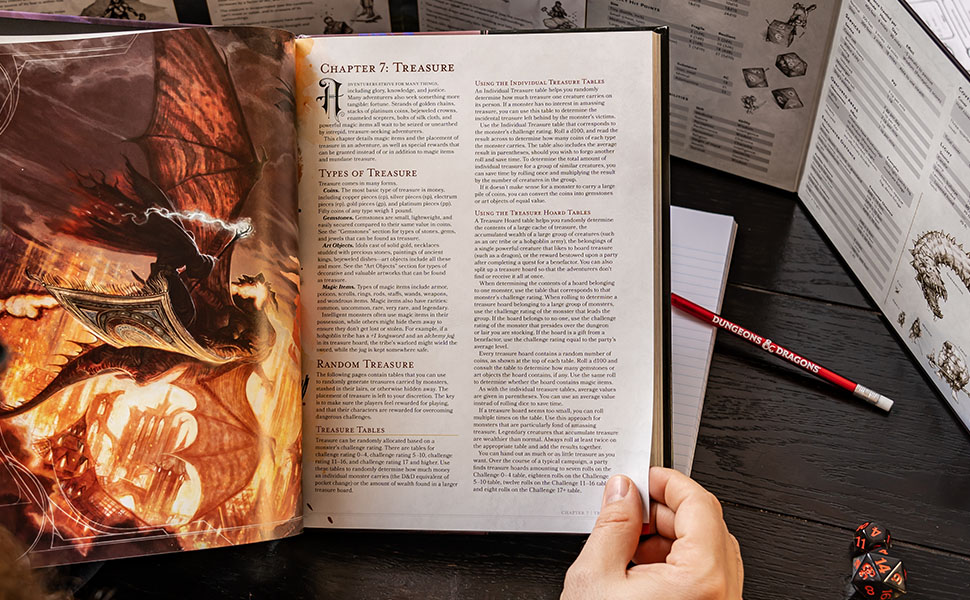
It's a common mistake for newbies to lean into the Dungeon Master's Guide in an effort to learn the game. I think it's weird that Wizards decided to market this as "All you need to run a Dungeons & Dragons game", because the DM's Guide doesn't actually tell you how to play D&D. It contains none of the essential rules. If you're approaching D&D for the first time, you should buy The Player's Handbook. Every single player and DM needs to know about Ch. 7 Using Abilities, Ch. 8 Adventuring, Ch. 9 Combat and Ch. 10 Spellcasting - this is the heart of the game. Once you're comfortable with the basics, you need to start customizing your game with "house rules", optional rules that work well for your group and playstyle. Your game will naturally flow between epic storytelling and gritty tick-tock action. Your players will do inspiring things worthy of reward. You'll sometimes need to ignore the dice, or follow the "Rule of Fun". The Dungeon Master's guide has solid, time-tested advice on all of that and more. Unfortunately all the good stuff is crammed in to Part 3; the DM's guide hasn't changed that much since the original bound AD&D version, including the awkward arrangement of chapters and information. Ch. 3 "Creating Adventures" and Ch. 5 "Adventure Environments" are important reads, and Chapter 8. "Running The Game" is what you think you're getting when you buy this - practical, detailed advice on running a D&D game. I really like Chapter 6 "Between Adventures", which helps you fill in the gaps with careers, philandering, politics and real-estate. All of Part 1 may as well be supplemental. It helps as background material for the official adventure modules, and can help ground your homegrown campaign in some official lore, but it's by no means essential, and you could get bored and discouraged if you tried to learn D&D by slogging through the differences between Arcadia vs Archeron vs Avernus. Save it for later. Chapter 7: Treasure. Ah, treasure. This is the other reason to get this book: it's the best all-in-one official sourcebook for D&D treasure. The stuff of legends. Some of this stuff - Boots of Elvenkind, Bag of Holding, Belt of Giant Strength - has been in the game 30+ years. There's newer treasure as well, and it all feels appropriately quirky and powerful. Old-school DMs have a reputation of granting treasure sparingly, and Chapter 7 has suitably stingy (but useful) random treasure tables, and additional random tables to give each magic item special characteristics - who made it and why, how is it activated, does it have a name? I like to hand-write the magic item's name, characteristics, background and quirky details on a 3x5 index card and hand it to players when they identify it - it makes getting one a little more special. All in all, the Dungeon Master's Guide is an absolute classic, but not an essential classic. You could play for a year before needing to crack it open, and I recommend buying The Player's Handbook and Monster Manual first. But once you've gained some experience as a DM, it provides tons of useful knowledge.
A**Z
I can now truly say that 5th Edition is the best edition yet
With the release of the new DMG completing the core rulebooks of D&D 5th Edition, I can now truly say that 5th Edition is the best edition yet. A real return to looser 1st Edition (and even OD&D) sensibilities after the extreme bureaucratization and accounting fetishization of 3rd Edition, and the extremely overly-gamized 4th Edition (I liked 3rd, but truly HATED 4th.) 5th Edition takes the basic approach of OD&D and Basic D&D, combined with the feel of 1E and the character customization of 3E, streamlined and simplified, with numbers reduced across the board; no more +30-50 to rolls, which make the variable of a roll of a D20 almost trivial, and Armor Class and DCs mostly top out around the low to mid 20s. The only thing to increase is Hit Point totals, but with the lower ACs the amount of hits increases, and the streamlined combat rounds make fights much faster (no more accounting for every second of a six-second combat round; every character gets to move and attack, one Bonus Action and one Reaction, and it plays out swiftly.) One of my favorite additions is Saving Throws for every Ability Score; Strength, Intelligence, and Charisma saves! Great idea! The optional rules ideas in this new DMG are great, from the Sanity Score (right up there alongside Strength and Intelligence, with a corresponding Sanity Saving Throw!) to rules for Injuries and slower healing, which helps deal with one of the few things I didn't like about 5E, the idea that everyone heals to full HP after a long rest (got a broken leg? a good night's sleep will take care of that!) The optional rules for injuries gives good spot rules for long term injuries like broken legs and lost limbs, and the core idea is easily expandable, and is essentially a system I was going to implement myself if the DMG hadn't included it! Magic Items return to much more of a 1E ideal; instead of the Diablo-style menu system of 3E or the "point and click ability" nature of 4E (and the Sword of Sharpness is back!) with the only real difference being that weapon and armor bonuses are reduced to a max of +3 (to fit with the general reduction of modifiers) and magic items are ranked by rarity, from Uncommon to Legendary (Potions of Healing are Uncommon, a Staff of the Magi is Legendary.) This is all in addition to general things required of a D&D DMG, such as rules for constructing buildings, a general tour of the other planes of existence and basic rules for them, and some nice discussions of the ideas behind D&D and the basic assumptions of different styles of campaign, such as a short talk about different subgenres of Fantasy, the general expectations inherent to them, and where the different D&D settings fit into each style (like the Sword & Sorcery genre of Greyhawk and Dark Sun, the Epic Fantasy of the Forgotten Realms, the High Fantasy of DragonLance, and the Dark Fantasy of Ravenloft.) This new DMG, and the new Edition of D&D in total, is a wonderful return to the original looser, more free-wheeling style of D&D, with Dungeon Master judgement and interpretation more important than a specific rule for every tiny possible detail, but all built around a very solid framework. It fulfills every desire I have for a D&D ruleset.
B**W
Everything a newbie DM could ever want to know about being a DM
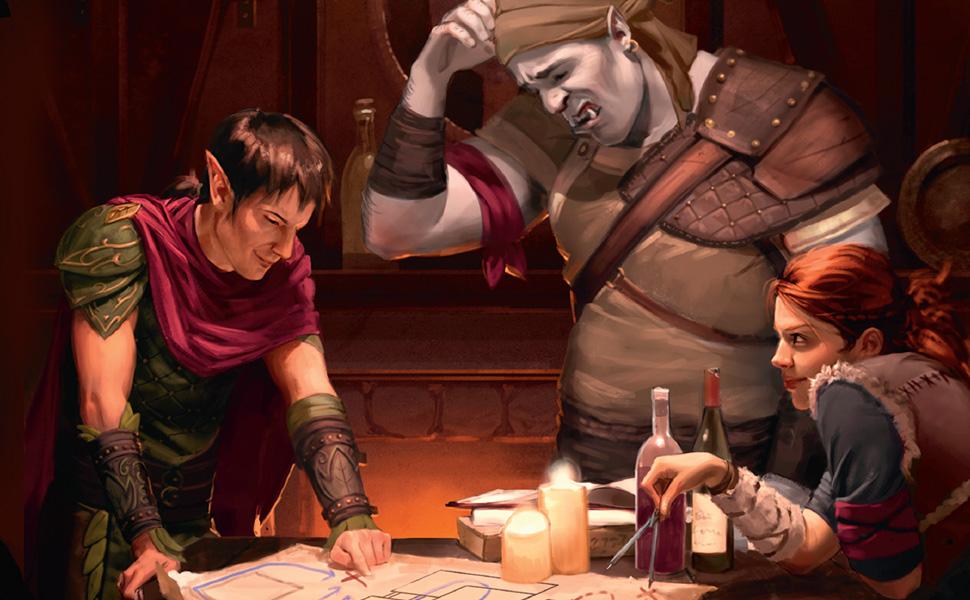
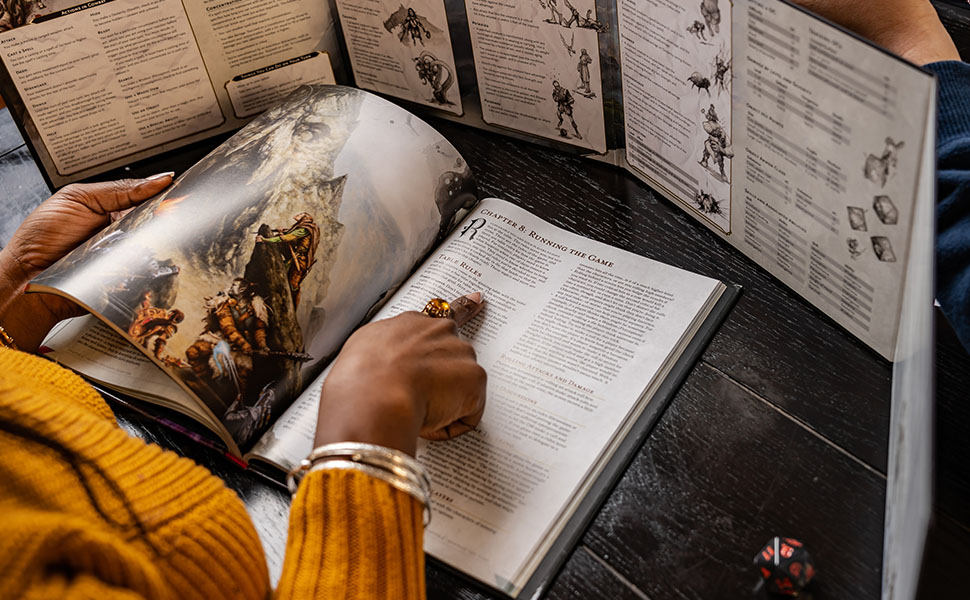
Previously, I wrote a review for the 3.5 edition of the Dungeon Master's Guide for Dungeons and Dragons, and I useful I found it for writing novels. All of that applies to the 5th edition too, but more so. I much prefer this edition as a writing aid. Oh yes, I also find it useful for running a Dungeons and Dragons campaign. This book is split into three main sections, each describing the responsibility of the Dungeon Master in the game. They are "Master of Worlds", "Master of Adventures" and "Master of Rules". The first is for creating the campaign world, the second is for creating the adventure, and the third is a list of rules to help the DM run the scenario, tweak situations to fit the campaign, and a section with advice on homebrewing elements. As a Dungeon Master, I find this book extremely helpful. I have several areas of it bookmarked for easier and quicker reference. One of them is the area for building encounters and managing random encounters. This helped break my previous conception of random encounters, which I picked up from video games. In video games, there is no point to a random encounter other to beatdown on the monsters for some droppable resource (Experience points, money, some form of loot). Then you move on. Not so in a Dungeons and Dragons session, where some groups play for 2-3 hours a week or even less. That can become tedious (as it sometimes happens in video games as well). This area of the book taught me how to make a random encounter more meaningful. There is a "Sylvan Forest" encounter table in here that I merged with another table in the Monster Manual to create the one for the area that my party is currently adventuring in. These "random" encounters provided the seed necessary to create events that are relevant to the here and now of the session. I also bookmarked the area that explains how to create maps for dungeons, settlements and wilderness, as well as adjudicating and describing what your players do in each. Because each area is different, different methods are used for each one. For instance, a dungeon is likely to be traversed room-by-room, as the player-characters check for traps and treasure. The wilderness, by contrast, is more likely to be a more general environment that does not involve the player-characters checking behind each tree or the top of each hill. Unless, of course, they are in a particular section of wilderness that doubles as a dungeon. Also, my players have done a lot of foraging recently so it is useful to have a table that enables me to quickly determine if they find something and how much they find. A third bookmark, of which I currently have seven in total, is a rule variant for chases. In Dungeons and Dragons 5th Edition, all creatures have a set movement speed, which makes chases deterministic and therefore less interesting. This area lists certain rules that can be used to add randomness to this otherwise pre-determined scenario, basically obstacles that both the pursuer and the quarry can run into, which can slow them down. There are also rules for determining when the chase begins, ends, or turns around and makes the hunter the hunted. Oh, I wish I had read this book cover-to-cover when I first started DMing. I thought I knew the rules well enough as a player and that I would do fine by imitating what our group's original DM did, but I didn't do fine. Not in the least. I have several embarrassing sessions under my belt, and this book could have prevented several of them. Particularly the Chase section; especially the Chase section. On another note, there is gorgeous art in this book. This review is mainly about the usefulness of the book for a Dungeon Master (and therefore also a novelist) but I have to mention the gorgeous art. You can see landscapes of everything from mountains and meadows to the Shadowfell or the Elemental Plane of Fire. You get portraits of an adventuring party consulting/drawing a map or in combat with a dragon. Most of the magic items listed in the treasure also get their own images along with their listing. Trickster Eric Novels gives "The Dungeon Master's Guide for D&D 5E" an A+
R**N
Really helped me out to get started DMing
I am new to D&D and after our DM kept changing rules of engagement during combat and changing the physical layout of the world (always to the benefit of our enemies.) I finally buckled down and bought all the essential books. I found these books very informative and after reading them over I had a conversation with him about these glaring issues. He got butt hurt and ended up saying he never wanted to DM, but it was the only way he can ever play. So I read more and ordered a published adventure book to run my own campaign. In conjunction with the players handbook, Monster Manual and the adventure book I have everything I need to DM. I found that none of these books except the published adventures are optional if you are wanting to be as informed as possible as a new player/DM. Some glance over things that the others will go into greater detail. I was told by our old DM that this guide was only useful if you are making your own campaigns and boy do I disagree with that statement (and understand why he is inconsistent and trying to play vicariously through enemy mobs.) It really helped me to understand how to tailor fit the game to the players style, instead of trying to force them into a linear style game. The published adventures do not answer all questions or give you every detail you need and this book can really help to fill in the blanks and get your mind ready to create NPC's at the drop of a hat or alter a quest line because you cannot convince players to take your intended path. Our old DM would basically just force us with environmental factors or massive enemies appearing from thin air to get us to keep to his path. That is not fun for anyone involved. I am really glad that I made this purchase and recommend it to other newer DMs as well. I would warn that veteran DMs may find this to be a bit of common sense. But, who knows you may find some things to challenge your current way of thinking. All I know is I lean more towards this being more useful to the newer guys/gals like myself. Now as for the physical quality of the book! These books are gorgeous. The pages are nice and smooth and I find it easy to read in both high and low light situations. The illustrations seem to give you ideas of how to describe things and capture everyone's imagination. It would seem that they spared no expense for the quality of these books.
W**S
Great Information Found Inside, Just Kind of Hard To Find.
First time buying any table-top RPG source book. Bought this with the Players Handbook. The DMG (Dungeon Masters Guide) has a lot of information which coming into as fresh as I did was overwhelming at first. I don't have many qualms about it other than that and some other small things. Keep in mind that this is more for creating a setting for the game you run then it is for rules, most of which can be found in the PHB(Players Handbook). Pros: *There is a lot of information that is useful in this guide * In depth information of things you might not have thought about such as downtime for players * Information as well as potential suggestions for creating your own world and campaign * Some suggestions and examples of creating items, monsters, spells, and character options * Suggestions and examples of how to run a game (EX: What a strength or wisdom check could be used for) * Artwork is very nice for visual aid Cons: * Some of the information may be overwhelming if you aren't sure where to look. * I love physical books, but a searchable pdf that came with it would be amazing. The index is nice, but ctrl + f is incredibly time saving * Some explanations are often times confusing Every time my group gets together this book is beside me. It is invaluable to me at the moment. As I get more experienced that may change but for the time being I do not regret the purchase. 4-Star explanation: Lack of a searchable pdf is just outright annoying and sometimes you don't quite know the term to look for in the index. Being able to have something to search based of a single word like "money," (which is listed as currency and that is listed under "Creating a world" in the index) is something that would be incredibly beneficial. All-in-all if you are going to get into DnD, whether you played you played before and now want to DM or have ran the starter set and want more to pull from, I recommend the DMG.
O**!
Must-have for DMs and for aspiring ones!
When I bought the Player's Handbook, I was actually looking for this awesome book, and I bought it once it went on sale. And I have to say, it makes my creativity EXPLODE and gives me kickstarting ideas for full campaigns! It is expensive, I admit that. So if you don't necessarily need the in-person book, you should buy it digital and still get the info. My favorite section is the magic items and the table where you can roll for the NAME OF A TAVERN. How cool is that? So yeah, great book, maybe not worth 50 BUCKS, but definitely worth a lot! Get this book in your hands (or in your face) as soon as you can, DMs!
O**.
Original
Not sealed in plastic shrink wrap but it is New and unused. almost 30% cheaper than buying it locally. so i can't complain. Perfectly Good for what it is.
A**D
5e Essiential
The only thing to improve this great guide are tabs.
N**S
Good
Produkten är en bok, vad kan jag säga?
K**N
Auf das wesentliche reduziert - dafür mit dem Fokus auf Gegenstände
Als bisheriger D&D 1st bzw. AD&D-Spieler, den die Edition D&D 3rd und D&D 4th nicht zu einem Wechsel bewegen konnten, war ich entsprechend skeptisch, was die D&D 5th Edition anging. Um es jedoch vorweg zu nehmen - ich bin vom DMG der D&D 5th Edition begeistert. Pro: - Qualitativ hochwertig und robust verarbeitet. - Viele schöne Illustrationen - insbesondere bei den Beschreibungen der Gegenstände - Viele Themen sind - im Vergleich zu AD&D - auf das Wesentliche und Essentielle heruntergebrochen. - Sehr übersichtlich - Es werden (wieder) alle Welten miteinbezogen (inkl. Krynn, Athas (zumindest angesprochen) usw.) und es ist ein verstärkter Fokus auf das AD&D PlaneScape-Setting vorhanden - was mir persönlich am aller Besten gefällt, da ich unter Anderem auch genau deswegen D&D 3rd und D&D 4th abgelehnt habe, bei denen mir dieser Bezug fehlte (Anm. ich habe die Werke (3rd & 4th) nicht auf Punkt&Komma untersucht - aber die gelegentlichen Einblicke waren schon schlimm genug). Neutral: - Einen Mehrwert in diesem Sinne hat das DMG 5th Edition in diesem Sinne (generelles RPG) nicht. Wer also das AD&D-DMG kennt, benötigt dieses nicht unbedingt, um die Grundregeln eines Meisters/Spielleiters und zum Beispiel der Dungeon-Erstellung zu erlernen. Aber man macht auch nichts verkehrt - bekommt man doch als Bonus zumindest ein auf die 5th-Edition optimiertes Auswahlverfahren wie zum Beispiel Wurf-Tabellen für Schätze etc. Kontra: - Konnte ich bisher keines feststellen. Fazit: Das DMG ist wie in D&D 1st oder AD&D kein muss - aber es macht das Leben für einen Meister/Spielleiter oft deutlich einfacher und ist eine Quelle vielerlei Inspiration. Dahingehend hat sich nichts geändert. Was mir persönlich besser gefällt wie in der D&D 1st bzw. AD&D ist die Ausführung der magischen & legendären Gegenstände. Für noch relativ unerfahrene Meister/Spielleiter ist dieses Buch in jedem Fall zu empfehlen und erfahrene Meister/Spielleiter (zu denen ich mich auch zähle) machen sicher nichts falsch, wenn sie darin investieren - ist es doch als Grundlage für Abenteuer in vielerlei Hinsicht sehr nützlich. :) Abschließend sei noch anzumerken, dass man vom DMG keine übermäßigen Regeln erwarten soll. Paragraphenreiter haben meiner Meinung ohnehin nichts beim RPG verloren und stören nur den Spielspaß. Phantasie ist das Zauberwort - und das schließt vor allem das Meistern mit ein. Erfahrene Rollenspieler wissen eines: (angeblich erfahrene) Meister/Spielleiter die ständig nachlesen sind die langweiligsten überhaupt und vermiesen den Spielern lediglich das Spiel. Meister/Spielleiter dürfen bis zu einem gewissen Grad Gott sein. Und genau das spiegelt auch das DMG der D&D 5th Edition wieder. Allein dafür würde ich einen Bonusstern geben - wenn es denn ginge ;).
J**Y
An obvious must have for a GM/DM
You can try to get by with sample rule books and starter guides but this is an absolute tomb of knowledge, that's a must have for anyone who intends to DM/GM for a longer campaign than Lost mines of Phalendelver or Dragons of Stormwreck isle.
Trustpilot
1 week ago
1 week ago