

Desert Online General Trading LLC
Dubai, United Arab Emirates
Desert Online General Trading LLC
Dubai, United Arab Emirates
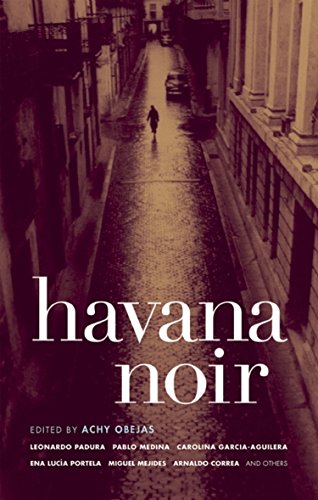
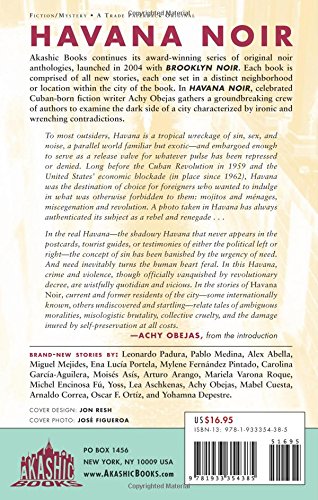
From Publishers Weekly The 17th in Akashic's acclaimed series of original noir anthologies is the first with a non-Anglo setting (the two earlier non-U.S. locales were London and Dublin). The choice to collect Cuban stories was a smart one: it will expose American noir fans to other cultures, and readers interested in those other cultures will get a taste of noir. The authors will be unknown to virtually all American readers, but by and large, they prove themselves as capable of crafting grim and gritty stories of despair and irony as their more familiar counterparts. The standout is Mylene Fernandez Pintado's The Scene, a short but searing portrait of trapped lives. As the unnamed narrator nears the end of his rope, he simultaneously faces eviction from his apartment and the impending death of his elderly mother, for whom he is caring. Pintado succeeds in using the genre without resorting to violence or sex, and this story should send readers in search of her other work, though most of it is available only in Spanish. (Oct.) Copyright © Reed Business Information, a division of Reed Elsevier Inc. All rights reserved. Read more From the Publisher Praise for Havana Noir: Miami Herald, 11/25/07 Sewer-dwelling dwarves who run a black market. An engineer moonlighting as a beautician to make ends meet. Street toughs pondering existentialism. An aging aristocrat with an unsolvable dilemma. A Chinese boy bent on avenging his father's death. These are the characters you will meet in this remarkable collection, the latest edition of an original noir series featuring stories set in a distinct neighborhood of a particular city. Throughout these 18 stories, current and former residents of Havana -- some well-known, some previously undiscovered -- deliver gritty tales of deprivation, depravity, heroic perseverance, revolution and longing in a city mythical and widely misunderstood. This is noir of a different shade and texture, shadowy and malevolent, to be sure, but desperate, too, heartbreakingly wounded, the stories linked more by the acrid pall of a failed but seemingly interminable experiment than by genre. Ambiguities abound, and ingenuity flourishes even as morality evaporates in the daily struggle for self-preservation. In this dark light the best of these stories are also the most disturbing. What For, This Burden by Michel Encinosa Fu, a resident of Havana, is a brutal and wrenching tale of brothers involved in drug deals and child prostitution; they peddle their own sister. The Red Bridge, by Yoss, another Havana resident, depicts a violent incident in the lives of two friends with apparently great potential who, though acutely aware of the depravity of their situation, are powerless or unwilling to extract themselves from the mean streets of El Patio. Cuban engineer Mariela Varona Roque's offering, The Orchid, is a short but powerful tale of the demise of a young boy frequently entrusted to the care of a browbeaten neighbor obsessed with his solitary orchid. Isolation, poverty and despair even in the midst of friends and family, lead to unthinkable cruelty, a common thread in these and other stories. But just as prevalent are resilience, hope, honor and ferocious devotion to the island. Pablo Mendina's Johnny Ventura's Seventh Try centers on the oft-repeated theme of getting to La Yuma, the United States. After six failures a man succeeds in building a boat sturdy enough to safely cross the Straits, only to find himself turning in circles in excruciating angst once out of the water. Alone in a decaying building overlooking the Malecon, a woman in Mylene Fernandez Pintado's The Scene sustains a semblance of quiet elegance for her dying mother. Then she's free but decides to stay on the island rather than join her brother in San Francisco. And in Carolina Garcia-Aguilera's beautifully rendered The Dinner, an elderly gentleman, his wife and a servant who hasn't been paid in 40 years agonize in their crumbling, once elegant mansion, over their inability to find the ingredients for an annual dinner for friends. With faint echoes of The Gift of the Magi and perfectly bridging the pre- and post-revolution days, the story is achingly splendid. Several murder stories, including one about an arrogant serial killer egged on by a woman he phones to brag about his exploits, and a film-noir style piece featuring a San Francisco private eye sent to bring out a thrill-seeking rich kid on the eve of the revolution, round out the collection and justify its place in the series. But if you're looking for slick, moody, detective noir, sunsets, mojitos at La Florida, or dancing girls at La Tropicana, you won't find them in Havana Noir. Along with grit and pluck and the disintegration of structure and values, there is an overarching sadness to these stories as evidenced by perhaps the most disturbing commonality: repeated loveless, disconnected sex, including rape and incest, but more often just mindless, pleasureless consensual copulation, all that's left to fill the time while waiting for something to change. South Florida Sun-Sentinel, 12/2/07 The streets of Havana teem with a diverse, complex people whose wants and needs are often neglected but who are connected by one ideal: to have a good life.In this superb collection of short stories edited by novelist, poet and journalist Achy Obejas, myriad characters show just how far they will go for just a small part of the world and keep their dignity despite, as Obejas says, "the damage inured by self-preservation at all costs."There's the cross-eyed young man whose "affliction" prevents him from getting a job but who finds a kind of refuge with a black market-dealing dwarf. There's a Chinese boy trying to avenge his father. And there's the woman tethered to Cuba by her dying mother.The 18 stories by current and former residents of Havana are gritty, heartbreaking and capture the city. Each story an unflinching look at Havana, giving a sense of hope -- and hopelessness -- for what the city was and is now and could be again.Says Obejas in her introduction, "In the real Havana -- the aphotic Havana that never appears in the postcards, tourist guides, or testimonies of either the political left or right -- the concept of sin has been banished by the urgency of need. And need inevitably turns the human heart feral."This is the kind of keen insight we've come to expect from the Noir anthologies published by Akashic. Each anthology features a different city, such as Baltimore, Miami, San Francisco and others, and acts as a mini-guide to each area. The compressed action, the layered plots and the character studies packed into just a few pages make short stories riveting for me. Those twists at the end a la O. Henry help, too.In The Dinner, by Miami writer Carolina Garcia-Aguilera, an annual meal with old friends becomes a symbol of an elderly man's life. A seafood dinner has the power to transport these friends "back to that time when they actually looked forward to a future." No cost is too great for these precious ingredients.The stiff penalty of freedom and love form Lea Aschkenas' La Coca-Cola Del Olvido.The authors pack a lot of story into a few pages. Mariela Varona Roque's The Orchid is only 4 1/2 pages, yet much power is in this chilling tale. Roque's story is a tome compared to the scant three pages of Yohamna Desprstre's haunting Abikú. Read more See all Editorial Reviews
Trustpilot
3 weeks ago
4 days ago