
DOWNLOAD THE APP


Customer Services
Copyright © 2025 Desertcart Holdings Limited
DOWNLOAD THE APP


🚀 Unlock your creative potential with the ultimate Raspberry Pi 4 starter kit!
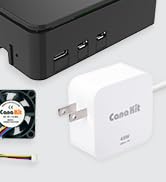
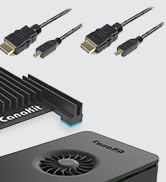
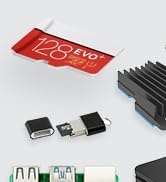
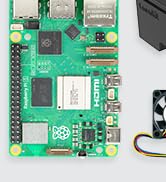
The CanaKit Raspberry Pi 4 2GB Basic Starter Kit bundles a powerful 1.5GHz 64-bit quad-core Raspberry Pi 4 with essential accessories including a premium clear case, active cooling fan, heat sinks, 6-foot micro HDMI cable supporting 4K 60fps, a noise-filtered 3.5A USB-C power supply, and an on/off power switch. Designed for seamless setup and reliable performance, this kit is perfect for professionals and makers looking to prototype, learn, or build high-performance projects with ease.




| ASIN | B07VXBMWQK |
| Best Sellers Rank | #8,487 in Single Board Computers (Computers & Accessories) |
| Customer Reviews | 4.8 4.8 out of 5 stars (2,843) |
| Date First Available | July 30, 2019 |
| Item Weight | 0.01 ounces |
| Item model number | PI4-K104WF-C4-CLR |
| Manufacturer | CanaKit |
| Package Dimensions | 9.69 x 6.1 x 2.24 inches |
S**W
Great kit, but note these specific details
This is a great kit, and the other reviews cover most of the key points. Here is what I would add that isn't covered elsewhere: 1) About the fan complaints -- it's not a big deal. Yeah, you can hear it, it's not whisper quiet, but it's not noisy either. If the room is silent, then you notice it. The moment there is some other noise (music, TV, talking, etc.) the fan dissapears into the background and is forgotten. The fan stays on when the Pi is off. My bigger complaint is that the "logo" shaped opening for the fan is very small, and doesn't seem like it can supply a lot of airflow. Most of the fan is actually blocked by the plastic case, and is not open. However, it doesn't seem to be harmful, as my Pi4 under "normal" heavy CPU usage (installing software, processing images, etc) maxes around 55C, and idles around 45C, just like all my other, older Pis. 2) The kit comes with micro (male)-to-regular (female) HDMI adapters, not full cables. I really like this option, and it's the main reason I got this kit. I often use old VGA displays, and I can plug my HDMI-to-VGA adapters into these adapters. If they had supplied micro-to-normal (male-to-male) HDMI cables, I couldn't do this. So, just be aware. 3) The case is not the most attractive in my opinion, but is very functional. It's a mostly transparent, but somewhat frosted plastic (not totally transparent). The "top" comes off easily (prefect friction fit) to access the GPIO, camera socket, etc., while the Pi remains in the rest of the case. This is nice. Other cases either can't do this without unscrewing something, or the friction fit is way too tight and you break your fingernails trying to open it. 4) There is no "convenient" opening to bring out the camera cable, GPIO connections, etc., in the top of the case. Instead, there is a thin 1mm gap between the top of the case and the body that goes almost all the way around the perimeter when the top is on, and you need to bring the cables out through that 1mm gap all around the sides. This is "functional" but doesn't look pretty. However, maybe this is a good thing for your application, as nothing ever comes out of the top of the case, only the sides, and you have a lot of control over which side it comes out of. 5) The power switch is also a separate adapter. This is nice, because then you can use the power switch on other USB-C cables, or use other power supplies and "give" them a power switch. Again, another reason why I got this kit. 6) I got the 4GB RAM version, because you never know how you might repurpose your Pi later. However, under most normal tasks, I tend to stay well under 2GB (actually, mostly under 1GB, unless running heavier apps). So if your budget is really tight, 2GB would be a way to save some cash without sacrificing anything, I think. With all the other improvements on the Pi4, I would probably stay away from 1GB if you actually want to use those improvements (dual 4k displays, etc.). If you think you'll only ever need 1 GB, you're probably better of just using one of the Pi3B's, or even earlier, unless you have a specific, exact need for a Pi 4 (e.g. headless operation of USB 3 ports, or something equally specific). I tend to use the Pi4 mostly, because of it's speed, to prototype projects that I then later move to old Pi 1's, 2's, or 3's anyway. But the speed improvement (while coding/compiling, web browsing, etc) is noticeable, even over the 3B+ (but it doesn't seem huge vs. the 3B+). 7) When I play MP3's with ANY media player (VLC, gxine, etc.), they are full of click artifacts (a few per second). This hasn't been a problem on my other Pis. I'm guessing this is just some issue with the Pi4 being so new that media software has not been optimized for it yet. I don't listen to music often on my Pi's anyway, so this isn't a huge deal for me. Again, just be aware. 8) It seems way easier to set up some software on the Pi4 (notably CUPS and Samba). You install it and Bam! it's ready to go. I didn't have to babysit it to get it to work right. Maybe that's just due to the new Buster version of Raspbian being better, I don't know. I haven't run Buster on any of my other Pis. I hope this review helps!
J**Y
Excellent single board computer, great teaching tool for robotics
I bought the Canakit Pi 4 Starter Kit (4GB) with the clear case. I also have the Canakit Pi 3 with clear case. The kit is easy to assemble, just be careful with the fan wiring and position it to blow air into the case. All the parts snap together very easily. The fit is secure with no wobbles and take-apart is also easy. The case top is easy to remove for access to GPIO pins. The power supply is rated at 3.5v Amps and I can connect a 1TB NVMe SSD via USB 3 with no issues (it uses USB 3 power from the Pi). Running a 100% CPU load stress test results are shown below - no thermal throttling occurred. I installed NOOBS and ran the full update of Raspian Buster which took a bit of time (depends on internet speed). I was using the home WiFi and the setup detected it with no problems. I installed a few pieces of software like Fritzing and Sysbench, etc., with no issues. I connected Chromium to my Google account and all my bookmarks synced. I installed KeePass 2 (a password manager) and exported my main computer database and imported it with no issues. Browsing YouTube and watching videos is quite acceptable in performance and response. Then I formatted a second MicroSD card with the Full Raspian image using Etcher and installed it just for fun. Boot time is very short and I can copy from my home directory on the Pi to the other SD card via a USB SD reader/writer (for backups). I have not used Ethernet yet, nor the audio port. Pros: Very small, inexpensive, and fast. A complete single board computer that snaps together in minutes. The fan is very quiet and prevents excessive heat from throttling the CPU. If you have used Linux before you will feel right at home. Cons: You will need to make the NOOBS installer on a microSD card separately. The fan connector gets in the way of a GPIO cable connector, so you may want some sort of Fan Shim if this is an issue, or maybe get a fanless cooling case like the Flirc Raspberry Pi 4 Case (I have no experience with that, I just heard good things about it). Flirc case at Amazon: https://www.amazon.com/Flirc-Raspberry-Pi-Case-Silver/dp/B07WG4DW52 ----------------------------------------------------------------------------- Stress test script I used - Canakit case and fan with standard NOOBS install: ---------------------------------------------------------------------------- #!/bin/bash # Stress test CPU # Jim Hurley # version 1.0 # 24 Aug 2019 # to install sysbench: sudo apt-get install sysbench # clear date echo "Starting stress test ..." #stress test the CPU - 4 threads, factor primes up to 25000, 10 times for counter in `seq 1 10` do date echo "Test start" $counter vcgencmd measure_temp # show temperature sysbench --test=cpu --cpu-max-prime=25000 --num-threads=4 run >/dev/null 2>&1 echo "Test done " $counter done echo "... stress test over" echo $date vcgencmd measure_temp =============== output text ============================================================ Sat 24 Aug 2019 06:31:51 PM PDT Starting stress test ... Sat 24 Aug 2019 06:31:51 PM PDT Test start 1 temp=46.0'C Test done 1 Sat 24 Aug 2019 06:33:18 PM PDT Test start 2 temp=59.0'C Test done 2 Sat 24 Aug 2019 06:34:45 PM PDT Test start 3 temp=61.0'C Test done 3 Sat 24 Aug 2019 06:36:12 PM PDT Test start 4 temp=61.0'C Test done 4 Sat 24 Aug 2019 06:37:38 PM PDT Test start 5 temp=62.0'C Test done 5 Sat 24 Aug 2019 06:39:05 PM PDT Test start 6 temp=63.0'C Test done 6 Sat 24 Aug 2019 06:40:32 PM PDT Test start 7 temp=63.0'C Test done 7 Sat 24 Aug 2019 06:41:59 PM PDT Test start 8 temp=64.0'C Test done 8 Sat 24 Aug 2019 06:43:25 PM PDT Test start 9 temp=63.0'C Test done 9 Sat 24 Aug 2019 06:44:52 PM PDT Test start 10 temp=64.0'C Test done 10 ... stress test over temp=63.0'C
D**L
A great little computer
This kit is a very nice Raspberry Pi kit. It comes with almost everything you need to get this thing up and running, you only need to supply a keyboard and mouse, and a memory card. I got this as an upgrade for my older raspberry pi 3b and it is definitely that. Not only does the pi feature USB 3.0 ports, but is a lot faster with it's upgraded CPU. I find that it is really easy to run and booting it was simple. I am using this as a NAS controller, and it is doing a great job at that. I even got windows to run on it as well, with limited usage, of course. This kit has a nice, solid case with a fan that gets put together with no screws, but seems to feel nice and secure and the fan is quiet, but seems to do well and moving air in the case. probably my favorite part of this kit is the small power button addon that is included in the kit. it makes it very easy to turn on/off and reset the device. If you have ever had a pi before, you know the annoyance of having to plug and unplug the device, so it is very helpful. Overall, if you are looking to pick up a raspberry pi, and are looking for something that is mostly a complete kit, I would highly recommend this one,
D**D
My little code cruncher
Bought this years ago, still up and running a server surprisingly. The heat sink and fan that came with it were enough to keep it cool while slamming Ubuntu nonstop, quiet little fan too. Surprised at the quality and speed I got after adding some mods, if you're debating getting one pull the trigger (but I suggest getting the newest version)
E**E
Es wurde ein Stromstecker geliefert, aus dem 2 flache Dinger herausschauen. Keine Ahnung, was das ist. Ich wollte dann einfach ein Netzteil mit passendem Stecker für DE neu kaufen. Aber bei den Angeboten steht was von "Raspberry 4 Modell B". Keine Ahnung, ob das B ist oder was. Total nervig, dieser Kram! Außerdem ist keine SD-Karte dabei (von deren Notwendigkeit ich vorher nichts wusste). Die Produktbezeichnung "Starter-Set" ist irreführend!
A**R
This product is a Birthday gift.
A**Y
I just received the CanaKit Raspberry Pi 4 2GB Basic Starter Kit with Fan (2GB RAM) And followed the instructions but the hdmi screen not turning on ! (keyboard/mouse connected, imaged SD Card, using HDMI 0) I am very disappointed with that first bad impression
Y**G
I bought it a month plus ago, but only had time to tinkle with it now. I set it up and there was power, but it was not able to boot up. Quite disappointed as my 4GB version worked flawlessly. Is there warranty?
B**A
Excellent experience so far..10 days use. It's really living up to the hype, idles at 3.3 watt and jumps to around 6- 10 watts depending on the load (overclocked @ 2.0 ghz) In June 2021 you no longer require SD cards, you can straight away boot off an SSD and you should because SD cards are very expressive and fail within months, getting 290 MB write speed locally and 110 MB download/ upload via network as samba shares. Pi4 dose an excellent job with wireguard, pihole, Plex, emby, jellyfin, samba, transmission but it struggles with 1080p YouTube playback so won't fit as an HTPC or desktop replacement.
Trustpilot
3 weeks ago
1 week ago