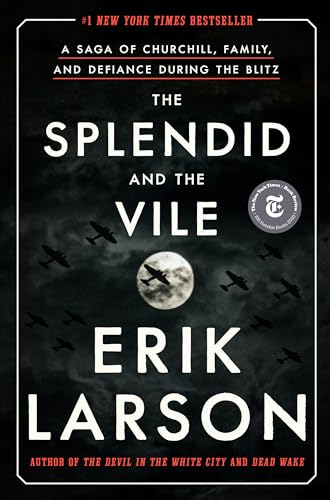


The Splendid and the Vile: A Saga of Churchill, Family, and Defiance During the Blitz [Larson, Erik] on desertcart.com. *FREE* shipping on qualifying offers. The Splendid and the Vile: A Saga of Churchill, Family, and Defiance During the Blitz Review: Character study of Winston Churchill and close associates during the Blitz - Other history books may have covered Winston Churchill's life in more detail, but this one covers a period critical to his legacy, specifically the years 1940 and 1941. Eric Larson's book portrays Churchill's essential leadership during one of Britain's worst trials of WWII, the Blitz. Larson describes the daily battles and personal traumas of England's prime minister. He gives intimate family portraits of Clementine, Churchill's wife, Mary, his daughter, and Randolph, his son. Close associates such as his secretary, security chief, advisers, and friends are all examined, in turn, to provide a complete picture of the atmosphere and community surrounding Churchill. Larson has done extensive research from personal diaries, public documents, and speeches. An intimate character study emerges of a leader whose perhaps most remarkable talent was to get people to believe in themselves. His rousing speeches and displays of confidence steadied a frightened public. German air raids, which killed thousands of British civilians, made people spend perilous nights in bomb shelters under blackout conditions. Throughout the trials of food scarcity, shelter uncertainty, and persistent bombings, Britain held together. Some of the more interesting stories about Churchill had nothing to do with his military acumen but rather his eccentricities. He did not suffer fools, despised people's habit of whistling, and took two baths a day. While bathing, he had his typist near him to record letters. He wore a special sky-blue one-piece suit, which his aides called "his rompers" to provide him with maximum comfort. Churchill was not self-conscious. Larson explores the German leadership from Hitler to Goebbels, Goering, and Hess. He provides the reactions of these men to British war strategies and Churchill's speeches. He covers the burgeoning friendship with President Roosevelt, first established through Roosevelt's charming emissary Harry Hopkins. If you are interested in the personalities behind WWII, you will enjoy this book. Larson has done a masterful job writing a comprehensive and highly readable study of Churchill's wartime life. Review: Excellent Read - There aren’t many writers whose work I enjoy reading as much as Eric Larson. I don’t remember the last time I got through 500 pages in a week. No matter how many stories I hear about that time in history, it is endlessly fascinating.





| Best Sellers Rank | #14,548 in Books ( See Top 100 in Books ) #1 in U.K. Prime Minister Biographies #7 in WWII Biographies #13 in World War II History (Books) |
| Customer Reviews | 4.7 4.7 out of 5 stars (45,327) |
| Dimensions | 6.48 x 1.58 x 9.57 inches |
| Edition | First Edition |
| ISBN-10 | 0385348711 |
| ISBN-13 | 978-0385348713 |
| Item Weight | 2 pounds |
| Language | English |
| Print length | 608 pages |
| Publication date | February 25, 2020 |
| Publisher | Crown |
K**Y
Character study of Winston Churchill and close associates during the Blitz
Other history books may have covered Winston Churchill's life in more detail, but this one covers a period critical to his legacy, specifically the years 1940 and 1941. Eric Larson's book portrays Churchill's essential leadership during one of Britain's worst trials of WWII, the Blitz. Larson describes the daily battles and personal traumas of England's prime minister. He gives intimate family portraits of Clementine, Churchill's wife, Mary, his daughter, and Randolph, his son. Close associates such as his secretary, security chief, advisers, and friends are all examined, in turn, to provide a complete picture of the atmosphere and community surrounding Churchill. Larson has done extensive research from personal diaries, public documents, and speeches. An intimate character study emerges of a leader whose perhaps most remarkable talent was to get people to believe in themselves. His rousing speeches and displays of confidence steadied a frightened public. German air raids, which killed thousands of British civilians, made people spend perilous nights in bomb shelters under blackout conditions. Throughout the trials of food scarcity, shelter uncertainty, and persistent bombings, Britain held together. Some of the more interesting stories about Churchill had nothing to do with his military acumen but rather his eccentricities. He did not suffer fools, despised people's habit of whistling, and took two baths a day. While bathing, he had his typist near him to record letters. He wore a special sky-blue one-piece suit, which his aides called "his rompers" to provide him with maximum comfort. Churchill was not self-conscious. Larson explores the German leadership from Hitler to Goebbels, Goering, and Hess. He provides the reactions of these men to British war strategies and Churchill's speeches. He covers the burgeoning friendship with President Roosevelt, first established through Roosevelt's charming emissary Harry Hopkins. If you are interested in the personalities behind WWII, you will enjoy this book. Larson has done a masterful job writing a comprehensive and highly readable study of Churchill's wartime life.
K**R
Excellent Read
There aren’t many writers whose work I enjoy reading as much as Eric Larson. I don’t remember the last time I got through 500 pages in a week. No matter how many stories I hear about that time in history, it is endlessly fascinating.
P**F
A Man in the Midst of War
This book traces a year, week by week, in the life of Winston Churchill. It begins when Churchill takes the mantle of Prime Minister and shoulders the burden of England’s war effort. As the year progresses, Larson traces the lives of Churchill’s family, closest advisors, and assistants while also keeping an eye on the actions of Goebbels, Goring, and Hitler. A primary focus is the bombing program against London. Larson keeps an eye on the logistics of Churchill’s life as well as those of the British war effort. He also invests a lot of attention toward the personal and social lives of these key players and makes extensive use of personal journals to keep the focus on the human impact of the war. The book helped to explain the development of technologies, ideas, and various conflicts. One thread that I found particularly helpful to trace was America’s involvement in offering aid to Great Britain. While week by week hundreds of civilians are being bombarded and dying, American aloofness must have been agonizing to Churchill and the British populace. Also agonizing must have been the wait for the Lend Lease Act to be passed. This act, which I had only known in name prior to my reading, allowed America to leverage its resources with repayment assured only for damaged property. Larson used the analogy of lending a neighbor a hose when his house is on fire. You don’t sit down and negotiate the terms and cost of hose usage, you give him the hose. Then, if it is burned up in the firefight, you can talk remuneration after the fire has been doused. So too would the Lend Lease Act make some of America’s resources available to our British allies. In reading the book, aside from specific actions on specific days, I didn’t learn much new information about Churchill. A great orator, indefatigable, an embracer of life, a drinker, a man with a temper, stalwart, a bit of an eccentric. Some interesting tidbits were sprinkled throughout such as his proclivity for working from the bathtub and the bed, but no deeper, heretofore unknown depths of character were uncovered. Having read two other books by Larson, Devil in the White City and Thunderstruck, I was glad to find a better organized story in this book. Chronology was clear and themes developed slowly but organically. Overall, I am left with a clearer understanding of Churchill as a man and military leader and a greater appreciation for the human impact of war. In the midst of truly prodigious bombing, the citizens of Great Britain carried on with their lives, withstood, endured. It seemed that every person, in one way or another, paid a terrible price and yet the result was triumph in the face of evil. GRADE: B+
T**K
Great insights into Churchill during the blitz
I loved the book but the printing quality was poor. The insights into Churchill's character as a leader, orator & savy politician were very interesting. He had his faults as it was apparent that he was an alcoholic but he was the right man for the job during WW2. The common people suffered greatly due the night time bombing of numerous cities. The military had little defense against the bombers other than pretty inaccurate AA guns. The UK was lucky that the Nazis turned their attention to invading Russia mid year 1941 and stopped the nighttime bombing and that America entered the war after Pearl. And contrary to popular belief the vast majority of people did not go to the tube and other shelters at night when the sirens sounded in London. As an aside it struck me odd that so many people of wealth continued to go to bars and nightclubs while London was bombed and the city burned around them. Many of the ladies & lords of the UK didn't suffer like the commoners as they all had their peaceful country estates to go to, and the food rationing affected them little. I highly recommend this book.
S**O
A well written, interesting, and complete recount of Churchill’s first year as PM during the war. Erik Larkson goes into lots of very interesting detail, with s splash of humour that the novel enjoyable to read!
J**O
I enjoyed so much to read. It has been a pleasure time to invest in this reading, I personally believe W.Churchill was a true leader that saves England to be defeated.
F**N
May, 1940. Already weakened by failures in Norway, the successful blitzkrieg in Holland and Belgium sounded the death knell for Chamberlain as Prime Minister. Reluctantly King George VI offered the position to Winston Churchill, a man adored by the public although many of his colleagues thought him too erratic for the role. Larson sets out to tell of Churchill’s first year in power: holding British morale together during the Blitz; desperately working to build up British forces to defend against the expected invasion; battling to get America, even if they weren’t willing to put boots on the ground, to at least assist with money and equipment while Britain stood alone against the overpowering forces of the Nazi war machine. Larson is brilliant at bringing historical events to life so that it feels as if the reader is there in the room rather than reading a dry recital of historical facts years afterwards. Here he uses a variety of personal accounts to paint a vivid picture of Churchill through this dramatic period – primarily the diaries of his daughter, Mary, and his private secretary, Jock Colville, supplemented by various letters and memos between Churchill and members of his inner team. Larson also turns to contemporaneous reports in the newspapers and on radio, to show what people knew and how they felt at the time rather than through the lens of hindsight. It’s probably true to say there’s nothing startlingly new in the book, but Larson brings out the drama and emotion of the time without sacrificing factual accuracy and detail. Names from the history books become living, breathing people – Beaverbrook, Lindemann, Goering, Hess, et al – and we see their weaknesses and vanities along with their passion and commitment, whichever side they were on. The use of the word “saga” in the subtitle made me fear this might be too geared towards gossip about Churchill’s family, but in fact we learn just enough about them to get a feel for Churchill as a family man, and through Mary’s diary extracts we also get a picture of how the young upper-classes lived and played during this early part of the war, and how their attitudes changed and hardened as the dark realities of modern air-led warfare became clear. What Larson does so well, though, is to bring the lives of the mass of ordinary working people into the story, not simply as a kind of audience for the great and the good, but as real participants in their own fate. For this, he uses extensively the records of the Mass Observation project, where many volunteer observers kept diaries in which they recorded not just their own lives but their impressions of what was happening in their localities. We see London reeling and terrified after the first air-raids, but the Londoners gradually realising that they were brave enough to take it, and showing the resilience and defiance for which they are remembered. He shows a kind of euphoria developing, and a good deal of sexual licence on display, due to a growing eat, drink and be merry attitude. Larson takes us to Coventry to see the devastating raid there and its aftermath, and his description of this piece of history I already knew well is so vivid that he reduced me to tears and roused my rage anew at this mindless death and destruction. Back with Churchill, we get to know the people in his smallish inner circle and how they interacted. We are critical of all government ministers and of course they should not be above criticism, but we perhaps don’t cut them enough slack for the enormous responsibilities we expect them to deal with on our behalf. Churchill lived a life of comparative luxury, and rationing, which hit the general public hard, didn’t seem to make his table any less lavish, or his brandy to run out. But he worked such long hours his staff were permanently exhausted and he himself became ill (and worked through it), he had to tolerate and soothe the ruffled feelings of those to whom he delegated the impossible while still driving them to get it done yesterday, he regularly put himself in danger to show the public that he understood and shared what they were going through, he had to cajole and flatter the American president endlessly for very little return in the way of practical assistance; and frankly I didn’t begrudge him his smuggled cigars and chocolate, his extensive cellar, his extra meat provided by grateful landowning Dukes, even the money that was raised by supporters to help pay his household expenses. I suspect his poor entourage regularly wanted to beat him over the head with a brick, especially when he would put on records and start dancing round the dining room at 1 a.m. after a twenty-hour working day, but I’m glad they didn’t. Another excellent book from Larson, his trademark blending of historical facts with the personal building to give an intimate and affectionate portrait of Churchill’s personality and daily life as he led Britain through its darkest hour. Highly recommended.
C**A
This is a well told story with some new aspects that I haven't seen before. This is a story that has been told many times, of the events to knock Great Britain out of WW II using air power - The Blitz as it has been described. I've read a good number of books on this topic as well as most of the major sources around Winston Churchill. I was pleased to see a new view of the historic events described from a different perspective with several story arcs tying the facts to what people were experiencing. The story mostly focuses on those close to Churchill with some additional material from diarists and minor embellishment to the facts around some of the many lives lost - much more interesting to get some minor feel for a person than to learn of their death as another number. I enjoyed finding that the title comes from paraphrasing a diarist's entry and it was fun to find it and remember reading their memoirs many years ago. It builds on works previously published, using first source material and keeping the major events in place while adding a new look at some of the more mundane aspects of life to deliver a story that shows the ordinary and extraordinary coexisting against the backdrop of war. The sources, bibliography and index were excellent. Despite the many story arcs presented, I had no problem keeping it straight over the intermittent reading of the story. A very satisfying read.
J**K
チャーチル首相が就任した1940年(昭和15年)から一年間のバトルオブブリテンを主題にしたドキュメンタリー。ヒトラー総統、ゲーリング元帥の元、猛威を振るったドイツ軍にただ一人最後まで抵抗したチャーチル首相。彼は戦争の本質を見抜き、米国を味方に付ければ、その工業力、資源力、そして国民数によってナチスドイツに勝利するとの確信を持っていたのです。翌年の日本軍による真珠湾攻撃の後、時のルーズベルト大統領からの知らせで翌日、米国は日本に宣戦布告をすると聞き、第二次世界大戦の勝利を確信し、喜びを抑えきれぬまま就寝したのです。当時の英政権、ドイツ政権の内情と戦況観が的確に描かれ興味深いです。一方で英国の貴族階級の常軌を逸した行動も描かれ英国王室を見る参考にも成りました。
Trustpilot
2 weeks ago
5 days ago