We remain fully operational. Our teams are working around the clock to ensure your deliveries continue safely.

DOWNLOAD THE APP


Copyright © 2025 Desertcart Holdings Limited
DOWNLOAD THE APP
Buy anything from 5,000+ international stores. One checkout price. No surprise fees. Join 2M+ shoppers on Desertcart.
Desertcart purchases this item on your behalf and handles shipping, customs, and support to KUWAIT.
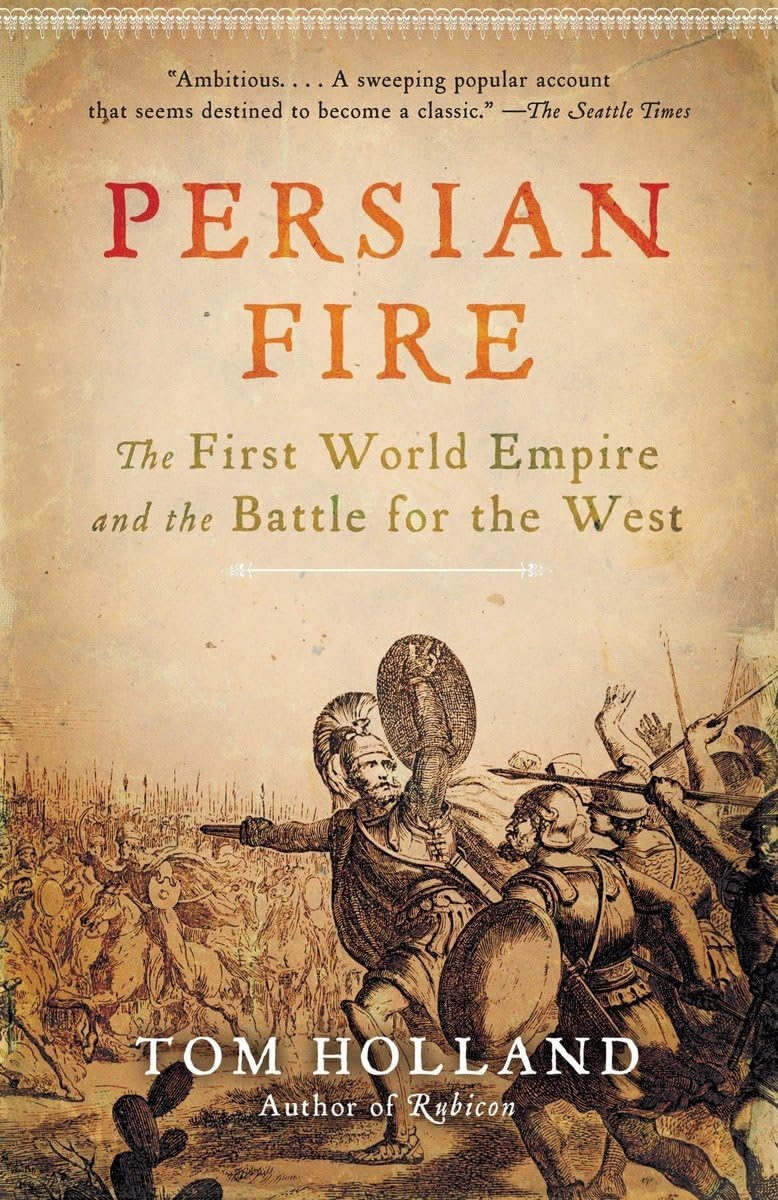
Persian Fire: The First World Empire and the Battle for the West [Holland, Tom] on desertcart.com. *FREE* shipping on qualifying offers. Persian Fire: The First World Empire and the Battle for the West Review: History made fun - Once again, Holland produces another exciting and readable history of the ancient world. This book covers the period of the early 400s BC, although it provides useful background on the Persian empire, Sparta, and Athens. While Holland rightly claims the battle was crucial in preserving Western civilization, he does try to allow the reader into the Persian mind. His introduction highlights the Persian empire's multi-ethnic nature and superpower status, making it somewhat analogous to America (as opposed to the chauvinistic, petty Greeks). One of the things Holland does well is use modern terms to describe ancient politics, making them more accessible to the modern reader. For example, in the introduction he describes the Greeks, from the Persian point of view, as terrorist states. He also accepts that the protagonists on both sides held certain religious/philosophical beliefs that cannot be left out of the narrative. For example, he incorporates the Gods into his story when it is clear Greek soldiers viewed the Gods as a source of woe or fortune. A cautionary note: if you tend to be bored by history, this book is not for you. Some of the other reviewers complained about the abundance of names and dates. However, this is necessary as Holland has a complicated story to tell spanning decades. On the other hand, if you are curious about history but bored by standard history textbooks or more academic pieces, this is a good, readable synthesis of the history. I should also caution that I am only a casual student of history, so I cannot verify that all of the facts in the book are true. Holland probably could not either since records of history during this time are so sketchy anyway. There is legitimate debate over other historical facts. Even if one or two tiny details are historically debatable (and so far as I can tell they are not), this book will hopefully educate more readers about the ancient world and an important war that shaped Western civilization. Review: Holland back and at his finest - Tom Holland scored some major points with Rubicon, a terrific, narrative account of the fall of the Roman Republic. His clear prose, entertaining characterization and solid research and diverse use of sources can be apppreciated by all levels of readers. Holland may not have improved between his two books, but he certainly hasn't lost a step either. In Persian Fire, he recounts the rise of the Persian Empire and the revolutionary changes in Greek life, focusing on the late Archaic age in Sparta and Athens. I'm sure the point has been made before, but I like Holland's insistence that Marathon proved to be the first real test of the democracy of Athens. Holland traces their subsequent rise in prestige and the spread of democracy to this great victory over the hegemonic superpower of Persia. Holland's narrative is sleek, the various Athenian factions are (thankfully) clarified and the representation of the Persians is quite good. He tends to over-do his comparisons to the contemporary world, but overall, Holland treats my favorite historical event with his unique touch and has written a wonderfully accessible account of a stodgy, academic conflict. Well done, Tom.

| Best Sellers Rank | #50,664 in Books ( See Top 100 in Books ) #9 in Ancient Greek History (Books) #13 in Iran History #48 in History of Civilization & Culture |
| Customer Reviews | 4.6 out of 5 stars 2,004 Reviews |
A**D
History made fun
Once again, Holland produces another exciting and readable history of the ancient world. This book covers the period of the early 400s BC, although it provides useful background on the Persian empire, Sparta, and Athens. While Holland rightly claims the battle was crucial in preserving Western civilization, he does try to allow the reader into the Persian mind. His introduction highlights the Persian empire's multi-ethnic nature and superpower status, making it somewhat analogous to America (as opposed to the chauvinistic, petty Greeks). One of the things Holland does well is use modern terms to describe ancient politics, making them more accessible to the modern reader. For example, in the introduction he describes the Greeks, from the Persian point of view, as terrorist states. He also accepts that the protagonists on both sides held certain religious/philosophical beliefs that cannot be left out of the narrative. For example, he incorporates the Gods into his story when it is clear Greek soldiers viewed the Gods as a source of woe or fortune. A cautionary note: if you tend to be bored by history, this book is not for you. Some of the other reviewers complained about the abundance of names and dates. However, this is necessary as Holland has a complicated story to tell spanning decades. On the other hand, if you are curious about history but bored by standard history textbooks or more academic pieces, this is a good, readable synthesis of the history. I should also caution that I am only a casual student of history, so I cannot verify that all of the facts in the book are true. Holland probably could not either since records of history during this time are so sketchy anyway. There is legitimate debate over other historical facts. Even if one or two tiny details are historically debatable (and so far as I can tell they are not), this book will hopefully educate more readers about the ancient world and an important war that shaped Western civilization.
R**T
Holland back and at his finest
Tom Holland scored some major points with Rubicon, a terrific, narrative account of the fall of the Roman Republic. His clear prose, entertaining characterization and solid research and diverse use of sources can be apppreciated by all levels of readers. Holland may not have improved between his two books, but he certainly hasn't lost a step either. In Persian Fire, he recounts the rise of the Persian Empire and the revolutionary changes in Greek life, focusing on the late Archaic age in Sparta and Athens. I'm sure the point has been made before, but I like Holland's insistence that Marathon proved to be the first real test of the democracy of Athens. Holland traces their subsequent rise in prestige and the spread of democracy to this great victory over the hegemonic superpower of Persia. Holland's narrative is sleek, the various Athenian factions are (thankfully) clarified and the representation of the Persians is quite good. He tends to over-do his comparisons to the contemporary world, but overall, Holland treats my favorite historical event with his unique touch and has written a wonderfully accessible account of a stodgy, academic conflict. Well done, Tom.
S**O
Though a poor example of popular history, it covers the subject
A word of warning to readers of fiction who want to try popular history: This is not a good sample. Even as an experienced reader of history, I had to occasionally slow down and repeat a sentence to comprehend it. Why? PERSIAN FIRE has an overabundance of long awkwardly constructed sentences. And it is verbose. I understand that ancient history presents a problem. Because source materials are scant, how can an author fill up enough pages to make a publishable book? Still, I prefer a short book that is to the point, over a long one with decorative words that clutter the mind. Unfortunately I cannot recommend something that is easier to read and equally informative of the subject. But if you can sift through Tom Holland's ostentatious prose, you will take home some shiny baubles. The three main characters are not persons, they are states: Persia, Sparta, and Athens, chronicled from birth to maturity. From the white horses and Great King Xerxes of Persia, to the polished shields and King Leonides of Sparta, to Themistocles and the democratic people of Athens--this is a variegated, fleshed-out epic. You have probably already heard at least a little about two of this story's legendary fields of play: Marathon and Thermopylae. Now Mr. Holland can invigorate you with the details. For extras, he provides an ample selection of photos, plenty of footnotes, and a long bibliography. His maps are tight with the text, though for quick reference you may want to paperclip the page with the "List of Maps." This can be a rewarding book for the determined reader. But unless you are specifically interested in the Greco-Persian wars, popular history is better exemplified by other works. I mean works that are easier to read. You could try something by David McCullough, Robert K. Massie, or Barbara W. Tuchman. Less reputable but even easier to read are works by John Toland, Stephen E. Ambrose, and Diana Preston. PERSIAN FIRE proves that a good subject is not enough for five stars, which I would have awarded if the style had been simpler and more humble.
A**R
easy to read
I was looking for an easy read for the greco persian wars, and this certainly was it. I struggled with herodotus, but this like a simpler version. So I can highly recommend it!
D**N
A Classic Clash of Civilizations.
The writer Tom Holland has just published a translation of "The Histories of Herodotus" which tells of the build up and invasion of Greece in 480 BC. "Persian Fire" might be considered a prologue to that epic tale. But it is more substantial than that. It gives a clear and complex description of the (currently named) Middle East from the Asiatic perspective. The period covered is from the late 7th century to the invasion and its strength is that it is primarily written from the Eastern point of view. From the Assyrian Empire to the emergence of the Persians and the spread of their empire it's an engaging mosaic that makes absolute sense of why the Greeks incurred the wrath of the Persians and why the war erupted. Only then does Holland let loose the details of the threat to Athens and Sparta, the events that shaped Marathon and the battle of Salamis and the final victory against massive Persian forces at Platea. This is epic history told by a fine scholar with the gifts of a novelist. Among the best reads of the subject that you will find. Highly recommended. I read the book on a Greek island overlooking the strip of Turkey that was once the Greek settlement of Ionia where much of the action is played out.
J**Z
it was that good. This is far and above one of the ...
I have read a large number of books regarding the Greco-Persian Wars and was quite hesitant to purchase yet another. Half way through the book I wanted to start it anew, it was that good. This is far and above one of the best books on the subject. There are a number of books that focus on a specific battle such as Marathon, Thermopylae, and Salamis and provide far greater detail. This book manages to provide a good level of detail without getting bogged down by minutia. Why is this so good... Holland is a master story teller; the gripping narrative leaves me wanting more after every chapter. In addition to the expert narrative the most important aspect of this book that made it so great were fascinating historical details I have rarely read in other accounts. From the background of the Spartan and Athenian city states through key events such as the Ionian Revolt, I constantly learned new facts told in a way that makes you put the book down for a moment and ponder what you have just read. I have added Holland to a short list of writers that I will follow closely and likely read his remaining books.
S**Y
Well Presented Historical Narrative
I picked up this novel after reading Holland's Rubicon, due partly to my preference for the author's narrative style of presenting history, and partly due to the intriguing subject matter. Much has been written of the Greco-Persian War, but almost exclusively from the Greek perspective. While this may be partially due to a pro-Western bias, it is at least partly due to the fact that there are virtually no Persian sources from the period. Almost everything we know of the early Persians comes from the writings of their enemies, most especially Greek historian Herodotus. Imagine the Nazis winning World War II and writing its history. The Allies might not come off looking so good. In any event, Holland has tried to write a more balanced history, while still being hamstrung by the lack of primary sources. He has probably done as good a job as could be expected, though there comes a point where educated opinion devolves into mere conjecture. To his credit, Holland does a good job pointing out where many of these instances occur. The history begins with a brief recap of Mesopotamian empires, beginning with Sargon, through Akkad, the Assyrians and into the brief ascendancy of the Medes. The Persians are then identified as they burst onto the scene through the brilliant career of Cyrus in the sixth century B.C. Once the story turns to the Greeks, primarily Sparta and Athens, Holland enters well trodden ground. However, despite having read numerous accounts of the period and its events, Holland has a way of presenting well known history in a new and interesting light. He succeeded in doing so with respect to the end of the Roman Republic in Rubicon and he does so here when presenting the Greco-Persian conflicts. Whether you are a well read student of the era, or a newcomer, I can highly recommend Persian Fire and other historical works by this author.
J**.
Readable popular history
I was pleasantly surprised by this book. Already being quite familiar with the Persian Wars, I expected just a light diversion retelling some favorite tales, but Holland does a remarkable job synthesizing Greek and Persian sources with archeological data to create a portrait of both sides of these famous wars. The portions on the Greek perspective, while well-written and engaging, relate nothing an educated reader doesn't already know, but the portions on the Persian perspective are fascinating.
Trustpilot
1 month ago
1 week ago