
DOWNLOAD THE APP


Customer Services
Copyright © 2025 Desertcart Holdings Limited
DOWNLOAD THE APP
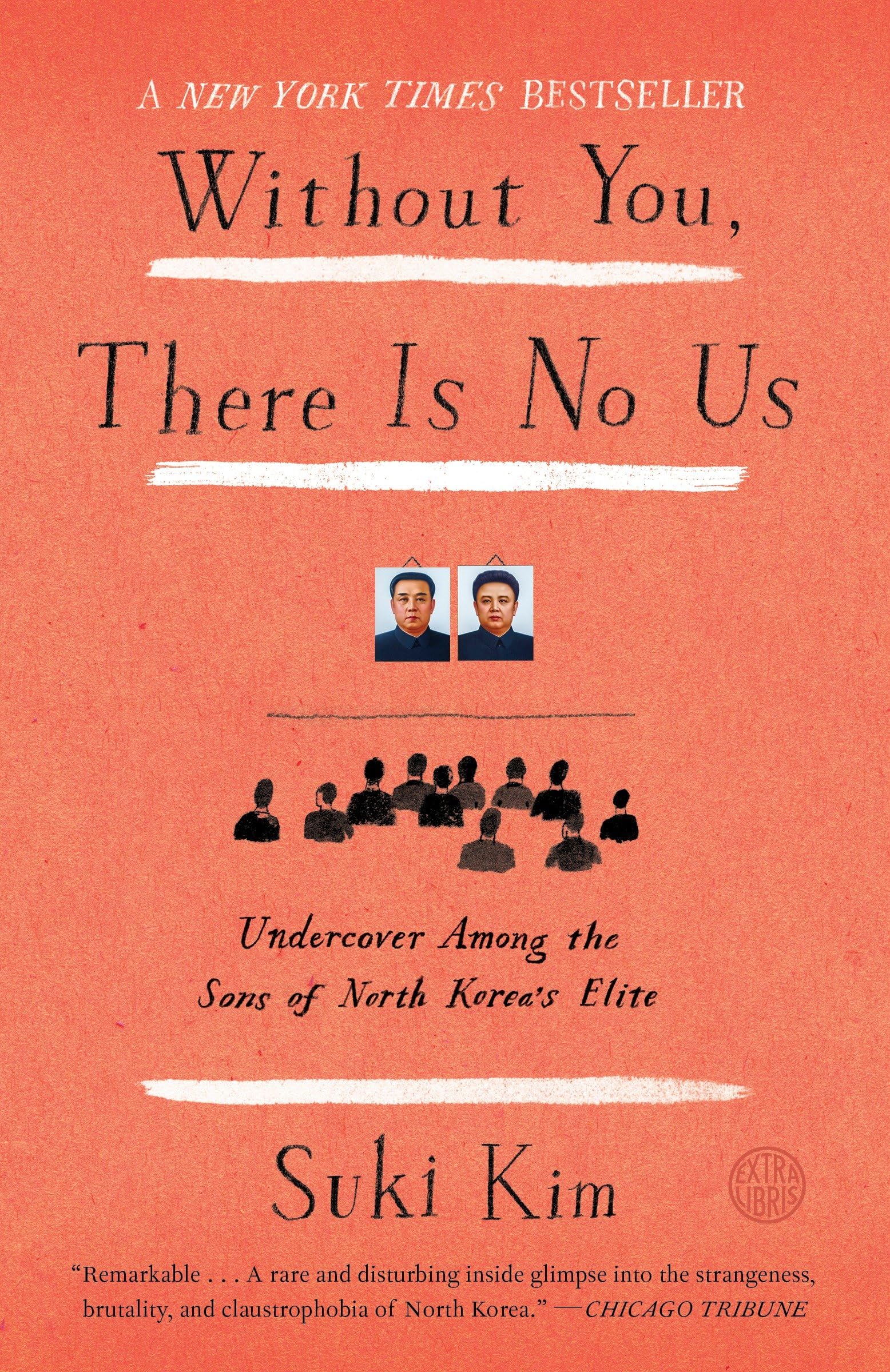
Without You, There Is No Us: Undercover Among the Sons of North Korea's Elite [Kim, Suki] on desertcart.com. *FREE* shipping on qualifying offers. Without You, There Is No Us: Undercover Among the Sons of North Korea's Elite Review: the “You” is the Great Leader Kim Jong-Il and the “Us” is the North ... - I posted this review on my website. It can be accessed here: http://arthurreber.com/home/suki-kims-book-on-teaching-in-north-korea.html along with views on a host of topics. ------------------------------------------------------------------------------------- The book chronicles her months teaching at a college in North Korea run (and financed) by fundamentalist Christians. While this seems wildly implausible there’s a strange logic behind it. Their church paid for the construction of the campus and provides the operating budget, the equipment and the teachers. They do not proselytize (or they would be quickly removed). They teach. They believe that North Korea is the next country that God plans to free from state-imposed atheism and they want to be there to be ready to spread the word of Jesus when this happens. They run a similar school in China. They are patient. Kim was hired to teach English by gently disguising her agnosticism. The title is from a song sung repeatedly by her students, the “You” is the Great Leader Kim Jong-Il and the “Us” is the North Korean people. Kim gives a remarkable, chilling insight into the black collectivist pit that is North Korea. It’s important to step back from Kim’s descriptions of her months teaching English there and appreciate, fully and depressingly, that her students and the stunted, impoverished, intellectually diminished lives they lead are, in fact, the sons of the elite. These are the future leaders of this backward land and, as she deftly chronicles, will come into positions of power and influence knowing virtually nothing. It isn’t possible to convey the complex interlocking relationships Kim forms with her students in a simple essay. They’re marked by efforts to reach out constrained by a self-censoring. She cannot tell them too much about the outside world, it could be dangerous — to them. If they were to learn that they live as virtual prisoners in the most backward, impoverished country on the planet it would not go well for them. She cannot let them know that their “Intranet” which only links to local servers, is not the real “Internet.” They do not know and must not learn that the highways in other countries actually have many cars travelling on them, that markets are filled with fresh vegetables and fruits, that libraries exist where you can choose which book you wish to read. She also must protect herself from prying eyes. She is accompanied by “monitors” wherever she goes. Her emails are read. All her letters are opened before posting. All the rooms have bugs. All her lessons must be cleared by “counterparts.” And, of course, she must also take care not to let her devout, occasionally fanatical Christian colleagues know of her true beliefs. The stress is crushing. Kim is vulnerable in an oddly charming way. Some of her revelations about her insecurities and longings and unfulfilled relationships are cringe-worthy but ultimately they complete the picture: complex person, strong and resilient when she needs to be and, at other times, anything but. But at the core is the very existence of North Korea and the life its citizens not only cannot escape from but do not, cannot, fully grasp what it is they live in. The focus is on her students all of whom are young men nineteen and twenty years old who have been sent to this college to learn — in her classes, English. They are the sons of the elite and are taking advantage of the largess of the Christian fundamentalists who are paying for everything, a significant factor in a land of crushing poverty. A couple of things popped out at me. For one, there was an intriguing, almost paradoxical self-centered element that emerged around exam time when several of her students did not do well. Suddenly the collectivist ideals, the group mentality that marked everything they did vanished and in swept a singular focus on themselves, on the impact these grades might have on their future, what university they might be admitted to, what level of Party involvement they may be offered. Earlier they were one, a collective fully conscious of and part of an oddly functional homo Gestalt. They dressed alike, sang, marched and ran in groups, worked together and, as Kim discovered to her surprise, would never even come to office hours without a least one friend in tow. Yet they were, at the same time, intensely competitive and when exam time arrived, they became individuals. Oddly, neither they nor Kim seem to appreciate this disconnect. There’s also an odd acceptance of Americans as teachers, revered for their knowledge, treated with great respect and almost always referred to as “Professor.” Yet they are raised to view America as the Great Satan, the obscene embodiment of capitalism, the nurturer of wars and their eternal enemy. Daily they are bombarded with speeches, songs, news programs all repeating a litany of the evilness of America and its values, which they dutifully parrot back. Yet, they welcome Americans as respected teachers whose opinions they probe for, whose language they strive to learn, whose knowledge they seek and whose trust they long for. Kim also describes her students as inveterate liars. They lie about everything. They tell tales of spending the weekend with their parents when she knows they are never permitted to leave the college grounds. They talk of having visited other cities when they clearly reveal that they do not know where they are. They tell of trips to China or London which are not possible. A favorite prevarication is the claim that they had been offered a scholarship to a famous university (in Singapore, Beijing or even Oxford) but they turned it down to stay at their current school in Pyongyang. When she pushes at these little fibs they use a device they’re quite fond of — they say, “let’s change the topic now and talk about something else.” Kim wonders if this repeated twisting of the truth might not come from being raised in a society where they are lied to all the time by everyone, especially the government. This might be part of it but more likely it’s just a feeble effort at self-aggrandizing. Her young charges seem astonishingly credulous. They appear to accept at face value the most preposterous stories about their “powerful and prosperous” country which is the envy of the rest of the world and whose “Great Leader” accomplishes near miracles on a daily basis. If they do question this touted magnificence they cover themselves well. When the Great Leader Kim Jong-Il dies they are stricken speechless. They weep uncontrollably and stare hopelessly at the horizons. Their pain feels real. The picture painted of North Korea is depressing beyond imagining. All of Kim’s experiences are with the favored elite in a select college but it is nightmarish — no heat, blackouts constantly, thin soups and wilted vegetables for meals, total control of all movements, forced labor at duties like guarding shrines, cleaning, weeding, construction, regular indoctrination sessions and endless hours at Juche, the virtual religion based on the life and deeds of godheads Kim Il-Sung and Kim Jong-Il. Her only glimpses of the typical citizens are on road trips outside Pongyang. Though these are tightly scripted and controlled she cannot be kept from seeing the shrunken, wizened, starving poor trudging along empty highways, carrying empty bags and looking like the damned in a cheap horror movie. On these trips they often come upon small groups of people sitting in the middle of a highway sharing food. There is so little traffic that these wide, smooth roads have become a place to gather. The photo shows the Korean peninsula at night. The single dot of light is the capital Pongyang. The row of lights to the north are in China, along the border. At one point Kim decides to bake her students a chocolate cake and finds that she cannot find the ingredients even at the most upscale markets (which she is only allowed to enter when on an official trip with “minders” alongside her every step). There is no cake flour, no fresh currants or raisins and, of course, no chocolate to be had. If nothing else the powers that run North Korea have found the way to keep a totalitarian state from being overthrown from within. There can be no revolution if the people truly believe that they are living in the most prosperous and successful country in the world, that their land is the envy of every other, that their Leader is revered and worshipped everywhere, that their kimchi is better than any other food and that in every country around the globe people strive to try to make a kimchi like that they are served every day — along with a watery soup, a few rancid vegetables and, perhaps once a week, a few slices of gristle and fat that once sat on the hind quarters of a pig. Kim comes to love her charges and she should. They are fascinating, engaging, smart, caring and loving. But the gap between where they are, what they know, what they believe, what they hope for and the reality that lies beyond the borders of this strange country where some twenty-seven million souls live in a beautiful, mountainous land is so vast that it cannot be bridged. Every once in a while a glimmer in a student’s eye tells her that he has grasped a sliver of truth about their fate and a tiny flicker of understanding about what is out there but it fades quickly, to be replaced by a robotic assurance that their lives are the best that could ever be hoped for. If these walls ever come down, if this government ever collapses the rubble that the world will find strewn across the land will be terrible. It could take a generation to recover from it. Review: A must-read for people curious about North Korea - This is an excellent and unique perspective on North Korea. The author, Kim, is an American woman of Korean descent who, despite being non-religious, joins a Christian-run university on the outskirts of Pyongyang -- the only foreign-run university in North Korea, and works as a teacher of English there. I appreciate that this book does not delve too deeply into well-known facts about North Korea, but rather provides fresh new insights into an admittedly narrow slice of the population : the sons of the elite. Kim maintains a level head, neither glamorizing nor belittling her charges, but portraying them as the complex individuals they are. The reader begins to feel the same affection and concern for the students as Kim did. Her experience is also enriched by being a woman of Korean descent, who speaks Korean fluently. This is incredibly rare among novels about North Korea written in English (except those written by defectors, which then suffer from translation issues as they are nearly always written in Korean first). As a genuine native speaker of both Korean and English, Kim's novel is both an enjoyable read and also provides important cultural context, clearly delineating between DPRK-specific curiosities and things which are simply part of Korean culture (such as respect for teachers). I appreciated her explanation of how the Korean language is spoken differently in the North, and it is obvious that speaking fluent Korean made her insights much richer -- there are no "The sign was written in bright red letters" or "The old woman appeared to be asking a question" instances in this book because Kim understands exactly what is written on the signs and what people are saying to her, even if her university requires she only speak English. A point where she does communicate with her students in Korean is particularly poignant as a result. Her status as an ethnic Korean is also helpful to her, in that she is invited to certain events which other non-Korean teachers (even those fluent in Korean) are not. It also seems her students opened up much more to her due to feeling more comfortable with a "fellow Korean", though when political tensions necessitate anti-US vitriol, the students did seem to view her as "American" as well. I would detract 1 star for two issues with the novel: first, the time spent pining for her "lover" back in New York, who frankly sounds like a not very caring or sensitive fellow, but more of a friend with benefits. Kim defends his decision on her website, arguing that she wanted to "humanize" herself by showing her need for relationships and contact with the outside, but if that is the case, it seems almost any other contact -- a genuine significant other, a college friend, a sister or cousin -- would have been more impactful. I just found myself feeling sorry for her that she was pining for a guy who seems disinterested in her. The second and perhaps larger issue is her running theme of equating Christians with adherents to the DPRK regime. I understand where she is coming from. I am not a religious person. The parallels are clearly there. But it struck me as a bit hyperbolic. She is also openly antagonistic to one of the "true" Christian teachers at one point. Perhaps it was a result of the stress of being in a tense living situation for too long. But by belittling Christians, the author runs the risk of alienating many of her potential readers (namely, Korean-Americans and Americans in general). It seems it would have been sufficient to state that she was not a religious person.


| Best Sellers Rank | #146,381 in Books ( See Top 100 in Books ) #15 in North Korean History #103 in Asian Politics #3,200 in Memoirs (Books) |
| Customer Reviews | 4.2 4.2 out of 5 stars (4,189) |
| Dimensions | 5.18 x 0.71 x 7.98 inches |
| Edition | Illustrated |
| ISBN-10 | 0307720667 |
| ISBN-13 | 978-0307720665 |
| Item Weight | 2.31 pounds |
| Language | English |
| Print length | 320 pages |
| Publication date | October 13, 2015 |
| Publisher | Crown |
A**R
the “You” is the Great Leader Kim Jong-Il and the “Us” is the North ...
I posted this review on my website. It can be accessed here: http://arthurreber.com/home/suki-kims-book-on-teaching-in-north-korea.html along with views on a host of topics. ------------------------------------------------------------------------------------- The book chronicles her months teaching at a college in North Korea run (and financed) by fundamentalist Christians. While this seems wildly implausible there’s a strange logic behind it. Their church paid for the construction of the campus and provides the operating budget, the equipment and the teachers. They do not proselytize (or they would be quickly removed). They teach. They believe that North Korea is the next country that God plans to free from state-imposed atheism and they want to be there to be ready to spread the word of Jesus when this happens. They run a similar school in China. They are patient. Kim was hired to teach English by gently disguising her agnosticism. The title is from a song sung repeatedly by her students, the “You” is the Great Leader Kim Jong-Il and the “Us” is the North Korean people. Kim gives a remarkable, chilling insight into the black collectivist pit that is North Korea. It’s important to step back from Kim’s descriptions of her months teaching English there and appreciate, fully and depressingly, that her students and the stunted, impoverished, intellectually diminished lives they lead are, in fact, the sons of the elite. These are the future leaders of this backward land and, as she deftly chronicles, will come into positions of power and influence knowing virtually nothing. It isn’t possible to convey the complex interlocking relationships Kim forms with her students in a simple essay. They’re marked by efforts to reach out constrained by a self-censoring. She cannot tell them too much about the outside world, it could be dangerous — to them. If they were to learn that they live as virtual prisoners in the most backward, impoverished country on the planet it would not go well for them. She cannot let them know that their “Intranet” which only links to local servers, is not the real “Internet.” They do not know and must not learn that the highways in other countries actually have many cars travelling on them, that markets are filled with fresh vegetables and fruits, that libraries exist where you can choose which book you wish to read. She also must protect herself from prying eyes. She is accompanied by “monitors” wherever she goes. Her emails are read. All her letters are opened before posting. All the rooms have bugs. All her lessons must be cleared by “counterparts.” And, of course, she must also take care not to let her devout, occasionally fanatical Christian colleagues know of her true beliefs. The stress is crushing. Kim is vulnerable in an oddly charming way. Some of her revelations about her insecurities and longings and unfulfilled relationships are cringe-worthy but ultimately they complete the picture: complex person, strong and resilient when she needs to be and, at other times, anything but. But at the core is the very existence of North Korea and the life its citizens not only cannot escape from but do not, cannot, fully grasp what it is they live in. The focus is on her students all of whom are young men nineteen and twenty years old who have been sent to this college to learn — in her classes, English. They are the sons of the elite and are taking advantage of the largess of the Christian fundamentalists who are paying for everything, a significant factor in a land of crushing poverty. A couple of things popped out at me. For one, there was an intriguing, almost paradoxical self-centered element that emerged around exam time when several of her students did not do well. Suddenly the collectivist ideals, the group mentality that marked everything they did vanished and in swept a singular focus on themselves, on the impact these grades might have on their future, what university they might be admitted to, what level of Party involvement they may be offered. Earlier they were one, a collective fully conscious of and part of an oddly functional homo Gestalt. They dressed alike, sang, marched and ran in groups, worked together and, as Kim discovered to her surprise, would never even come to office hours without a least one friend in tow. Yet they were, at the same time, intensely competitive and when exam time arrived, they became individuals. Oddly, neither they nor Kim seem to appreciate this disconnect. There’s also an odd acceptance of Americans as teachers, revered for their knowledge, treated with great respect and almost always referred to as “Professor.” Yet they are raised to view America as the Great Satan, the obscene embodiment of capitalism, the nurturer of wars and their eternal enemy. Daily they are bombarded with speeches, songs, news programs all repeating a litany of the evilness of America and its values, which they dutifully parrot back. Yet, they welcome Americans as respected teachers whose opinions they probe for, whose language they strive to learn, whose knowledge they seek and whose trust they long for. Kim also describes her students as inveterate liars. They lie about everything. They tell tales of spending the weekend with their parents when she knows they are never permitted to leave the college grounds. They talk of having visited other cities when they clearly reveal that they do not know where they are. They tell of trips to China or London which are not possible. A favorite prevarication is the claim that they had been offered a scholarship to a famous university (in Singapore, Beijing or even Oxford) but they turned it down to stay at their current school in Pyongyang. When she pushes at these little fibs they use a device they’re quite fond of — they say, “let’s change the topic now and talk about something else.” Kim wonders if this repeated twisting of the truth might not come from being raised in a society where they are lied to all the time by everyone, especially the government. This might be part of it but more likely it’s just a feeble effort at self-aggrandizing. Her young charges seem astonishingly credulous. They appear to accept at face value the most preposterous stories about their “powerful and prosperous” country which is the envy of the rest of the world and whose “Great Leader” accomplishes near miracles on a daily basis. If they do question this touted magnificence they cover themselves well. When the Great Leader Kim Jong-Il dies they are stricken speechless. They weep uncontrollably and stare hopelessly at the horizons. Their pain feels real. The picture painted of North Korea is depressing beyond imagining. All of Kim’s experiences are with the favored elite in a select college but it is nightmarish — no heat, blackouts constantly, thin soups and wilted vegetables for meals, total control of all movements, forced labor at duties like guarding shrines, cleaning, weeding, construction, regular indoctrination sessions and endless hours at Juche, the virtual religion based on the life and deeds of godheads Kim Il-Sung and Kim Jong-Il. Her only glimpses of the typical citizens are on road trips outside Pongyang. Though these are tightly scripted and controlled she cannot be kept from seeing the shrunken, wizened, starving poor trudging along empty highways, carrying empty bags and looking like the damned in a cheap horror movie. On these trips they often come upon small groups of people sitting in the middle of a highway sharing food. There is so little traffic that these wide, smooth roads have become a place to gather. The photo shows the Korean peninsula at night. The single dot of light is the capital Pongyang. The row of lights to the north are in China, along the border. At one point Kim decides to bake her students a chocolate cake and finds that she cannot find the ingredients even at the most upscale markets (which she is only allowed to enter when on an official trip with “minders” alongside her every step). There is no cake flour, no fresh currants or raisins and, of course, no chocolate to be had. If nothing else the powers that run North Korea have found the way to keep a totalitarian state from being overthrown from within. There can be no revolution if the people truly believe that they are living in the most prosperous and successful country in the world, that their land is the envy of every other, that their Leader is revered and worshipped everywhere, that their kimchi is better than any other food and that in every country around the globe people strive to try to make a kimchi like that they are served every day — along with a watery soup, a few rancid vegetables and, perhaps once a week, a few slices of gristle and fat that once sat on the hind quarters of a pig. Kim comes to love her charges and she should. They are fascinating, engaging, smart, caring and loving. But the gap between where they are, what they know, what they believe, what they hope for and the reality that lies beyond the borders of this strange country where some twenty-seven million souls live in a beautiful, mountainous land is so vast that it cannot be bridged. Every once in a while a glimmer in a student’s eye tells her that he has grasped a sliver of truth about their fate and a tiny flicker of understanding about what is out there but it fades quickly, to be replaced by a robotic assurance that their lives are the best that could ever be hoped for. If these walls ever come down, if this government ever collapses the rubble that the world will find strewn across the land will be terrible. It could take a generation to recover from it.
L**A
A must-read for people curious about North Korea
This is an excellent and unique perspective on North Korea. The author, Kim, is an American woman of Korean descent who, despite being non-religious, joins a Christian-run university on the outskirts of Pyongyang -- the only foreign-run university in North Korea, and works as a teacher of English there. I appreciate that this book does not delve too deeply into well-known facts about North Korea, but rather provides fresh new insights into an admittedly narrow slice of the population : the sons of the elite. Kim maintains a level head, neither glamorizing nor belittling her charges, but portraying them as the complex individuals they are. The reader begins to feel the same affection and concern for the students as Kim did. Her experience is also enriched by being a woman of Korean descent, who speaks Korean fluently. This is incredibly rare among novels about North Korea written in English (except those written by defectors, which then suffer from translation issues as they are nearly always written in Korean first). As a genuine native speaker of both Korean and English, Kim's novel is both an enjoyable read and also provides important cultural context, clearly delineating between DPRK-specific curiosities and things which are simply part of Korean culture (such as respect for teachers). I appreciated her explanation of how the Korean language is spoken differently in the North, and it is obvious that speaking fluent Korean made her insights much richer -- there are no "The sign was written in bright red letters" or "The old woman appeared to be asking a question" instances in this book because Kim understands exactly what is written on the signs and what people are saying to her, even if her university requires she only speak English. A point where she does communicate with her students in Korean is particularly poignant as a result. Her status as an ethnic Korean is also helpful to her, in that she is invited to certain events which other non-Korean teachers (even those fluent in Korean) are not. It also seems her students opened up much more to her due to feeling more comfortable with a "fellow Korean", though when political tensions necessitate anti-US vitriol, the students did seem to view her as "American" as well. I would detract 1 star for two issues with the novel: first, the time spent pining for her "lover" back in New York, who frankly sounds like a not very caring or sensitive fellow, but more of a friend with benefits. Kim defends his decision on her website, arguing that she wanted to "humanize" herself by showing her need for relationships and contact with the outside, but if that is the case, it seems almost any other contact -- a genuine significant other, a college friend, a sister or cousin -- would have been more impactful. I just found myself feeling sorry for her that she was pining for a guy who seems disinterested in her. The second and perhaps larger issue is her running theme of equating Christians with adherents to the DPRK regime. I understand where she is coming from. I am not a religious person. The parallels are clearly there. But it struck me as a bit hyperbolic. She is also openly antagonistic to one of the "true" Christian teachers at one point. Perhaps it was a result of the stress of being in a tense living situation for too long. But by belittling Christians, the author runs the risk of alienating many of her potential readers (namely, Korean-Americans and Americans in general). It seems it would have been sufficient to state that she was not a religious person.
K**V
If you are looking for gory behind the scenes documentation of North Korea’s dictatorship, this is not the book for you. However, if you truly enjoy good literature, you should definitely give this book a read. It not only shows the beautiful relationships that can be forged between the most unlikely groups of people, but also shows the daily internal struggles that Suki Kim went through just to be able to bring this story out. There’s poetry even in the way she narrates some of the most heart wrenching anecdotes. I’d suggest this not only to those who want to know more about this forbidden nation, but also to those who want to read about how beautiful relationships are formed in the most unlikely of places.
V**K
Achei bem interessante o livro, dá uma visão nova sobre o macabro dia a dia dentro do regime. Eu achei que algumas passadas a autora fez algumas deduções desnecessárias sobre os acontecimentos que passou, tentando sempre alfinetar/criticar. Recomendo para todos
M**I
I really liked this book, an interesting gateway into life of the North Korean "elite". Very recommendable, an easy read
T**C
This was a very interesting read.
B**E
Interesante libro para quien tenga curiosidad de cómo es Corea del Norte y cómo También incluso a la élite estudiantil tienen también restricciones.
Trustpilot
1 day ago
2 months ago