🔋 Elevate Your Power Game!
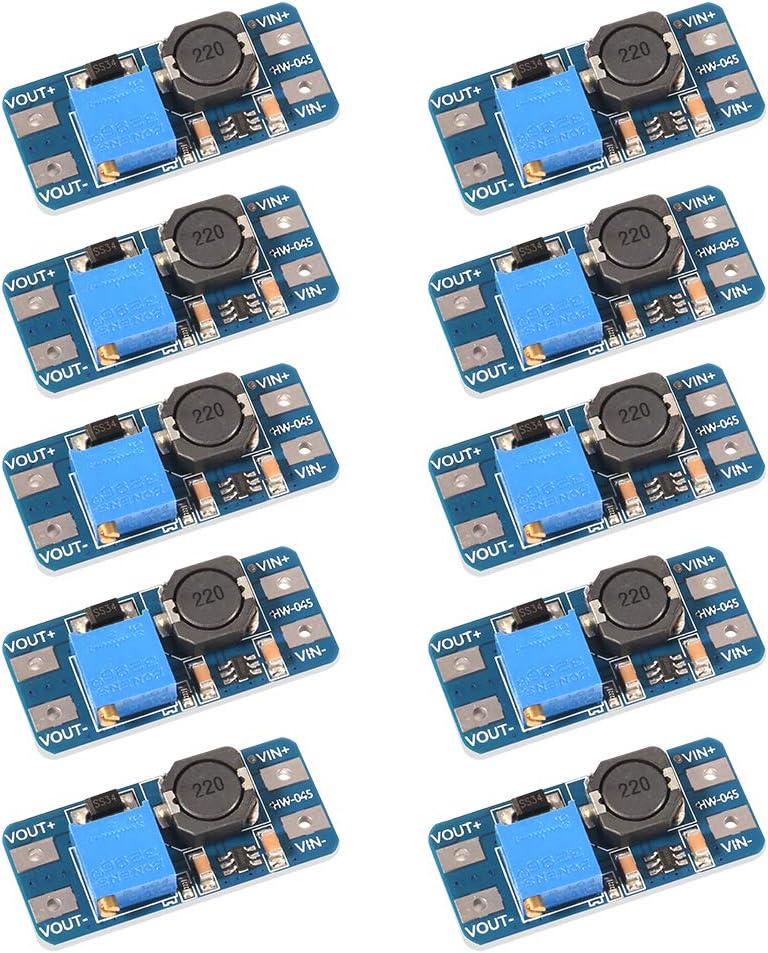
The MT3608 DC-DC Step Up Boost Power Converter is a highly efficient voltage regulator module that allows you to convert input voltages from 2V to 24V into adjustable output voltages ranging from 5V to 28V. With a conversion efficiency of up to 93%, this module is ideal for a variety of applications including DIY projects, battery storage, and industrial equipment. It features built-in safety mechanisms to protect against overloads, making it a reliable choice for both hobbyists and professionals.
| ASIN | B089JYBF25 |
| Best Sellers Rank | #21,894 in Tools & Home Improvement ( See Top 100 in Tools & Home Improvement ) #83 in Power Converters |
| Brand Name | DORHEA |
| Current Rating | 2 Amps |
| Customer Reviews | 3.8 out of 5 stars 483 Reviews |
| Item Weight | 1.76 Ounces |
| Manufacturer | DORHEA |
| Model | U13538-1 |
| Mounting Type | PCB Mount |
| Power Source | Dc Power Supply |
| Specification Met | UL |
| UPC | 701715434011 |
P**G
The boards are defective. Not really finally.
I received 10 boards and tested 1 of them and did not work with 4.1v input. No change in output voltage regardless of potentiometer. Tried two more boards and they are the same. The boards should work with greater than 2v but did not work. I am returning them no point of checking remaining 7 boards. After further testing none of the boards are defective. The issue is that you need to turn potentiometer at least 20~30 turns all the way both sides and at one point output voltage will increase. Turn until u hear click sound. If no change then turn opposite direction and it should work but many turns in that direction.
A**S
Trial and try till it works
Hello I purchased the MT3806 so I could boost my 9v to 11volts DC. My intended use was for raising the voltage of an original Made In Japan CE-2 guitar pedal. My first thought was that the MT3806 was small enough that it could easily be hidden, and I could use heat shrink on it to hide it. My first attempt to use the MT3806 was a failure, it literally sparked, burnt and caught on fire when I turned on the power. On guitar pedals the Center is Center Negative so I reversed the VIN- and VIN+. After that it started working but the voltage did not change at all. I returned to Amazon and read the reviews and started with another brand NEW MT3806. The great part is they are very affordable(cheap) and it doesn’t hurt my wallet to try again. I tightened until the thread ran out and clicked(no voltage change). After that I began to lefty loosen the Screw type potentiometer. It took a long time but it worked towards the end of the screws thread. I was able to regulate the output voltage to 10.76vDC from an input of 9vDC. Of course I do think and I also know that I don’t intend to use a load greater than 30mA. Worked out great, no issues, no noise issues either in an audio device.
C**R
Failed within hours
Two of these failed immediately. Other two worked for a while. I am using 2 of them simultaneously for two circuits up-converting from 12V to 24V, powering a 16W circuit. But both of them failed within a few hours of use. The failure resulted in them producing only the input voltage at the output. I am on the last one (of the 5-pack) and I expect it to fail as well. Very unpleasantly surprised. Actually heavily disappointed. I removed 1 star for each failed board from the 5-pack. The ad says that these up-converters work with loads up to 2 amps. I am using them only for 0.7A each so they should be able to handle that just fine. But they do not. I requested a replacement package, foolishly hoping that another batch might work better. I will post an update once I test them out. Though I should not fail to provide more details about the up-converters. They come with nice pre-drilled solder pads, they are big enough for bigger wires for 2 amps, that is a nice touch. The adjustment trim-pot is pretty funky, the quality really is not good because when it is turned maybe 1/4 turn, the voltage barely changes, then it is just barely touched and now the output voltage jumps an extra volt. The trim-pot operation simply is not smooth enough for fine adjustments. Otherwise, once the trim-pot is adjusted, the board holds the output voltage well, no big deviations, maybe a tenth of a volt but that's also the reading error on my DMM so it's hard to tell. Size of the boards is acceptable and as advertised. If I ever get any that will actually stay working, I will slide them into a 1.5" heat shrink sleeve for protection. As far as the refund goes, I have been waiting almost a month. I have neither the boards, nor my money. On the product returns page, Amazon indicates when I should receive the refund. Whenever the date comes up, they move it out. The return page shows "Refund issuance is delayed". No explanation. Amazon is pretty good about issuing a refund once they receive the merchandise but they've had the boards 2 weeks and no refund. I wonder about their actual procedural policy and why the process is stuck. Disappointed on this front as well.
A**H
Finicky But Works (mostly)
These things are easy to destroy by accident. I applied 7v on my first one right out of the box and definitely destroyed it. They are really finicky and the processes for adjusting them is very specific. While the first was my own fault, I watched a tutorial after and I still couldn't get 2 of them to work. That left me down three out of the ten. Still enough for what I needed and price and shipping time were very good which is why I decided to give it four stars instead of three. I am just a little disappointed that two seemed DoA. First, you have to apply a load (use a meter or voltage display module) and 3v DC in. These things are calibrated to the lowest possible value out of the box and exceeding the minimum voltage by a volt or two can ruin them. Rotate the adjustment pot counter clockwise until you see a voltage increase. This can take half a dozen to a dozen rotations. Adjust until the output reaches the target voltage you have in mind for your product. Once you have it set, disconnect it from the 3v power supply. It's now safe to connect any supply (that I assume doesn't match or exceed the Vout) you set and changing it after seems to work fine. When doing the initial setup, I found sometimes be as little as .1v under or .2v over seemed to prevent the calibration logic from kicking in. Once the logic kicks in for the first time, adjusting it is easy.
T**S
Don’t know what all the fuss is about, they all work fine.
I saw the copious negative reviews for these, but they were dirt cheap so I gambled anyway. I rapidly tested three modules on my bench just to see what all the fuss was about. They all worked perfectly fine. Even with 3.4V input I could take them past 20V output at moderate load. At lower voltage delta, I could push them past an amp. Yeah, voltage will sag at high loads, so adjust based on your load. Voltage was reasonably stable for a given load and pot adjustment. At certain points I could hear some switching harmonics, but that’s normal. I think people need a reality check. You want a truly constant voltage power source? You ain’t getting it from a <$1 module. Sure the listing rates these at 2A, but also use some common sense. That’s probably an intermittent maximum rating and it very much depends on how much of a step up you are asking the little device for. More realistically, put a realistic power expectation in your head and understand that you need to derate as you increase the step up. I tested 12Vin and 16Vout with 2A output and had no issues. Efficiency drops as voltage delta increases. It’s a tiny little switcher IC and there’s no heatsink. Play stupid thermal games with it and win stupid thermal prizes. You want a comprehensive datasheet with exact thermal and load ratings? Go spend more money or build your own to spec. If you don’t understand that most trimmer pots are 20 turn, don’t play with module level components. If you just want a really cheap way to step up a voltage and you have realistic power expectations based on the size of this little IC, hard to beat these.
J**I
Needs a load resistor across the output.
You need to put some sort of load on the output pins or this will self destruct. I soldered a 33k resistor between the + and - output pins on the . If this is unloaded, there is nowhere for the stored energy in the inductor to go, so it's only a matter of time before it eventually arcs across the output transistor and fries it. At least that's what happened to the first one I powered up. I'll do a long-term test to verify this, but I'm pretty sure that's why these are blowing themselves up. So, just make sure that it's always got some kind of load on it. You have to dissipate the energy in that coil to somewhere.
S**N
Great for prototyping and working with USB port power (Updated: lowered to 3 star)
Update: Lowered my rating to 3 star. I originally ordered a dozen in January 2023 and they worked great (original review 5 star). I ordered another dozen in Sept 2024 and the first 3 I tried didn't work. Order at your own risk, seeing other more recent reviews it appears there are some serious quality issues going on. There appears to be a few differences on the PCBs between my two orders (a new silkscreen on the back clues me in that they created new gerber files). Upon very very close inspection I notice a couple vias that are different, but there's only 6 components and this is a very simple circuit - there should have been no reason to change it. Also - from my original order there was one (pictured) where the inductor was broken when I took it out of the bag. So, ultimately, they are cheap - if you order them, order far more than you need and test them with a meter before trying to use them. Original review: Easy to and quick to use, might as well have a bunch of them handy for various projects. Extremely useful when trying to work with USB power, you can take the 5vdc from the USB and step it up to what you need to run another board if you need 9 or 12v instead. I wired it up to a usb port, tossed a voltmeter on the outputs and turned the pot. until I got the voltage I wanted. Be aware of the power limitations of your usb port of course.
E**S
Must connect to 2 amp power or less otherwise it burns up
Works great, but I accidently burned up 2 of them connecting them to a power source that was not limited to 2 amps. I'm using them on rc cars to step up 6v to 24v for some led strips. Power them from the bec of the reciever instead of directly from the battery if you do the same thing. These have a good amount of voltage ajustability while being small in size and a pretty good price so I would easily buy more if I need to. If you know what you're doing it's easy to use and easy to tune the accuracy of the voltage you want. (Don't worry it's just a temporary setup; everything will be soldered when it's done)
Trustpilot
1 month ago
2 months ago