
DOWNLOAD THE APP


Customer Services
Copyright © 2025 Desertcart Holdings Limited
DOWNLOAD THE APP
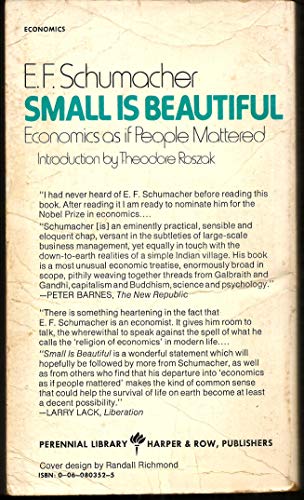
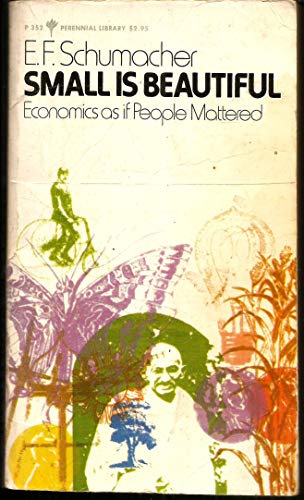
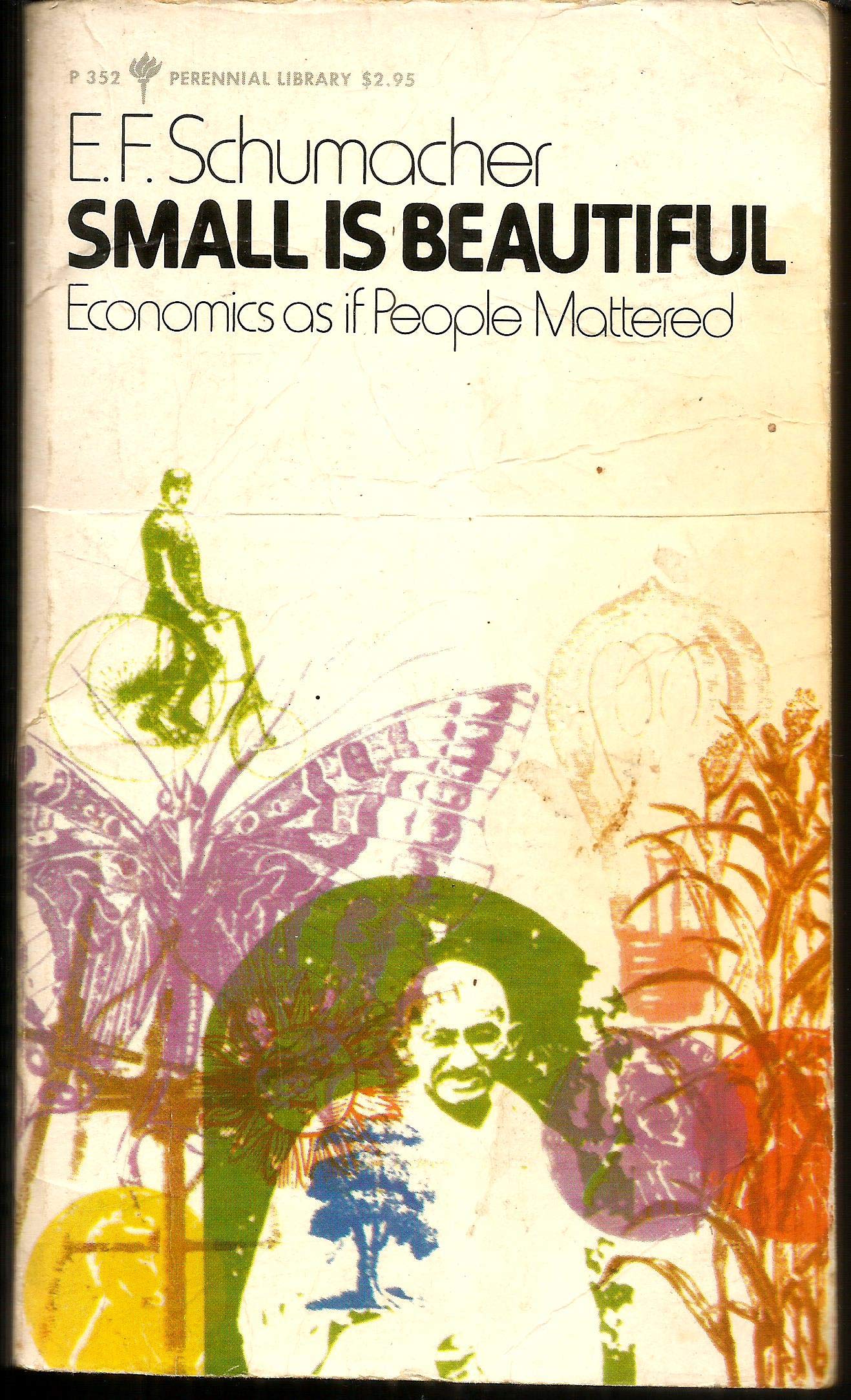
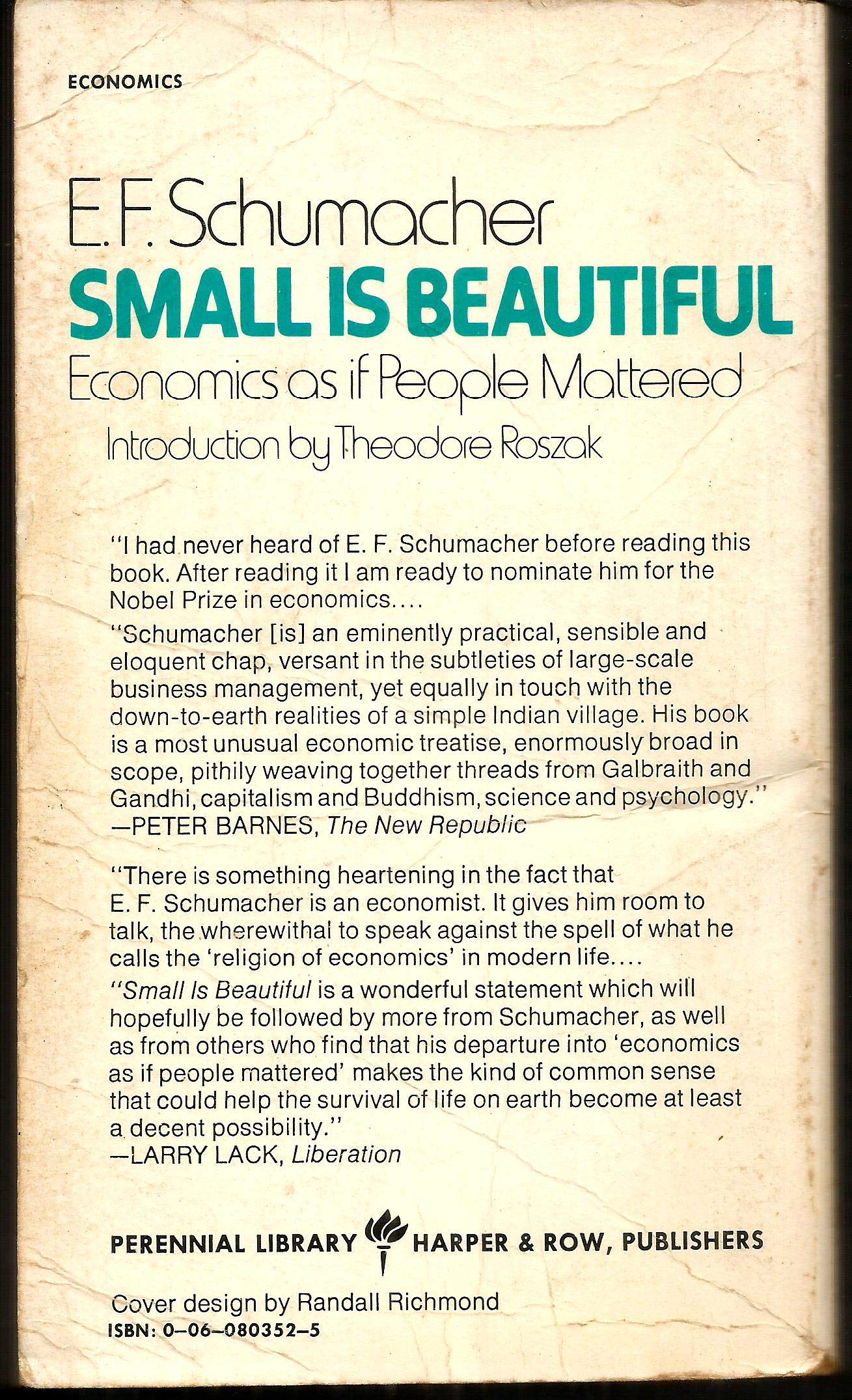
Small is Beautiful: Economics as if People Mattered [E.F. Schumacher] on desertcart.com. *FREE* shipping on qualifying offers. Small is Beautiful: Economics as if People Mattered Review: Not Only Beautiful, But Also Practical - In my college days I struggled with economics and barely passed. My economic professors and the course material were dull, ambiguous, and non-stimulating. None of these adjectives could be used to describe Schumacher's Small is Beautiful: Economics as if People Mattered. Schumacher makes economics come alive with wit, humor, and practicality. His approach is qualitative, not quantitative. A recurring statement throughout the book epitomizes his philosophy, "Why use the computer if you can make the calculation on the back of an envelope"? He gives the science a personality when identifying the disparities between the rich and poor, the educated and uneducated, and the gap between city people and country-folk. Small is Beautiful created a humanistic economics movement. It's a wholistic approach containing ethical, ecological, and metaphysical components that are missing from the statistical models that solely measure GNP. Schumacher sounded the alarm regarding globalization when asking "how much further 'growth' will be possible, since infinate growth in a finite environment is an obvious impossibility". He was critical of a society that generates unbounded materialism, and motivated by greed and envy. Some of the more interesting of the 20 essays are: "Peace and Permanence", "The Role of Economics", "Buddhist Economics", "The Greatest Resource - Education", "Technology with a Human Face", "Development of Intermediate Technology", and "Two Million Villages". Although the book was written in 1973, it is as timely now as it was then. The 25th anniversary edition contains provocative updates provided as sidebars by contributors such as Hazel Henderson, Peter Warshall, Amory Lovins, Godric Bader, et al. Review: Economics and Environment Book - This book was published in 1973. The author, E.F. Schumacher , was ahead of his time as an environmentalist. The book is a collection of essays divided into four parts. It is not a typical econonics book filled with numbers, charts, graphs, and formulas. "Bigness is the nemesis of anarchism, whether the bigness is that of public or privat bureaucracies, because from bigness comes impersonality , insensitivity, and a lust to concentrate abstract power. Hence, Schumacher's title ' Small is Beautiful.'" He weaves together threads from Galbraith and Gandhi, capitalism and Buddhism, science and psychology.
| ASIN | 0060803525 |
| Best Sellers Rank | #840,430 in Books ( See Top 100 in Books ) #280 in Microeconomics (Books) #496 in Environmental Policy #595 in Theory of Economics |
| Customer Reviews | 4.4 4.4 out of 5 stars (72) |
| Dimensions | 6.11 x 1.11 x 8.11 inches |
| ISBN-10 | 9780060803520 |
| ISBN-13 | 978-0060803520 |
| Item Weight | 10.7 ounces |
| Language | English |
| Print length | 305 pages |
| Publication date | January 1, 1975 |
| Publisher | Perenial Library /Harper & Row, Publishers |
T**Y
Not Only Beautiful, But Also Practical
In my college days I struggled with economics and barely passed. My economic professors and the course material were dull, ambiguous, and non-stimulating. None of these adjectives could be used to describe Schumacher's Small is Beautiful: Economics as if People Mattered. Schumacher makes economics come alive with wit, humor, and practicality. His approach is qualitative, not quantitative. A recurring statement throughout the book epitomizes his philosophy, "Why use the computer if you can make the calculation on the back of an envelope"? He gives the science a personality when identifying the disparities between the rich and poor, the educated and uneducated, and the gap between city people and country-folk. Small is Beautiful created a humanistic economics movement. It's a wholistic approach containing ethical, ecological, and metaphysical components that are missing from the statistical models that solely measure GNP. Schumacher sounded the alarm regarding globalization when asking "how much further 'growth' will be possible, since infinate growth in a finite environment is an obvious impossibility". He was critical of a society that generates unbounded materialism, and motivated by greed and envy. Some of the more interesting of the 20 essays are: "Peace and Permanence", "The Role of Economics", "Buddhist Economics", "The Greatest Resource - Education", "Technology with a Human Face", "Development of Intermediate Technology", and "Two Million Villages". Although the book was written in 1973, it is as timely now as it was then. The 25th anniversary edition contains provocative updates provided as sidebars by contributors such as Hazel Henderson, Peter Warshall, Amory Lovins, Godric Bader, et al.
K**R
Economics and Environment Book
This book was published in 1973. The author, E.F. Schumacher , was ahead of his time as an environmentalist. The book is a collection of essays divided into four parts. It is not a typical econonics book filled with numbers, charts, graphs, and formulas. "Bigness is the nemesis of anarchism, whether the bigness is that of public or privat bureaucracies, because from bigness comes impersonality , insensitivity, and a lust to concentrate abstract power. Hence, Schumacher's title ' Small is Beautiful.'" He weaves together threads from Galbraith and Gandhi, capitalism and Buddhism, science and psychology.
A**R
Great book. Life changing and should be on every ...
Great book. Life changing and should be on every person's "must read" list.
E**P
Four Stars
Interesting to read cautions about the environment and the world from only 40 years ago.
H**A
Everyone should read this book regardless of whether or not ...
Everyone should read this book regardless of whether or not your liberal arts education required it. Also, this particular copy came with a few notes in it, which proved very helpful in school. Thanks, Amazon!
F**R
Three Stars
A thought-provioking read.
C**R
On time good condition
Book came on time and in good condition considering used.
P**R
Economics matters to the few!
The author explains in practical terms why a small percentage of the world dominates economic policy. Well written and prescient to our time.
S**R
Very useful book in contemporary times. The modern economists should read this book
M**N
Ce livre a été un best seller dans les pays anglo-saxons et il a marqué le début d'une critique radicale de l'économie politique moderne. Dans une perspective humaniste, c'est-à-dire tenant l'homme pour le facteur essentiel, et non pour une simple variable d'ajustement. Paru en 1973, il a été constamment réédité en anglais depuis, mais il n'a fait l'objet que d'une seule édition française... en 1978. Bien sûr les éléments chiffrés et les prévisions statistiques auraient besoin d'être remises dans le contexte et réévalués aujourd'hui, mais l'essentiel du point de vue reste valable et même novateur. C'est une pensée visionnaire qu'il faudrait d'urgence remettre en circulation.
U**D
30年前に書かれた本だが、現代経済の問題点を人間的見地からよく分析しており、全く古さを感じない。化石燃料と自然の許容度と人間性を消耗することによって成り立つ経済を批判し、中間技術などの解決法を提示しているが、これは現在行われている「サステイナビリティー:持続可能性」の議論そのものである。30年前にして本議題を持ち出す著者の洞察力は素晴らしい。グローバル化によって暴走し、ますます利益第一主義の傾向が強くなり、倫理を失う経済システムを前に本書のような思想はますます重要になるのではないかと思う。また、本版は25周年記念版で、ポール・ホーケンなど著名な人たちが各ページの横にコメントを書いているが、こちらも素晴らしいコメントが多い。
Trustpilot
1 month ago
1 month ago