We remain fully operational. Our teams are working around the clock to ensure your deliveries continue safely.

DOWNLOAD THE APP


Copyright © 2025 Desertcart Holdings Limited
DOWNLOAD THE APP
Buy anything from 5,000+ international stores. One checkout price. No surprise fees. Join 2M+ shoppers on Desertcart.
Desertcart purchases this item on your behalf and handles shipping, customs, and support to KUWAIT.
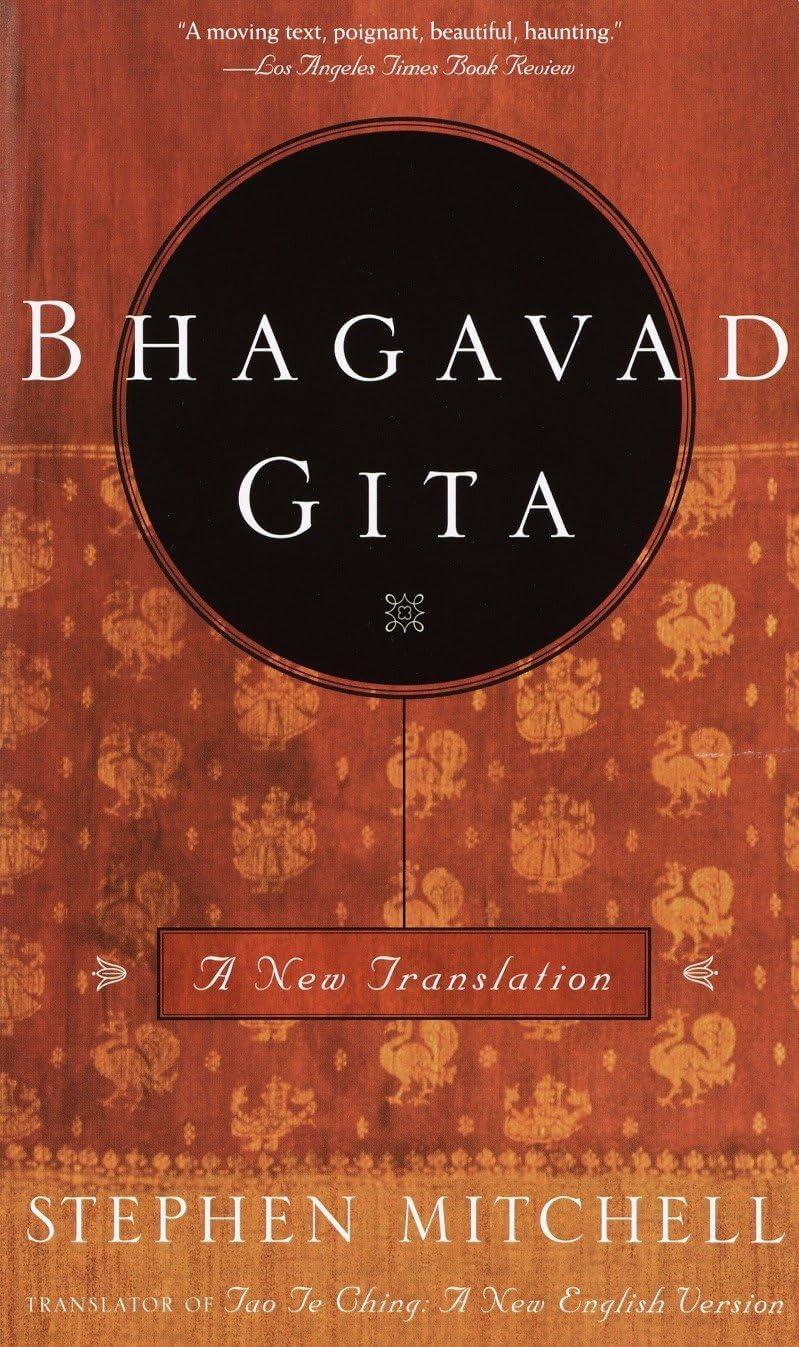
Bhagavad Gita: A New Translation [Mitchell, Stephen] on desertcart.com. *FREE* shipping on qualifying offers. Bhagavad Gita: A New Translation Review: Intelligent, accessible and beautifully presented - First of all this is a beautiful book. The design by Barbara Sturman in which the text is presented in a handsome wine/purple font set in wide margins with the chapter titles in a contemporary font of soft vermillion suggests reverence for the Gita while hinting of a twenty-first century Western appreciation. There is a ribbon sown into the binder for keeping your place. Second, the emphasis is on the text of the Gita itself garlanded by Mitchell's brief introduction and his "About the Translation" and a most appropriate and valuable appendix, "The Message of the Gita" by Mohandas K. Gandhi from his Collected Works. Third, there is the translation itself, which is poetic and easily accessible to the contemporary reader without diluting the sacred essence of this great work of spirituality. Mitchell, who has had extensive experience rendering poetic and spiritual works into English, including a much-admired translation of the Tao Te Ching, worked hard at fusing "the dignity of formal verse" into a "sound like natural speech" (p. 32). Rather than go through torturous artificialities in trying to fit all of the text into metric lines, Mitchell has chosen to present some of the Gita in prose. Thus the opening chapter, which he calls "Arjuna's Despair," in which the scene is set and the participants identified, is gracefully told in prose, as is the introduction of the second chapter until Krishna speaks. The effect is beautiful, since it highlights the importance of what Krishna is about to say in a speech that really begins the poem and the teaching. (Shakespeare used this technique.) Mitchell has solved the problem of the word "yoga," a long time bugaboo for English translators of the Gita, by sometimes using "yoga" and sometimes using "discipline." I certainty appreciate his discretion, having been annoyed for years by those translators who use only "discipline," a word that in many instances misleads the reader and muddies the text with exactly the wrong meaning and connotation. Restricting himself to the word "discipline" alone, as Mitchell explains, "would be an impoverishment." He adds, "how could one expect the reader to keep a straight face at the image of Krishna as the ?" (p. 33). Krishna is indeed the Lord of Yoga. Mitchell does not attempt to translate some other terms, like "guna," because, "Attempts to find English equivalents...have been uniformly unsuccessful and confuse more than they clarify" (p. 33). Anyone versed in yoga knows that the gunas--sattva, rajas, and tamas--represent something close to an entire philosophy and cannot be understood without some study. The usual rendering as "qualities" or "strands" is tolerable, but, as Mitchell indicates, impoverished, and sometimes leads to a misrepresentation of the text. (See especially 13.21 and compare it with other translations and to the gloss of Sankara, which can be found in the translation by Swami Nikhilanada (1979) published by the Ramakrishna-Vivekananda Center, and elsewhere.) However not all scholars agree with this. Kees Bolle in his translation (1979), published by the University of California Press, insists that "words like , , and must be translated" (p. 226). His concluding essay, "On Translating the Bhagavadgita" is a sharp, candid, and entertaining discussion of some of the problems that translators face. Where Mitchell runs afoul of some readers is in his worldly attitude toward the Gita as revealed in the introduction, where he uses a story by Borges and a reminiscence by Robert J. Oppenheimer to make a couple of points. He also assumes a somewhat Taoist position. To those not conversant with the Tao Te Ching, Mitchell's statement on page 30, "The healthiest way to begin reading and absorbing a text like the Bhagavad Gita is to understand that ultimately it has nothing to teach," is definitely off-putting. To me Mitchell's position is not a detriment and indeed the only proper stance for a translator is secular. The Gita is a sacred work to Hindus and yogis and others, but to people who practice other religions and who have been raised in other traditions, the Gita, while a great poetic and spiritual work, has to take its place alongside the Bible, the Tao Te Ching, the Koran and other religious works. To others, the Gita is, as it was to T.S. Eliot, simply a great philosophical poem. (Eliot considered it second to Dante's the Divine Comedy.) Mitchell may also startle some uncritical readers of the Gita with his argument in a footnote on pages 200-202 that the last six chapters are not of the same quality as chapters 1-12. He sees a difference in attitude and finds the last six chapters "much inferior...both poetically and spiritually." I tend to agree, but all venerable religious works are uneven and contain different voices. It is also true that the Gita is repetitious to some extent (although that is not necessarily to its disadvantage as a didactic scripture), and even seemingly contradictory. I believe this is an unavoidable consequence of being complex and of having been passed down through many generations both before and after it was written down. To those who might find Mitchell not completely qualified to bring yet another translation of the Gita into the English-speaking world because, as he admits on page 30, his "knowledge of Sanskrit is rudimentary," I can only say, his is a fine tradition. I am thinking of the poet W. B. Yeats, who also without much Sanskrit, but with the help of Shree Purohit Swami, wrote a beautiful translation of The Ten Principal Upanishads (1937), and of Christopher Isherwood, also without much Sanskrit, but with the help of Swami Prabhavananda, published a graceful rendition of the Gita (1944). Bottom line: this is a beautiful and valuable book that would enhance anyone's library, and I recommend it highly. --Dennis Littrell, author of "Yoga: Sacred and Profane (Beyond Hatha Yoga)" Review: A Partial Revelation of the Christian Gospels - I first heard of the Bhagavad Gita as kid in the quote attributed to Robert Oppenheimer, when he witnessed the first atomic explosion. Educated in the Christian tradition, I later formed an idea of the Bhagavad Gita as a Hindu work of high reputation that a Christian in the West should not be very interested in, something Steve Jobs might have dabbled in as part of his quest to overcome all doctrines selectively (that is, all doctrines except the ones he picked up from India, which in his mind somehow favored minimalist designs despite the profusion of decoration in Hindu and Buddhist art). Picking up this work by accident one Sunday after Mass, in a coffee shop in Old San Juan, left me astonished. The beauty, wisdom and revelation contained in the Bhagavad Gita should make it widely read, especially but not only by Christians. In the Christian tradition, theologians have recommended for centuries, and even required, the reading of “pagan” (i.e. not Christian, Jewish or Muslim) authors like Plato and Aristotle, whom they regarded as recipients from God of a partial revelation of philosophical truth that anticipated many aspects of Christianity. The Bhavagad Gita is in many ways more of a partial revelation of the Christian faith than anything Greek pagans wrote. For example, in stanzas 4.7-11 Lord Krishna tells Arjuna that “whenever righteousness falters” Krishna takes on a human body to manifest himself on earth, adding: “Whoever knows, profoundly/My divine presence on earth/is not reborn when he leaves the body/but comes to me.” The Jewish prophets did not come closer to describing a reason for the incarnation of God than that passage. And there is also this: “However men try to reach me,/I return their love with my love;/whatever path they may travel,/it leads to me in the end.” Elsewhere, the Gita advises detachment from desire as the root of evil, speaks of communal meals as a religious exercise, and wisely describes the need for balance between contemplation and action. Its belief in polytheistic and reincarnation errors (yes, errors; truth is not a matter of opinion) do not obscure the fact that the Gita sometimes expresses some core Christian beliefs more beautifully than many theologians do. This translation is a joy to read. It is clear and accessible, spare, elegant and therefore simple. So I ordered this book as a gift for one of my sons as a college graduation present, to complement an earlier gift of Marcus Aurelius and his 12 years of primary and secondary Catholic education. I am happier with his reading this than Plato’s Republic (after all, if Socrates were correct that might is not right, how would the Jews have conquered the promised land, how would Christians have taken over the Roman state after the Milvian Bridge, and how would Mecca have converted to Islam?). The Gita is a wonderful portal to the riches of India.

| Best Sellers Rank | #22,366 in Books ( See Top 100 in Books ) #4 in Bhagavad Gita (Books) #4 in Indian Eastern Philosophy #128 in Meditation (Books) |
| Customer Reviews | 4.7 4.7 out of 5 stars (1,734) |
| Dimensions | 5.49 x 0.64 x 9.17 inches |
| Edition | Reprint |
| ISBN-10 | 0609810340 |
| ISBN-13 | 978-0609810347 |
| Item Weight | 8.8 ounces |
| Language | English |
| Print length | 224 pages |
| Publication date | August 27, 2002 |
| Publisher | Harmony |
D**L
Intelligent, accessible and beautifully presented
First of all this is a beautiful book. The design by Barbara Sturman in which the text is presented in a handsome wine/purple font set in wide margins with the chapter titles in a contemporary font of soft vermillion suggests reverence for the Gita while hinting of a twenty-first century Western appreciation. There is a ribbon sown into the binder for keeping your place. Second, the emphasis is on the text of the Gita itself garlanded by Mitchell's brief introduction and his "About the Translation" and a most appropriate and valuable appendix, "The Message of the Gita" by Mohandas K. Gandhi from his Collected Works. Third, there is the translation itself, which is poetic and easily accessible to the contemporary reader without diluting the sacred essence of this great work of spirituality. Mitchell, who has had extensive experience rendering poetic and spiritual works into English, including a much-admired translation of the Tao Te Ching, worked hard at fusing "the dignity of formal verse" into a "sound like natural speech" (p. 32). Rather than go through torturous artificialities in trying to fit all of the text into metric lines, Mitchell has chosen to present some of the Gita in prose. Thus the opening chapter, which he calls "Arjuna's Despair," in which the scene is set and the participants identified, is gracefully told in prose, as is the introduction of the second chapter until Krishna speaks. The effect is beautiful, since it highlights the importance of what Krishna is about to say in a speech that really begins the poem and the teaching. (Shakespeare used this technique.) Mitchell has solved the problem of the word "yoga," a long time bugaboo for English translators of the Gita, by sometimes using "yoga" and sometimes using "discipline." I certainty appreciate his discretion, having been annoyed for years by those translators who use only "discipline," a word that in many instances misleads the reader and muddies the text with exactly the wrong meaning and connotation. Restricting himself to the word "discipline" alone, as Mitchell explains, "would be an impoverishment." He adds, "how could one expect the reader to keep a straight face at the image of Krishna as the <Lord of Discipline>?" (p. 33). Krishna is indeed the Lord of Yoga. Mitchell does not attempt to translate some other terms, like "guna," because, "Attempts to find English equivalents...have been uniformly unsuccessful and confuse more than they clarify" (p. 33). Anyone versed in yoga knows that the gunas--sattva, rajas, and tamas--represent something close to an entire philosophy and cannot be understood without some study. The usual rendering as "qualities" or "strands" is tolerable, but, as Mitchell indicates, impoverished, and sometimes leads to a misrepresentation of the text. (See especially 13.21 and compare it with other translations and to the gloss of Sankara, which can be found in the translation by Swami Nikhilanada (1979) published by the Ramakrishna-Vivekananda Center, and elsewhere.) However not all scholars agree with this. Kees Bolle in his translation (1979), published by the University of California Press, insists that "words like <yoga>, <moksa>, and must be translated" (p. 226). His concluding essay, "On Translating the Bhagavadgita" is a sharp, candid, and entertaining discussion of some of the problems that translators face. Where Mitchell runs afoul of some readers is in his worldly attitude toward the Gita as revealed in the introduction, where he uses a story by Borges and a reminiscence by Robert J. Oppenheimer to make a couple of points. He also assumes a somewhat Taoist position. To those not conversant with the Tao Te Ching, Mitchell's statement on page 30, "The healthiest way to begin reading and absorbing a text like the Bhagavad Gita is to understand that ultimately it has nothing to teach," is definitely off-putting. To me Mitchell's position is not a detriment and indeed the only proper stance for a translator is secular. The Gita is a sacred work to Hindus and yogis and others, but to people who practice other religions and who have been raised in other traditions, the Gita, while a great poetic and spiritual work, has to take its place alongside the Bible, the Tao Te Ching, the Koran and other religious works. To others, the Gita is, as it was to T.S. Eliot, simply a great philosophical poem. (Eliot considered it second to Dante's the Divine Comedy.) Mitchell may also startle some uncritical readers of the Gita with his argument in a footnote on pages 200-202 that the last six chapters are not of the same quality as chapters 1-12. He sees a difference in attitude and finds the last six chapters "much inferior...both poetically and spiritually." I tend to agree, but all venerable religious works are uneven and contain different voices. It is also true that the Gita is repetitious to some extent (although that is not necessarily to its disadvantage as a didactic scripture), and even seemingly contradictory. I believe this is an unavoidable consequence of being complex and of having been passed down through many generations both before and after it was written down. To those who might find Mitchell not completely qualified to bring yet another translation of the Gita into the English-speaking world because, as he admits on page 30, his "knowledge of Sanskrit is rudimentary," I can only say, his is a fine tradition. I am thinking of the poet W. B. Yeats, who also without much Sanskrit, but with the help of Shree Purohit Swami, wrote a beautiful translation of The Ten Principal Upanishads (1937), and of Christopher Isherwood, also without much Sanskrit, but with the help of Swami Prabhavananda, published a graceful rendition of the Gita (1944). Bottom line: this is a beautiful and valuable book that would enhance anyone's library, and I recommend it highly. --Dennis Littrell, author of "Yoga: Sacred and Profane (Beyond Hatha Yoga)"
J**T
A Partial Revelation of the Christian Gospels
I first heard of the Bhagavad Gita as kid in the quote attributed to Robert Oppenheimer, when he witnessed the first atomic explosion. Educated in the Christian tradition, I later formed an idea of the Bhagavad Gita as a Hindu work of high reputation that a Christian in the West should not be very interested in, something Steve Jobs might have dabbled in as part of his quest to overcome all doctrines selectively (that is, all doctrines except the ones he picked up from India, which in his mind somehow favored minimalist designs despite the profusion of decoration in Hindu and Buddhist art). Picking up this work by accident one Sunday after Mass, in a coffee shop in Old San Juan, left me astonished. The beauty, wisdom and revelation contained in the Bhagavad Gita should make it widely read, especially but not only by Christians. In the Christian tradition, theologians have recommended for centuries, and even required, the reading of “pagan” (i.e. not Christian, Jewish or Muslim) authors like Plato and Aristotle, whom they regarded as recipients from God of a partial revelation of philosophical truth that anticipated many aspects of Christianity. The Bhavagad Gita is in many ways more of a partial revelation of the Christian faith than anything Greek pagans wrote. For example, in stanzas 4.7-11 Lord Krishna tells Arjuna that “whenever righteousness falters” Krishna takes on a human body to manifest himself on earth, adding: “Whoever knows, profoundly/My divine presence on earth/is not reborn when he leaves the body/but comes to me.” The Jewish prophets did not come closer to describing a reason for the incarnation of God than that passage. And there is also this: “However men try to reach me,/I return their love with my love;/whatever path they may travel,/it leads to me in the end.” Elsewhere, the Gita advises detachment from desire as the root of evil, speaks of communal meals as a religious exercise, and wisely describes the need for balance between contemplation and action. Its belief in polytheistic and reincarnation errors (yes, errors; truth is not a matter of opinion) do not obscure the fact that the Gita sometimes expresses some core Christian beliefs more beautifully than many theologians do. This translation is a joy to read. It is clear and accessible, spare, elegant and therefore simple. So I ordered this book as a gift for one of my sons as a college graduation present, to complement an earlier gift of Marcus Aurelius and his 12 years of primary and secondary Catholic education. I am happier with his reading this than Plato’s Republic (after all, if Socrates were correct that might is not right, how would the Jews have conquered the promised land, how would Christians have taken over the Roman state after the Milvian Bridge, and how would Mecca have converted to Islam?). The Gita is a wonderful portal to the riches of India.
A**I
Spiritual wisdom
Such a good read. Doesn’t matter religion or what you believe in, anyone can learn from it. Not my religion and I enjoyed the book.
J**R
This is a Masterpiece
Only recently did I contemplate attempting a transliteration of the Gita. I intuited the meter to be 8. I had read Maharishi's translation of one third of it decades ago. It really did not touch me. I then read Kamala Subramanian's Mahabharata (which includes the Gita). That touched the hidden God within, and penetrated me, as if I were there. After, I read Swami Prabhupada's. This was literalistic, and scholarly but left me feeling it to be a great guide to the words, but no more. Subsequently I have been working through Swami Yogananda's God Talks to Arjuna. But I realized, I am not a translator, I am a transliterator, a dramatist. I happened on Stephen Mitchell's. It had the verse meter I intuited, and beautiful clarity. Additionally, it explained that, bluntly, as I interpreted it, it suffered edit by the demon false translators. Mr. Mitchell is a gifted translator and gifted poet. Each translation has something to offer, but Mr. Mitchell's is very, very special; and I thank him for sharing his cosmic and intellectual gifts with the world. And thank you for enkindling a spiritual fire in me. I give his translation my highest review. Salut! God speaks for Itself. Here, I believe God speaks approval.
M**E
A new perspective on religion and life
A most interesting book that I had been meaning to read for years and finally got around to add to the stacks. While I won’t claim to understand all of it… I will say it was a breath of fresh air and a new perspective on religion and life
P**R
Shining
A lucid interpretation of one of the world’s greatest spiritual treasures.
I**A
Very poetic and beautifully written.
C**N
A must read for any seeker, no mater of what background you may have. First, the english is superb, so clear and easy to read, second, unlike my other translations of the Gita I have, it is free from the commentaries that seem to slant it one way or the other towards the views of the translator. This is the raw, the original Gita just put simply into very good English. and it has power, when i read it, I am moved. Strange maybe, but I think every Christian should read this book, place the name Christ where the Gita puts Krishna, and it has a remarkable message to bring to the west. Not in invalid move if you read the first lines of the Gospel of John carefully,
E**I
S**R
This is a great translation - capturing essence and poetry. However readers should be aware that any translation not coming from a deeply studied and practiced teacher will certainly give a false understanding.
A**ー
人生をより良く、 戦闘的に生きる哲学が書かれたギーターの英語訳! この英文は、 原文からの翻訳で、 そんなに難しい単語は、出てこない! 英文で読むと日本語のニュアンスとは、大きく違い、また違ったギーターの解釈が可能となる。
Trustpilot
4 days ago
2 weeks ago