🎧 Elevate your sound game with power, precision, and planet-friendly vibes!
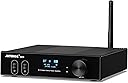
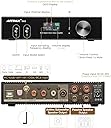
The AIYIMA D03 is a compact yet powerful 2x150W Class D stereo amplifier featuring Bluetooth 5.0 with aptX HD for lossless wireless streaming, multiple digital and analog inputs, and customizable EQ controls. Its OLED display and remote control ensure user-friendly operation, while ClimatePartner certification highlights its commitment to sustainability.


| Item Dimensions | 7.09 x 5.04 x 1.57 inches |
| Mounting Type | Coaxial,Plug Mount |
| Number of Channels | 2 |
| Output Power | 3E+2 Watts |
| Voltage | 32 Volts |
T**R
Surprisingly good
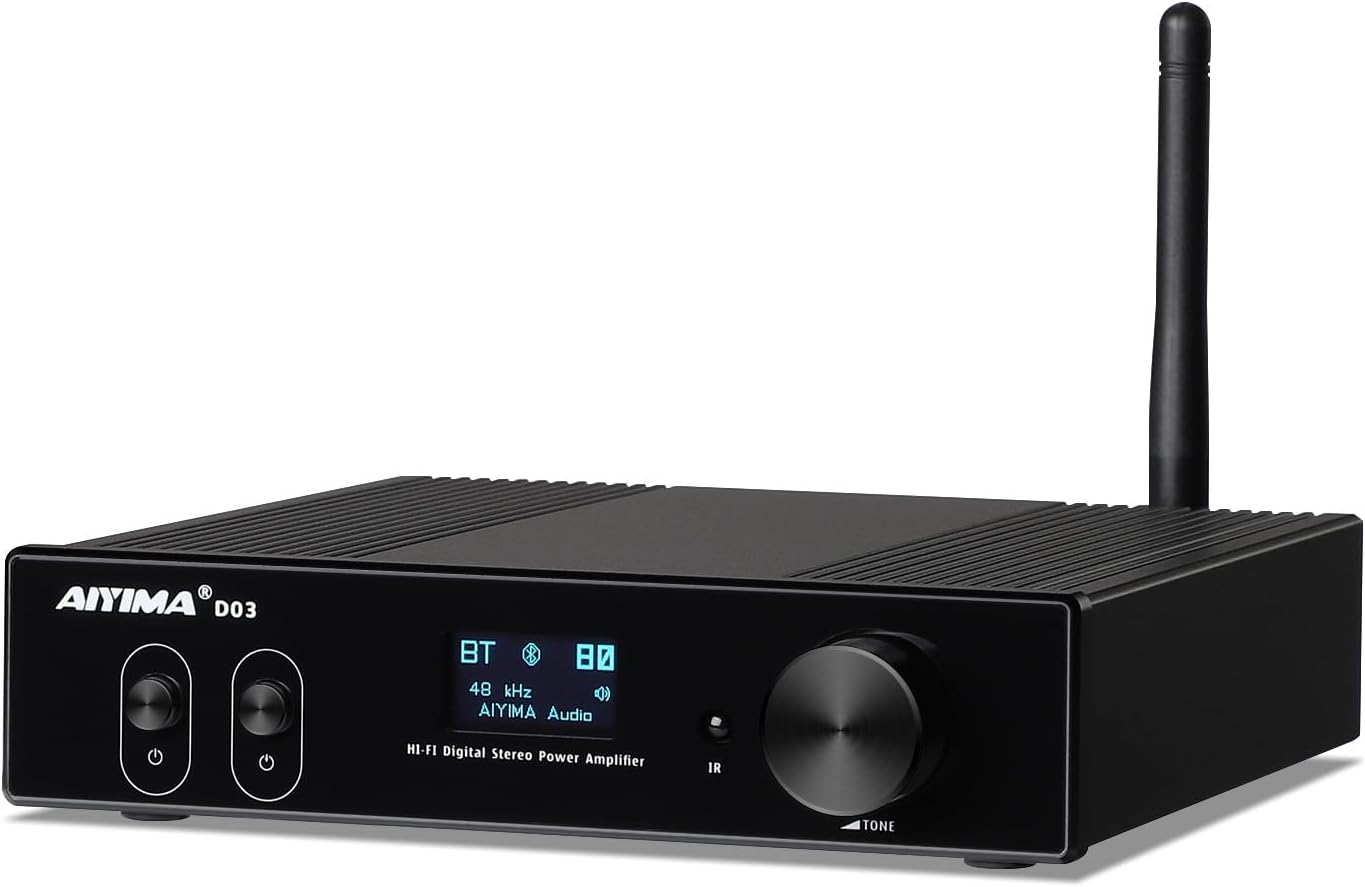
I wanted to upgrade my audiovisual setup in my new house, and needed a small stereo amp, with just three specific features: an optical input, a subwoofer output, and a usable remote control for at least volume. After scouring the Amazon website, I settled on the Aiyima D03. While I have had mixed results when buying electronics from an unknown mainland China manufacturer, this product was the simplest one available with the right combination of features. I wanted the optical input, because my entire signal chain is digital: HDMI from the BluRay DVD/CD player, into the Samsung TV, out via the TV's optical port, through a Bluetooth transmitter (for using Apple AirPods), and then out to the amp. I also needed the subwoofer output to drive an existing powered speaker, and finally, the remote volume control was also mandatory. The product also supports Bluetooth, although I won't be using that.This product fit the bill perfectly, and I have been very pleasantly surprised by it. The D03 is truly tiny; the cord-bump power supply is actually bigger than the amp. While it has a volume knob and input selection controls, the remote provides that, along with bass and treble controls, input selection, and more. When I connected it to my Klipsch bookshelf speakers, I got excellent sound performance, and completely quiet operation, no noise or hum.The amp features a nice graphic display which unfortunately, and owing to the tiny size of the amp, cannot be read from more than a few feet away. No matter, in my application, I really don't need to see it, since I'll only be using the optical input.The product came with a Bluetooth antenna (which I won't be using) and an optical cable, but without the necessary AAA batteries (x2) needed for the remote.Despite the five star rating I'm giving this product, no product is absolutely perfect, and I do have a minor criticism or two. The binding posts for the speaker outputs are really tiny, and a challenge to use with my stubby fingers. They also won't work well with heavy gauge speaker wire, so it makes sense to use 18 ga. or smaller wire, and abandon the myth that speaker cable gauge has anything to do with sound quality, especially with nearby bookshelf speakers. The instruction guide is also rather minimal, albeit sufficient.Class D amp design, something which I did professionally until my retirement, is truly amazing, in terms of reducing the size and weight of amplifiers. While class D amps have their challenges, they have the advantage on not needing massive amounts of iron and copper for transformers, as well as big heatsinks. As for the power output, I never believe the power rating claims of manufacturers like these, because they never specify the conditions for such a test. However, suffice it to say that the amp is far more powerful than it needs to be, to drive the Klipsch bookshelf speakers.Of course, since I only just installed this amp 24 hours ago, reliability will be my chief concern, and I would reserve the right to edit my review, should things go pear-shaped. However, once past the infancy failure stage, audio electronics can run for a very long time; I once had a Technics receiver in my office which remained turned on continuously for well over 20 years, until it finally failed. We'll see if Aiyima holds up as well.UPDATE: I've had this product since last May, and bought a second one for my daughter in August. I'm knocking off one star, for a couple of small problems in both that might be annoying to users. First, the IR remote control has a particularly weak output... it requires pointing the remote directly at the amplifier, and unless there's a clear and direct view, it often fails to work. Second, the volume control, via the remote, is difficult to use; each 'step' results in a very small volume change, so it takes a lot of clicks to meaningfully raise or lower the volume.Aside from those two issues, I still consider it to be an excellent product.
S**R
Excellent DAC/Amp combo
Excellent sound and power in the palm of your hand! I've got all my other integrated receiver/amps on standby while I continue to enjoy this newly found gem. Bass and treble controls if you desire to use them are available on the remote as well. Paired with the Aiyima tube T3 (also recommended) for vinyl, and using the optical input for CD playback I'm very pleased. Bluetooth connects flawless with my firestick and sounds just as good. Very nice small footprint system compared to all my other much larger components. I'm enjoying the added space not taken up by 30 pound receivers. It's definitely worth a try if you're considering a smaller amp option. 5 stars from me!UPDATE 9/3/23I still love this little amp. UNFORTUNATELY, for no apparent reason the Optical in and Bluetooth no longer work. I'm very gentle with my gear, it was not dropped or abused. I'm disappointed, but still using the Aux in input to supply sound in a spare bedroom. 1 1/2 years after purchasing, these 2 inputs suddenly quit..
M**S
Excellent, but requires days to warm up
Aiyima D03: 30 day reviewI'm writing this review now because I wish someone had written it months ago. It contains some facts that weren't obvious to me and may not be obvious to you. It also contains some subjective impressions. They are my own. I've had no contact with the seller or any other party with a financial interest in your purchasing decision.I'll start with the bottom line so you can skip the rest if you'd like. The Aiyima D03 is an excellent amp but it's not a good fit for everyone. You're most likely to enjoy it if the following statements are true about you:* You're looking for a stereo (two channel) amplifier for a small to mid-sized room.* You are moderately picky about sound quality.* You listen mainly to digital audio sources.* You don't already have a favorite DAC that you expect to pair with your new amp.* You are prepared to be extremely patient as your new amp warms up.The BasicsThe Aiyima D03 is a Class D integrated amplifier. I'll explain those terms in case you're unfamiliar with them."Class D" is a relatively new amplification strategy that relies on electronic switches to do most of the work and consequently can acheive much higher efficiency than the previously dominant "AB" class. This efficiency is why the Aiyima D03 is so much smaller than competing products like the (also excellent) Sony STRDH190 and Yamaha R-S202. The main difference between the classes lies in how much power they require and how much heat they generate. Class D amps don't necessarily sound better or worse than Class AB amps. As with many things in life, the outcome depends a great deal on the details.All amplifiers amplify sound. Integrated amplifiers also provide some kind of conversion or processing. The exact kind will vary from one model to another. In the case of the D03, you'll find a bluetooth receiver and a DAC that allows you to connect digital audio sources (coaxial, optical, USB) directly to the amp. Like simple ("power") amplifiers, the D03 also allows you to connect an analog (RCA) source.PowerHere's where comparison shopping gets tricky. Manufacturers usually advertise an amplifier's power in terms of watts-per-channel. This might lead you to the obvious conclusion that a 100 WPC amp will produce twice the sound volume of a 50 WPC amp. Obvious, but not even close to correct. First, WPC will vary dramatically with the resistance (ohms) of your speakers. Some manufacturers (like Yamaha) assume 8 ohm speakers. Others (like Aiyima) assume 4 ohm speakers. This prevents a straightforward comparison. Second, the relationship between watts and decibels is not linear. Each watt you add produces only a third of the volume that the previous watt did. You can learn the gritty details by researching speaker sensitivity and amplifier power. Or you could take my word for it and accept that the D03 has more than enough power to drive most bookshelf speakers deep into hearing damage territory. Don't let the small size fool you.Alternatives to ConsiderThe price gives you some idea about how Aiyima positioned the D03 relative to its competition. It's in line with the previously mentioned Sony SDRDH190 and Yamaha R-S202, both fine, basic, entry-level class AB integrated amplifiers. It's priced considerably higher than the Pyle PDA6BU which offers comparable features but also introduces much more harmonic distortion and noise. On the opposite boundary, you can find an array of high end integrated amplifiers from makers like Yamaha, Denon/Marantz, and Onkyo with prices that start a couple of hundred dollars more than the D03 but quickly reach well into the stratosphere. The law of diminishing returns applies. You get to decide how much you are willing to pay for that next nibble of improved fidelity.Aiyima isn't the only manufacturer of class D integrated amplifiers on Amazon. For example, Fosi Audio produces good stuff and has a few options, all priced below the D03. You can draw your own conclusions about why each seller chose to price their products as they did.If you listen only to analog sources or have your own DAC, the highly rated Aiyima A07 power (non-integrated) amplifier may be a better bet. As I'll describe under "subjective impressions," I see analog input as a weakness of the D03.Subjective ImpressionsAt the end of all the technical terms and numbers, the only thing that really matters is how your stereo system sounds to your ears in your room. Some of the more detailed reviews include information about who is listening and what other equipment is involved. You might find this tedious to read but it ends up making a huge difference to your understanding of the product because you are different from me and I am different from the next reviewer.I classify myself as a "discerning listener" rather than an "audiophile." I developed my ear through many years of playing musical instruments and editing audio files. On the other hand, I lack the inclinaton or patience to squeeze every last drop of fidelity out of my stereo system. I've never upgraded an op-amp. My usual standard is "sounds pretty good to me."Here's how I like to think about the sound quality of a stereo system. You start with the quality of the original source. Then you subtract all of the distortion and noise from each component and each connection between them. In other words, an awful amplifier can make great speakers sound awful but the reverse isn't true. A great amplifier can't make awful speakers sound great. Your stereo system can sound no better than its worst component, and will almost certainly sound worse. I raise this point here because it's unfair to blame bad sound on your amplifier unless you have done the hard work of eliminating all of the other possible causes. Don't forget the connections and interactions between components.I set the D03 up in my home office. I attached it to a pair of Polk S15 "Signature Series" bookshelf speakers, plus an Acoustic Audio PSW-6 subwoofer under my desk. The equipment is just a notch above entry-level. It's "pretty good" but won't win any audiophile competitions. The subwoofer connected to the designated RCA port on the D03 and had its crossover dialed all the way down to 50 Hz. This is not the best way to establish a speaker/subwoofer relationship but it's simple and acheived the "pretty good" sound I was going for. It also tested the D03's subwoofer output. My primary audio source is Spotify via a Macbook. It's connected to the USB port on the D03 and configured to play at 96 kHz. I found a volume of 15-20 (out of 100) to be plenty loud for my ears.To test sound systems, I often use "Toota Lute" from Mannheim Steamroller's Fresh Aire II. It contains some back-and-forth between a guitar and a harpsichord. I can learn quite a bit from how distinct the strings sound and how well they resonate (or don't). To my astonishment, the noise coming out of the D03 setup was positively dreadful. The strings were wrapped in wax paper and stuffed down a drain pipe. Any resonance could be attributed to a plumbing accident. After fiddling with wires for a few minutes and accomplishing nothing, I remembered a D03 review which mentioned that it "came alive" after a few days. I thought the author meant that the sound went from "pretty good" to "great" so didn't pay much attention. Lacking better ideas, I kept the D03 powered on and walked away. Two hours later, I thought it sounded marginally better but couldn't tell for sure. Maybe I was fooling myself. The next day, the improvement was remarkable but I still wasn't impressed with the sound. It took an entire week of gradual progress before I started to feel good about what I was hearing. I threw challenging pieces at it from every genre I knew and had to strain my ears to detect faults. Without reservation, I can call this D03 system "pretty good."I intended to keep using the USB port but also experimented with the others, mainly so I could mention them in this review. The optical port sounded excellent. At the same smaple rate, I couldn't detect any difference from the USB. Bluetooth sounded like bluetooth. It wouldn't be my first choice or even my third, but it worked. I found the analog (RCA) inputs to be the only disappointment. Switching from a digital source to an analog one resulted in a volume significant enough to be annoying. Even at equivalent volumes, the sound was flat and lifeless to my ears.Wrap-upThis review starts with my bottom line so I won't belabor the point here. I like the D03 quite a bit and intend to keep it for years. If you remember only one thing from this review, I hope it's this: before you pass judgment on this amplifier, let it warm up for several days. I realize how crazy this statement is in our post-vacuum tube world, but solid state components have temperatures too.[Update 9 Nov 23: Ejected After 16 Months]After sixteen months of near-daily use, the D03 no longer graces my office. It didn't break and it surprised me only once, but that discovery was a doozy. In my initial evaluation, I noted a significant volume difference between analog and digital sources. I played only digital sources and forgot about this quirk -- until I got annoyed with the uneven discrete volume control and attempted to hack around it by attaching an external DAC. This hack required the analog inputs and led to truly atrocious noises pouring out of my "pretty good" speakers. After a bit more experimentation, here's what I learned:1. Volume control is uneven. I landed in a state where 10 was too loud, 1 was about the same, and 0 worked as advertised. Discrete volume control is a challenging feature to implement. A simpler, continuous design would have served the budget D03 better.2. Sound quality from analog sources is worse than you'd expect from a simple low-budget power amp. Amazon carries dozens of them.3. The integrated DAC (TI TAS5548) performs admirably. I expect you would have trouble finding a superior DAC for less money than you would spend on the entire D03.Bottom line: Think of the Aiyima D03 as a "good-enough" DAC with a built-in amplifier. It's a portable headphone amp for your speakers. Don't try to use it like a power amp and you'll get along fine.In case you're curious, I replaced the integrated D03 with separates. A HiFime S2 DAC feeds an Aiyima A07. The S2 is a better DAC and the A07 is a better amp, so the same old speakers produce a richer and fuller sound. Because the S2 was designed for headphones, its analog output is louder than power amps generally expect. I mitigated this tension by sticking an adjustable attenuator between the two components. Switching to separates opens all kinds of possibilities if you're willing to get some wiring dirt under your fingernails. If you're like most people and just want to play digital audio through your speakers, the D05 remains a "pretty good" option. For this reason, I'll let my original four-star rating stand.Still here? Let's talk about the Aiyima D05 for a moment. It's easy to think "5 is bigger than 3, so the D05 must be newer or better." Easy and reasonable but completely wrong. On paper at least, the D03 is the better amp because it contains better/newer TI chips. I didn't bother with a real-life side-by-side sound comparison. It would be fun to see one.
Trustpilot
2 days ago
2 weeks ago