🌍 Stay connected, stay secure—your pocket-sized network guardian!
The GL-MT300N-V2 (Mango) is a compact, ultra-lightweight 2.4GHz travel router featuring dual Ethernet ports, 128MB RAM, and 16MB Flash. Powered via USB, it transforms public or wired networks into private Wi-Fi hotspots with pre-installed OpenVPN and OpenWrt firmware, offering advanced security and customization. Its intuitive app and web interface enable quick setup and network management, making it an essential tool for professionals seeking secure, portable connectivity anywhere.





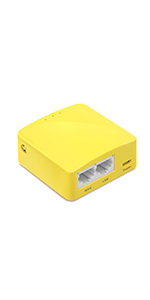
| ASIN | B073TSK26W |
| Best Sellers Rank | #3,680 in Electronics ( See Top 100 in Electronics ) #30 in Computer Routers |
| Customer Reviews | 4.1 4.1 out of 5 stars (12,622) |
| Date First Available | July 9, 2017 |
| Is Discontinued By Manufacturer | No |
| Item Weight | 1.41 ounces |
| Item model number | GL-MT300N-V2 |
| Manufacturer | GL Technologies |
| Product Dimensions | 2.3 x 2.3 x 1 inches |
A**N
Nice travel router
2025 Update: Took the rating from 3 stars to 5. First: Mainline OpenWRT now supports the device chipset which means I can use official downloads instead of ones made by the company that did not provide source code. Second: While the Ad-hoc/IBSS mode is not supported by the chipset, 802.11s mesh point mode *is* supported. This is a better long-term solution, and works great. I wanted to do B.A.T.M.A.N with some Pi Zero units (which can only do Ad-hoc, station, and AP modes), but that project fizzled out. Combining these with my home router also setup with 802.11s gave a very reliable mesh network (these provided extended wifi out on the patio). Original review: First, let me say that I did not purchase these (I bought two) to use in their intended purpose as a travel router. I was more interested in them as a cost-efficient learning platform for building a batman-adv mesh network. Unfortunately, the chipset in this little device is a MediaTek MT7628AN v1 which doesn't seem to have mainline OpenWRT support. The manufacturer does maintain several firmware images and an opkg repository, but I do not see any source code posted for their customized OpenWRT images (GPL violation?). The good: * Small and travel friendly. * Sufficient wifi signal * Easy to set up and use its basic functionality out of the box. Easily sets up as a wifi repeater. * Has a custom web UI that simplifies the most frequent, basic configurations. For more advanced options, LuCI is also available. The bad: * The wireless chipset doesn't support ad-hoc / IBSS mode which means they're useless as-intended for my batman-adv mesh project. * Can't even query the capabilities of the wireless chipset. "iw phy" returns nothing, and all of the radio interfaces seem to be "hardwired" into pre-defined modes (ra0 = iface used for AP mode, apcli0 = iface used in STA mode, wds0-3 for WDS). * I honestly don't trust this device not to send every secret that flows through it to Beijing, and the next thing I do will be a WireShark analysis. Assuming the silicon itself isn't compromised, I was hoping to simply reflash a vanilla OpenWRT image and build on that, but the architecture is not supported in mainline, and the chipset of the device was not published in the product description. Before giving up on these, I'm going to look into setting up a build environment for the chipset and compile my own image. * The OpenVPN client is garbage. It periodically disconnects and refuses to reconnect without several reboots. Clients lose internet access completely. Internet is otherwise solid with VPN disabled. Working on setting up WireGuard to see if it is any better. This is pretty much a core advertised feature of the product, so this is pretty unforgivable. * Chipset isn't supported in mainline OpenWRT. While the manufacturer's opkg repo does provide packages for that architecture, and that repo has so-far covered my needs, it makes me solely rely on the manufacturer. I suppose I could mirror their repo locally, but community support would be much preferred. * 3rd party OpenWRT packages are pretty much off the table. As with OpenWRT itself on this device, I'm looking into compiling the packages from source myself to bypass this limitation.
R**E
A good router
I recently purchased this Wi-Fi router, and I’m really impressed with its performance. The setup was straightforward, and it works seamlessly with all my devices. The signal strength is strong throughout my home, even in rooms far from the router. Streaming movies and online gaming are smooth, without any noticeable lag. The security features give me peace of mind, and I appreciate the parental controls for managing internet access. Overall, it’s a reliable router that delivers excellent speed and coverage at a reasonable price. Highly recommend!
D**N
Works as advertised so far.
We purchased the product so we could use it on a cruise. As people may know, cruise ships charge for each device you connect to the WiFi, so we should be able to connect a router, and then connect our phones and tablets to the router. 1. That "shared repeater" part worked. As long as we were in the room, we were able to connect two phones and an iPad to a single purchased WiFi. It takes a while to connect, and runs a little on the slow side, but it was usable, and good for the price. 2. This device does not have a built-in battery. If you want to carry it around the ship, you will need to plug it into a battery pack or some such. You will also need to keep an eye on cables, because it seems to come unplugged very easily or to at least lose the WiFi it is repeating. (The good news is that I could fit the modem and battery in a waterproof bag.) 3. The device allows use of two common VPN protocols (OpenVPN, WireGuard), but our cruise ship disconnected us when I tried to install WireGuard. I have no idea how it knew, so this may be user error. But if you are planning to use this with a VPN, then I would suggest you install and test it before you travel. 4. You have to be careful about the login and logoff, because our phones seemed to be identifying to the router using the same codes that the router was using to link to the ship's WiFi. So if the router turns off, then the ship might think that line is still connected, and not let anyone else connect on that account. This seems like pretty common behavior when a router is used as a repeater, so plan accordingly. 5. We did not use the Mango for USB modem, tethering, or ethernet. I have no reason to believe these don't work, it was just not what we were looking for. 6. This was almost a five-star review, but it was not as easy to set up as I had wanted. If you wait to get to the cruise ship before you try to set it up, you might spend a few hours of your cruise trying to figure out the instructions. This was only slightly harder than a regular modem repeater, but I had been trying to do the set-up on the flaky ship's Wifi, it would have been much harder.
L**K
I set one up as a wifi repeater to extend wifi range on a second floor of a house. Note that it is a repeater and not an extender, so it appears as a new wifi network rather than just extending the range of an existing network, but the effect is otherwise the same once you connect devices on the second storey to the new wifi network. This is actually how you might use it in a hotel or public wifi area to add an extra layer of security (connect to the wifi firewall router which is then protecting you before passing the connection through to public wifi, especially if you use the VPN feature). Interface made sense. Not 100% perfect but intuitive enough to figure out. No Ethernet connection required for setup. Very good device for the money.
E**A
I am amazed and impressed by this one. Obvious use: when travelling, use it to provide WLAN over the available hotel Wifi connection or other not that trustworthy connections. Not that obvious but hugely useful: - When abroad. Securing your connection while working and making it appear as being in the country you want. - Making an account work as you would, bypassing region limitations (in combination with your VPNs features). Useful for streaming services with regional restrictions, sharing when not in the same "house", using a bank or country public service that has geo-limitations ... It is really easy to install and setup. It will ask for a new router password in the first setup. My advice: change the default Wifi SSID name and password, too and make the Wlan not public. No point to use a router for securing your life via VPN and leaving these as default. It works with NordVPN (just remember to use as username and password the SERVICE ones, as found in the NordVPN page). It is way better than using your own router's VPN client (in case it provides one), since there are cases where you want to avoid it. Example would be a company PC running company VPN. Then there is no reason to have this on top of the Router's VPN. In such a case, the company PC can go over the normal router internet connection, having the company VPN. But your home PC or smart TV could go over the GL.iNet Wlan, thus getting automatically anonymized and secured. It is also much better than installing VPN clients to each device. Too much of an effort to do and maintain up to current. Plus, there are some devices where there is not even a client for them. It will also help your devices not being overloaded with clients and operations, leaving this to the GL.iNet router. Obvious observation: this is the smallest family member. Its resources as as low as it can be. Meaning, if you want to have many devices coming out of this, as your central VPN, and you intend to watch a lot of streaming services, HD, 4k, if you have special needs that you need to configure, like special triggers of what to be done, when VPN is down, different subnets, special behaviors (even though you can do quite nice basic configurations with this small router), you should look for something more versatile and strong. Especially for NordVPN, you can download their own configuration files or upload and use yours. It is small, it is silent, it looks positively funny (yellow). To reset to factory defaults, just press the button for 10 sec. You can not have it simpler. Only one "negative" i found. It does not come with the power supply (USB charger). Not hard to find one these days, but I expected that there was one with it in the box.
J**G
Super transportable. Excelente opción para armar una pequeña red y se puede alimentar hasta con una powerbank.
M**R
router deed precies wat ik wilde.
M**O
📝 DESCRIPCIÓN Mini enrutador WiFi portátil ideal para viajes, con funcionalidades avanzadas de seguridad y extensibilidad. * En Amazon puedes encontrar un modelo superior, con wifi dual: https://amzn.to/3VBX7sR 🧾 ESPECIFICACIONES - Marca: GL.iNet - Modelo: GL-MT300N-V2 - Banda de frecuencia: 2.4 Ghz - Estándar de comunicación inalámbrica: 802.11m - Velocidad máxima: 300 mbps - Tecnología de conectividad: USB, Por cable, Ethernet, Wifi, Inalámbrico - Color: Blanco 📦 CONTENIDO · Enrutador inalámbrico GL-MT300N-V2 · Manual de usuario · Cable de ethernet · Adaptador de corriente (enchufe UE+Reino Unido) · 2 años de garantía 📲 APP • glinet 💶 PRECIO • 14 de Marzo de 2024: 25,49€ 🟢 PROS • Diseño compacto y portátil, ideal para viajes. • Económico • Funciona como repetidor para redes Wi-Fi públicas. • Fácil de configurar y usar. 🔴 CONTRAS • No tiene banda de conexión de 5Ghz • No tiene puertos Gigabit para una conexión de alta velocidad. 8️⃣ VALORACIÓN Este router inalámbrico es ideal como opción para viajeros que necesitan conectividad privada y segura. También es perfecto para poder utilizar en tu vivienda, para mantener una red privada con VPN. Este router es el más básico de la gama, sin compatiblidad con wifi 6, sin doble banda wifi, con velocidades mayores en la banda de 5 Ghz y sin puerto de ethernet de gigabit. En cuanto a velocidades, tengo las siguientes: - Sin VPN: 85 Mb - Con VPN TCP: 6 Mb - Con VPN UDP: 9 Mb - Con Wireguard: 22 Mb Con algunos protocolos puedo ver IPTV sin problemas y jugar online. En cuanto a su diseño, es muy compacto y portátil, con diferentes opciones avanzadas de configuración, que garantiza una experiencia de uso satisfactoria. Tiene una fácil configuración y es muy versátil, que lo hace ideal para una variedad de situaciones gracias a su portabilidad. Entres sus funciones, tienen la opción de funcionar como: - Modo Router: En este modo, el router funciona como el dispositivo principal que gestiona la red local. Se conecta al módem de Internet y distribuye la conexión a Internet a través de cables Ethernet o de forma inalámbrica a dispositivos como pcs, móviles, tablets, etc. También realiza funciones como asignar direcciones IP a los dispositivos conectados, administrar el tráfico de la red, y proporcionar seguridad a través de cortafuegos y protocolos de seguridad como WPA2. - Modo Punto de Acceso (AP): En este modo, el router se utiliza para extender la red existente cableada a dispositivos inalámbricos. Se conecta a un router principal a través de un cable Ethernet y luego emite una señal WiFi para que los dispositivos inalámbricos se conecten a la red. Es capaz de realizar funciones de enrutamiento y gestiona la asignación de direcciones IP en su red. - Modo Repetidor (Repeater) o Extensor de Rango: En este modo, el router recibe la señal WiFi de otro router o punto de acceso y la amplifica para extender el alcance de la red inalámbrica. Se coloca en un área donde la señal WiFi existente es débil y la amplifica para proporcionar una cobertura más amplia. Funciona retransmitiendo la señal WiFi recibida desde el router principal. - Modo Tethering: El tethering permite compartir la conexión a Internet de un dispositivo móvil con otros dispositivos, como ordenadores o tablets, utilizando un cable USB, Bluetooth o Wi-Fi. Es útil cuando no hay acceso a una red Wi-Fi tradicional, convirtiendo tu móvil en un punto de acceso portátil. Su configuración se realiza desde un explorador, una vez conectado a él y también tienes la opción de configurarlo desde la app glinet. ✅ CONCLUSIÓN Es la primera vez que utilizo uno de estos router y me gustó la facilidad de uso y configuración. Soy usuario a nivel básico y conseguí de una manera rápida, crear mi propia red vpn. Tiene una buena relación calidad / precio, en comparación con otros modelos que encontré por Amazon. No es un dispositivo para grandes velocidades, pero es válido para transmisiones en streaming. 👍 RECOMENDABLE. ✳️ Espero que mi comentario ✍️ te haya sido útil 😃
Trustpilot
1 month ago
3 weeks ago