

Desert Online General Trading LLC
Dubai, United Arab Emirates
Desert Online General Trading LLC
Dubai, United Arab Emirates
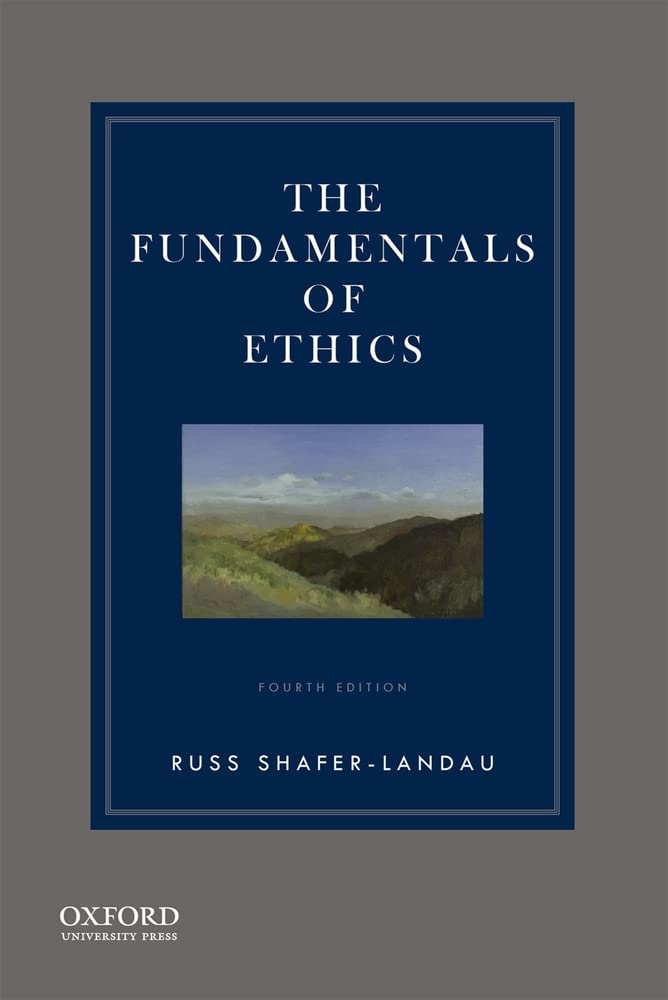
The Fundamentals of Ethics
D**A
This is one of the best books on ethics I've ever read
This is one of the best books on ethics I've ever read, and I've read a lot of books on ethics. It's a book meant for beginners who have little to no experience with moral philosophy, but even professionals or ethics-enthusiasts (like myself) will find much value in this book. It manages to cover an impressive amount of information in a relatively short time, beginning with questions of value, then the various normative ethical views, and ending with meta-ethics. Each chapter is divided into chunks that either explain a position or the arguments for and against it. The companion book is also great, which is a collection of historical ethical literature.I'm still giving it five stars but a gripe I did have was that the final section on meta-ethics was a little sparse. Shafer-Landau focuses primarily on skeptic perspectives of ethics, such as subjectivism, relativism, non-cognitivism and error theory. I wish he would have included something more about moral realism, and maybe even his own realist views. But in general it's not that big of an omission. I can understand why he didn't include some of the more nuanced positions in meta-ethics, like constructivism or Blackburn's quasi-realism, but if you're looking for a book that has more substance in meta-ethics, you might want to complement this book with another one that focuses more on meta-ethics. I personally would recommend "Foundations of Ethics: An Anthology" which is partly edited by Shafer-Landau, as well as "A Companion to Ethics" edited by Singer.But yeah, five stars no question about it. Fantastic book, entertaining and filled with information. Would recommend.
R**S
Supreme clarity
The author's uniquely clear and conversational writing style is a real boon to beginning students of philosophy. Concepts are lucidly and succinctly explained, too.R. Pies
A**K
The best philosophy textbook I have been assigned to read.
Russ Shafer-Landau's The Fundamentals of Ethics was just one of the books assigned in a semester's worth of reading for my graduate studies. Philosophy texts are usually a chore to read, and many of them are quite boring. However, there was never an instance where I did not look forward to reading Fundamentals when I had to fulfill the week's reading assignment. I cannot think of any other textbook I have owned that I could say that about!Shafer-Landau's writing is lucid and engaging, sprinkled with wit and humor and brilliant summaries of complex moral theories. Perhaps some could complain that his treatment of various views is oversimplified, but that would miss the point. The purpose of the text is to introduce the reader to popular theories of normative systems of ethics, and give a short defense of his preferred view of moral objectivity. If one wants to dive deeper, one will find abundant references to primary sources easily found in one of Shafer-Landau's edited volumes (e.g. Ethical Theory: An Anthology).This book serves the purpose of education well in that it mercifully introduces the reader to thinking about ethics in a way that invites more learning--not just for learning's sake--but for living well.
C**L
Shafe gives us a good primer on ethics
This is just the first edition and I notice that the second edition came out only two years later, however I still think this book is worth the cheap price that it is being sold for.Shafer goes over the basics in this introductory book in ethics as he goes over different ethical theories such as:Hedonism, Desire Theory, Divine Command Theory, Natural Law Theory, Psychological Egoism, Feminist Ethics, Ethical Egoism, Consequentialism, Kantian ethics, Social contract theory and Virtue ethics. Shafer spends a good deal of time giving arguments for and against these views with a good amount of fairness.He then takes on the status of morality whilst giving us a good primer on the metaethical positions such as ethical objectivism and moral relativism, and moral nihilism.Moral nihilism is broken up into two parts:Error Theory and Expressivism, both views IMO are the toughest to take down, and I say this as someone who holds to a version of Divine Command Theory. Shafer shows its flaw, but I think more work isShafer really lets it rip on moral relativism and definitely takes off the gloves in his criticismRuss Shafer Landau explains"Subjectivism is unable to explain the existence of moral disagreement. In order to avoid generating contradictions, subjectivists have to understand all moral judgments as reports of whether I approve of something or not. The claim that meat-eating is wrong becomes the claim that I disapprove of meat-eating....but on this line, moral debates that seem to involve intense disagreement become something completely different. In fact now it becomes IMPOSSIBLE for people to morally disagree with one another.To see this imagine an earlier disputeYou say: It's wrong to eat meatYour friend says: It's ok to eat meatThe subjectivist translates this as follows:You: I disapprove of eating meat.Your friend: I approve of eating meat.The contradiction has indeed disappeared, BUT SO HAS THE DISAGREEMENT. If you are both taking this seriously, you'll agree with your friend's claim, and she with yours. If all that moral judgments do is report people's outlooks, then there is no way to morally disagree with anyone - except to charge them with insincerity. But that seems plainly wrong"- QEDThe few cons of this book are as follows:The objection to the Divine Command theory is terrible, Shafer acts like we've never heard of the Euthyphro before and doesn't give any replies from formidable Theist philosophers who have knocked it down. (William Alston, Robert Adams).I would have liked more substance on why moral facts exist. (though I guess he wants us to check out his book on moral realism for that)Shafer is an elite moral philosopher in academia and he is someone who I find to be enlightening on this subject. I will continue to use his works on moral philosophy, along with Robert Adams and John Hare.
P**K
PHENOMENAL ETHICS BOOK
Ladies and Gents,If you are looking for a fundamental, all-encompssing, thorough but not dry (!), college level book about the various spheres of thought within ethics, read this book. No question, one of the most informative books I have ever laid my hands and eyes on. (Yes, I did end a sentence with a preposition.)Seriously, this book + Peter Singer’s ethics essay compilation are some of my favorite reads ever. (Singer is often referred to as the smartest philosopher that people love to hate. Utilitarian perspectives tend to evoke that emotion.)Regardless, you will become a better thinker for adding these books to your reading list.
Trustpilot
1 month ago
3 weeks ago