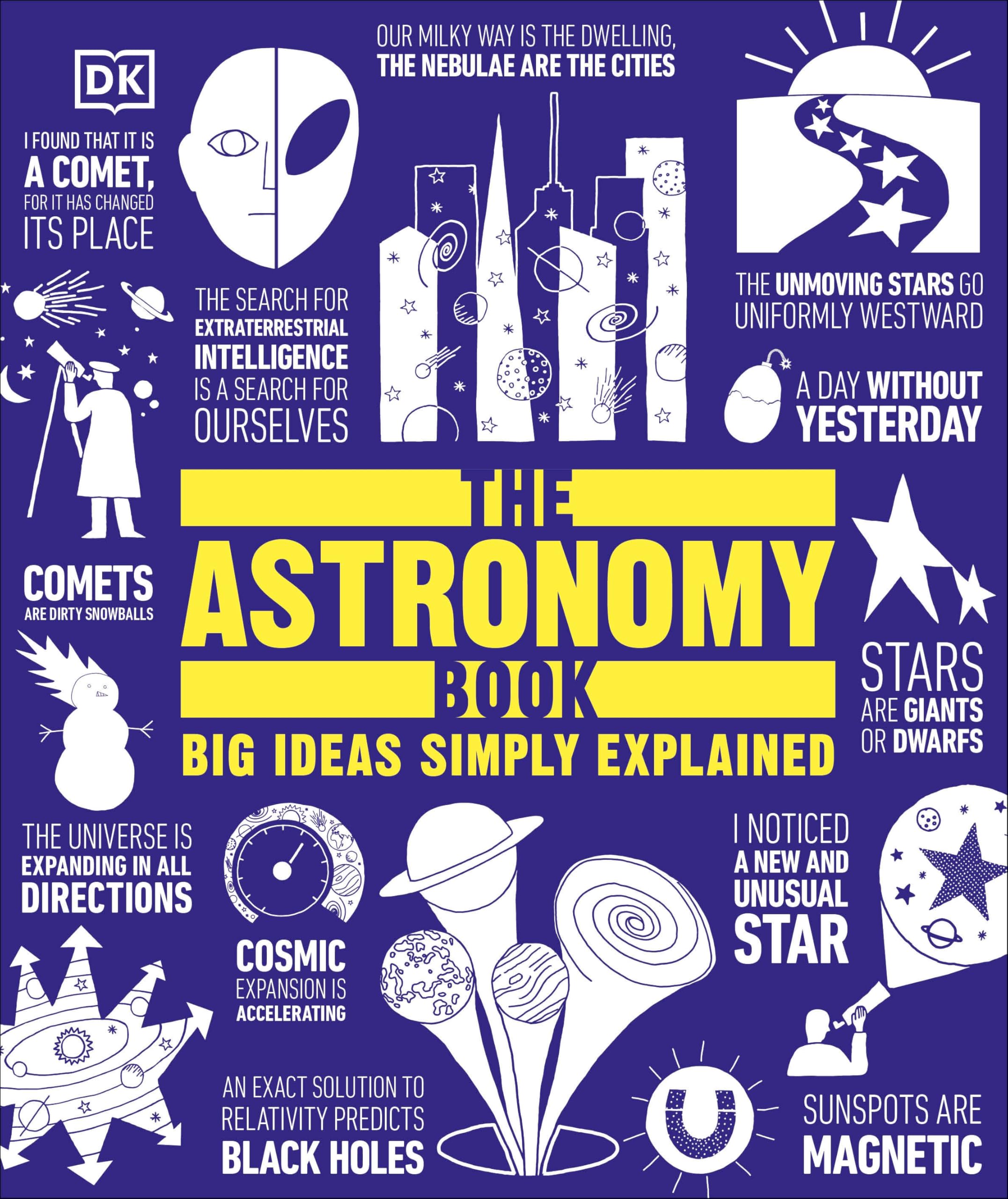
The Astronomy Book: Big Ideas Simply Explained [DK] on desertcart.com. *FREE* shipping on qualifying offers. The Astronomy Book: Big Ideas Simply Explained Review: It's astronomy for everyone and a browser's delight !! - Looking for a gift book for a curious 7th-grader? A high-schooler who likes science? An adult who likes to look at the sky? Someone (maybe yourself) who has never understood why Pluto got 'demoted', how we know there was a Big Bang, or what the heck gravity waves are? This latest fact-filled, picture-rich, and accessible to most everyone volume from Dorling Kindersley Ltd. (Great Britain) is a sure-fire winner in every respect. Having taught science for 38 years at levels from middle school through college, I can tell when a science-related volume hits the mark with both its content's "reach" and its presentation. As with DK's 2014 Science Book, the on-point text is augmented with simple flow charts, full-color illustrations, links to related topics, and lots of brief bios about the people who spent years discovering what is presented. Also noteworthy... this volume contains several longish biographies of women astronomers like: Jocelyn Bell Burnell, Annie Jump Cannon, Margaret Geller, Henrietta Swan Leavitt, Cecilia Payne-Gaposchin, Vera Rubin, and Beatrice Tinsley. The contributors are experienced in science book writing and in astronomy to the degree necessary in order to pull off the task of communicating both simple and challenging ideas to a wide variety of potential readers. Review: Book Approved by Bill - I wonder often about the universe, but not as a number cruncher does, because they believe something can come from nothing. I am much more sensible in knowing that it was created by an all knowing and powerful God. The book is a general knowledge book that even a novice can see that the universe has order, and I chose to believe that order comes not by physics laws, but intelligence. You do know that the moon is not the correct size and weight to act as it does? The dogma that tv physicists would want you believe is bunk, as Archie Bunker would say. NASA wants to go to Mars costing 1 Trillion, yet we have so many disease's than still ravage man, but NASA knows, and this book is not to full of Scientific Dogma, but just facts your teenager needs to know about the Heavens, and "This book is Approved by Bill." You see that stamp you can be sure it does not clash with the truth.























| Best Sellers Rank | #1,120,122 in Books ( See Top 100 in Books ) #40 in Astronomy for Teens & Young Adults #168 in Astronomy (Books) #392 in Astrophysics & Space Science (Books) |
| Customer Reviews | 4.7 4.7 out of 5 stars (1,438) |
| Dimensions | 8 x 1.01 x 9.44 inches |
| Edition | 1st |
| ISBN-10 | 1465464182 |
| ISBN-13 | 978-1465464187 |
| Item Weight | 2.57 pounds |
| Language | English |
| Part of series | DK Big Ideas |
| Print length | 352 pages |
| Publication date | September 5, 2017 |
| Publisher | DK |
J**.
It's astronomy for everyone and a browser's delight !!
Looking for a gift book for a curious 7th-grader? A high-schooler who likes science? An adult who likes to look at the sky? Someone (maybe yourself) who has never understood why Pluto got 'demoted', how we know there was a Big Bang, or what the heck gravity waves are? This latest fact-filled, picture-rich, and accessible to most everyone volume from Dorling Kindersley Ltd. (Great Britain) is a sure-fire winner in every respect. Having taught science for 38 years at levels from middle school through college, I can tell when a science-related volume hits the mark with both its content's "reach" and its presentation. As with DK's 2014 Science Book, the on-point text is augmented with simple flow charts, full-color illustrations, links to related topics, and lots of brief bios about the people who spent years discovering what is presented. Also noteworthy... this volume contains several longish biographies of women astronomers like: Jocelyn Bell Burnell, Annie Jump Cannon, Margaret Geller, Henrietta Swan Leavitt, Cecilia Payne-Gaposchin, Vera Rubin, and Beatrice Tinsley. The contributors are experienced in science book writing and in astronomy to the degree necessary in order to pull off the task of communicating both simple and challenging ideas to a wide variety of potential readers.
J**L
Book Approved by Bill
I wonder often about the universe, but not as a number cruncher does, because they believe something can come from nothing. I am much more sensible in knowing that it was created by an all knowing and powerful God. The book is a general knowledge book that even a novice can see that the universe has order, and I chose to believe that order comes not by physics laws, but intelligence. You do know that the moon is not the correct size and weight to act as it does? The dogma that tv physicists would want you believe is bunk, as Archie Bunker would say. NASA wants to go to Mars costing 1 Trillion, yet we have so many disease's than still ravage man, but NASA knows, and this book is not to full of Scientific Dogma, but just facts your teenager needs to know about the Heavens, and "This book is Approved by Bill." You see that stamp you can be sure it does not clash with the truth.
D**S
Wonderful History of Astronomy
A fantastic overview of the history of astronomy. Hits all the highlights. Aimed at young people, but great for all ages.
R**E
I like this book - helps me when I volunteer at the astronomy park here ...
I like the book! It is straight forward and helps me deliver answers to folks attending the astronomy park here. I am not a trivia guy or a story teller and I tend to get too into the weeds. This book helps a lot!
B**K
excellent resource
Big ideas simply explained, indeed. I can't remember being so enthralled with a book that I ordered for my children. My homeschoolers love this; they love the setup of each topic and the accompanying information. It's a really terrific resource.
R**J
Very Detailed
A very good book to catch up on Astronomy. Wel organized and covers the subject historically. Does justice to Chinese, Arab, Indian achievements.
S**R
PERFECT gift!!!
I bought 2 of these for each of my boys that are very much into the stars. My 30 year old is becoming a Astrophysics and loves it , my other son, loves the stars as well, could not put it down, both were gifts, my husband is reading over his shoulder and says I WANT ONE!!!! SoI will be getting a 3rd one!!
K**R
I learned alot
Very interesting book. Breaks everything into easy to read sections. Goes through the history of astronomers and is easy to understand.
A**8
Questa collana di libri non delude mai! Consigliatissima per alcuni spunti su tematiche altrimenti ampie. Come sempre la logistica Amazon funziona alla perfezione
R**)
He loved it, didn’t stop talking about it till he’d analysed every page. Has concepts you won’t read or find anywhere else.
L**A
8)
J**T
We are living through a portion of time on the cosmic calendar called the Stelliferous Age — the Age of Stars (which began more than 13 billion years ago). Stars produce energy in the form of light, heat and warmth. They also double as chemical factories, laboratories for stirring and mixing the elements, the birthplace of life, or the place where life’s ingredients are made. So when the Stelliferous Age passes (some 100 trillion years hence), life will too. A famous book says there is a season to everything. The season for life and living is now. Yet we inhabit a tiny portion of cosmic real estate in the visible universe, an area whose dimensions encompass only five percent of the cosmos. That portion looks boundlessly immense to us — so immense that no one can properly picture it mentally. Yet most of the universe, roughly 95 percent, is totally unknown, as we haven’t yet solved the puzzle and paradox of how to see the invisible. Even so, not knowing its composition and properties, we can gauge its impact on the visible universe through gravity, observing the effects of light as it bends through spacetime. We know this strange world is there and that it’s extremely powerful. The laws of physics, including those of thermodynamics, say inertia in the form entropy should be slowing the speed of our expanding universe, still growing 13.8 billion years after creation in the form of the Big Bang. But it isn’t slowing down. In fact, quite the opposite: it’s accelerating. How can this be? The answer is dark matter and dark energy, vague labels for properties or qualities of reality we do not understand. Yes, we know little about our cosmic home, yet we know more now than our ancestors who preceded us over thousands of generations. We live in a great age of discovery, or at least one great to us, although the age may look like one of ignorance and superstition thousands of years from now if our descendants and their developing technologies are still here. They will be the ones to decode the composition and properties of dark matter and dark energy, each of which respectively makes up roughly 25 and 70 percent of the universe. These ideas and many other fascinating ones are contained in this wonderful new book (2017) produced by DK Publishing in London. “The Astronomy Book” is part of a series DK is calling “Big Ideas Simply Explained”. Many people are probably thankful for this series, myself included. As such, the volume at hand here is a collection of knowledge that can teach one much about our cosmic home. The book is laid out chronologically, as this is probably the best way to grasp its concepts (the logical linear order of before and after). ‘Before’ of course makes up most of the book, what we knew then (in the past) compared to what we know now. It begins in a section called “From Myth to Science, 600 BCE-1550 CE”. Some sections that follow are: “The Telescope Revolution, 1550-1750”; “The Rise of Astrophysics, 1850-1915”; “Atoms, Stars and Galaxies, 1915-1950”; “New Windows on the Universe, 1950-1975”; and “The Triumph of Technology, 1975-Present”. The final section is the most recent of course (and perhaps most fascinating). A few of its subsections are: “Most of the Universe is missing (Dark matter)”; “Stars form from the inside out (inside giant molecular clouds)”; “Wrinkles in time (Observing the CMB)” — cosmic microwave background noise, echoes of the Big Bang; “Cosmic expansion is accelerating (Dark energy)”; and “Ripples through spacetime (Gravitational waves)”. Each section is laid out simply with an easy-to-follow, eye-pleasing design that includes “In Context” sidebars; quotations from famous astronomers; colourful graphics, diagrams, illustrations; very little math and complicated equations; brief sidebar biographies of astronomers; and a “See Also” reference guide at the bottom of many pages, directing the reader to additional, relevant material by subject heading and page numbers. Reference sections at the end of the book include a Directory of famous or influential astronomers (laid out chronologically), a Glossary of important terms, an Index, and an Acknowledgements page for editorial assistance and photo credits. This isn’t a book to be read in one go, just as the night sky does not invite one long, sustained glance. Instead, it’s one to return to time and again as certain ideas and questions arise in the mind. The best questions usually begin with ‘How’. This is the basis or foundation of science. Then many ‘w’ questions may follow: ‘what’, “when’, ‘where’, ‘who’, ‘why’. It’s a primer for understanding home, your place in the cosmos: what this place is, where it came from, how and why it’s here, how you and life could ever come to be. So naturally it’s philosophical as well, as many of the best questions we ask ourselves are. We want to know things. Why? Science tries to answer this question too by studying the structure and evolution of the human brain. It’s part of our Faustian pact with the universe. It made us — or allowed us to become — thinking reeds, as Pascal loved to say. We are wanderers, nomads, explorers on a long journey out of Africa, a journey that has now taken us intellectually to the heavens and stars in our desire to emotionally go home, retracing our steps to our birthplace. In a way, life is exactly this — one long homecoming, coming to terms with who you are and where you come from. This book, a wonderful thing, will hold your hand on the journey back through time.
M**A
It’s written in the style of school books, chapter by chapter, I think if you’re person who doesn’t have a problem to jump through pages and skip some, then you can find what you need
Trustpilot
2 months ago
2 weeks ago