
DOWNLOAD THE APP


Customer Services
Copyright © 2025 Desertcart Holdings Limited
DOWNLOAD THE APP

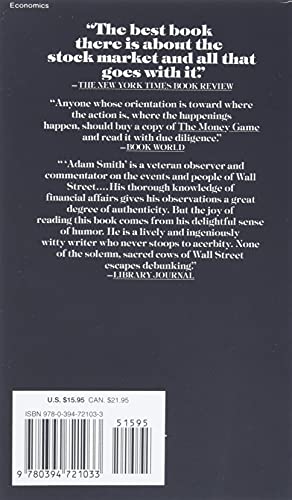
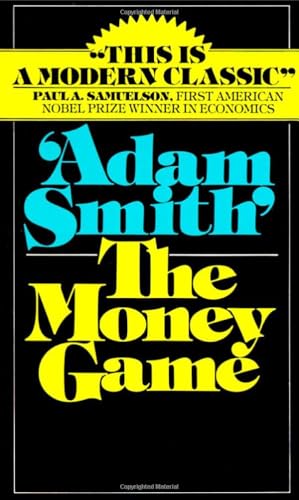



The Money Game [Smith, Adam] on desertcart.com. *FREE* shipping on qualifying offers. The Money Game Review: Adam Smith Reborn! - This is a classic about the stock market and investing. George covers a breadth of topics in that area based on his insider experience. This includes the psychology of the investor ("you"), IT systems and their impact on the investing field, the professional money managers and their role in the Game etc. The concepts are introduced in an accessible, and often humorous style. While the author does not offer direct investing advice, he does expose what he calls "the biases" that exist in the market - that are essential to take into account to be successful together with good judgment. George is very successful at immersing the reader into the culture, the psychology and way of thinking that dominates the financial markets and its participants. While this book is dated, most of the concepts discussed still apply to the financial industry today. A recommended read for anyone looking to gain more insight into the Stock Market. Below are excerpts from the book that I found particularly insightful: 1) "If you are a successful Game player, it can be a fascinating, consuming, totally absorbing experience, in fact it has to be. It it is not totally absorbing, you are not likely to be among the most successful, because you are competing with those who do find it absorbing." 2) "The irony is that this is a money game and money is the way we keep score. But the real object of the Game is not money, it is the playing of the Game itself. For the true players, you could take all the trophies away and substitute plastic beads or whale's teeth; as long as there is a way to keep score, they will play." 3) "In short, if you really know what's going on, you don't even have to know what's going on to know what's going on." 4) "You must use your emotions in a useful way...Your emotions must support the goal you're after...You must operate without anxiety." 5) "The strongest emotions in the marketplace are greed and fear. In rising markets, you can almost feel the greed tide begin...the greed itch begins when you see stocks move that you don't own." 6) "If you know that the stock doesn't know you own it, you are ahead of the game. You are ahead because you can change your mind and your actions without regard to what you did or thought yesterday." 7) "Who makes the really big money? The inside stockholders of a company do, when the market capitalizes the earnings of that company." 8) "What you want is the company which is about to do that (compounding earnings) over the next couple of years. And to do that, you not only have to know that the company is doing something right, but what it is doing right, and why these earnings are compounding." 9) "What I have told you is a set of biases so you can make your own judgement." 10) "It is an informal thesis of charting that there are roughly four stages of stock movement. These four are: 1) Accumulation: To make a perfect case, let us say the stock has been asleep for a long time, inactively trade. Then the volume picks up and probably so does the price. 2) Mark-up...Now the supply may be a bit thinner, and the stock is more pursued by buyers, so it moves up more steeply. 3) Distribution. The Smart People who bought the stock early are busy selling it to the Dumb People who are buying it late, and the result is more or less a standoff, depending on whose enthusiasm is greater. 4) Panic Liquidation. Everybody gets the hell out, Smart People, Dumb People, "everybody." Since there is "no one" left to buy, the stock goes down." 11) "Does this mean that charts can be ignored? Perhaps charts can be a useful tool even without inherent predictive qualities. A chart can give you an instant portrait of the character of a stock, whether it follows a minuet, a waltz, a twist, or the latest rock gyration. The chart can also sometimes tell you whether the character of the dancer seems to have changed." 12) "The computer is going to sanctify charting. The Chartists are on their way." 13) "The characteristics of performance are concentration and turnover. By concentration, as I said before, I mean limiting the number of issues. Limiting the number of issues means that attention is focused sharply on them, and the ones that do not perform well virtually beg to be dropped off...Furthermore, you are going to be scouting for the best six ideas, because if you find a really good one it may bump one of your other ones off the list. Turnover means how long you hold the stocks...All that turover has doubled the volume in the last couple of years, and the brokers are getting very rich." 14) "The further we come along, the more apparent becomes the wisdom of the Master in describing the market as a game of musical chairs. The most brilliant and perceptive analysis you can do may sit there until someone else believes it too, for the object of the game is not to own some stock, like a faithful dog, which you have chosen, but to get to the piece of paper ahead of the crowd. Value is not only inherent in the stock, it has to be value that is appreciated by others...It follows that some sort of sense timing is necessary, and you either develop it, or you don't." 15) "The aspiration of the people are a noble thing and no one is against jobs. But it does seem easy to produce them with currency rather than productivity. Central governments soon learn the utility of a deficit. It is convenient to take the views of the economists who followed Keynes and spend money during recessions. There are even problems on that side of the equation, because even with the breadth of statistical reporting and with computer, speed, this kind of economics is still inexact, and the central government can find itself pressing the wrong lever at the wrong time." 16) "The love of money as a possession - as distinguished from love of money as a means to the enjoyments and realities of life - will be recognized for what it is, a somewhat disgusting morbidity, one of those semi-criminal, semi-pathological propensities which one hands over with a shudder to the specialists in mental disease." Review: Your Grandfather's "Liars Poker" - Every generation, a writer and their books pop up that show the back end of Wall Street and its ilk running back to Bagehot’s “Lombard Street”. There was then Livermore’s Reminiscences of a Stock Operator, and Schwed’s “Where Are the Customers' Yachts?” The generation before me had Michael Lewis and his “Liar’s Poker.” You may say that he is contemporary, since he is still writing, but that book made his name, and he hasn’t worked on the street since. He’s more of an outsider now – in fact, “Liar’s Poker” just got a rerelease for its 25th anniversary. Our generation lacks our defining book. The writers who might have written those books are still grappling with the legacy of the 2008 financial crisis. But I digress. Then if Lewis was for our fathers, the Adam Smith was for our grandfathers. It is an interesting read in the more things change, the more they stay the same sort of way. Some of the references are dated, but others are remarkably contemporary. One example is traders talking about the income potential of shale gas out west to produce once technology comes on line. There is a joke that they have always been waiting for technology to extract the oil, at least since the thirties. You know what the new technology was that was so promising 50 years ago? Drillers were going to plant small nuclear devices down wells to make them produce. It makes the current fracking debate seem quaint – oh, what’s a little flammable hydrocarbon in your water matter? It could have been much worse. That’s just a tiny part of the book. There’s also some good advice built in. For example, I flagged “If you know the stock doesn’t know you own it, then your ahead of the game” (72), which is evergreen advice against getting stuck in the sunk cost fallacy. There’s also worries that computers will take over and the value of the dollar will go down – which also seems familiar. Overall, this book is well worth a read for someone who is interested in the history of the market or even someone looking for advice in today’s market.


| Best Sellers Rank | #136,834 in Books ( See Top 100 in Books ) #121 in Theory of Economics #619 in Investing (Books) #1,415 in Personal Finance (Books) |
| Customer Reviews | 4.3 4.3 out of 5 stars (670) |
| Dimensions | 4.18 x 0.72 x 6.94 inches |
| ISBN-10 | 0394721039 |
| ISBN-13 | 978-0394721033 |
| Item Weight | 5.6 ounces |
| Language | English |
| Print length | 272 pages |
| Publication date | August 12, 1976 |
| Publisher | Vintage |
O**H
Adam Smith Reborn!
This is a classic about the stock market and investing. George covers a breadth of topics in that area based on his insider experience. This includes the psychology of the investor ("you"), IT systems and their impact on the investing field, the professional money managers and their role in the Game etc. The concepts are introduced in an accessible, and often humorous style. While the author does not offer direct investing advice, he does expose what he calls "the biases" that exist in the market - that are essential to take into account to be successful together with good judgment. George is very successful at immersing the reader into the culture, the psychology and way of thinking that dominates the financial markets and its participants. While this book is dated, most of the concepts discussed still apply to the financial industry today. A recommended read for anyone looking to gain more insight into the Stock Market. Below are excerpts from the book that I found particularly insightful: 1) "If you are a successful Game player, it can be a fascinating, consuming, totally absorbing experience, in fact it has to be. It it is not totally absorbing, you are not likely to be among the most successful, because you are competing with those who do find it absorbing." 2) "The irony is that this is a money game and money is the way we keep score. But the real object of the Game is not money, it is the playing of the Game itself. For the true players, you could take all the trophies away and substitute plastic beads or whale's teeth; as long as there is a way to keep score, they will play." 3) "In short, if you really know what's going on, you don't even have to know what's going on to know what's going on." 4) "You must use your emotions in a useful way...Your emotions must support the goal you're after...You must operate without anxiety." 5) "The strongest emotions in the marketplace are greed and fear. In rising markets, you can almost feel the greed tide begin...the greed itch begins when you see stocks move that you don't own." 6) "If you know that the stock doesn't know you own it, you are ahead of the game. You are ahead because you can change your mind and your actions without regard to what you did or thought yesterday." 7) "Who makes the really big money? The inside stockholders of a company do, when the market capitalizes the earnings of that company." 8) "What you want is the company which is about to do that (compounding earnings) over the next couple of years. And to do that, you not only have to know that the company is doing something right, but what it is doing right, and why these earnings are compounding." 9) "What I have told you is a set of biases so you can make your own judgement." 10) "It is an informal thesis of charting that there are roughly four stages of stock movement. These four are: 1) Accumulation: To make a perfect case, let us say the stock has been asleep for a long time, inactively trade. Then the volume picks up and probably so does the price. 2) Mark-up...Now the supply may be a bit thinner, and the stock is more pursued by buyers, so it moves up more steeply. 3) Distribution. The Smart People who bought the stock early are busy selling it to the Dumb People who are buying it late, and the result is more or less a standoff, depending on whose enthusiasm is greater. 4) Panic Liquidation. Everybody gets the hell out, Smart People, Dumb People, "everybody." Since there is "no one" left to buy, the stock goes down." 11) "Does this mean that charts can be ignored? Perhaps charts can be a useful tool even without inherent predictive qualities. A chart can give you an instant portrait of the character of a stock, whether it follows a minuet, a waltz, a twist, or the latest rock gyration. The chart can also sometimes tell you whether the character of the dancer seems to have changed." 12) "The computer is going to sanctify charting. The Chartists are on their way." 13) "The characteristics of performance are concentration and turnover. By concentration, as I said before, I mean limiting the number of issues. Limiting the number of issues means that attention is focused sharply on them, and the ones that do not perform well virtually beg to be dropped off...Furthermore, you are going to be scouting for the best six ideas, because if you find a really good one it may bump one of your other ones off the list. Turnover means how long you hold the stocks...All that turover has doubled the volume in the last couple of years, and the brokers are getting very rich." 14) "The further we come along, the more apparent becomes the wisdom of the Master in describing the market as a game of musical chairs. The most brilliant and perceptive analysis you can do may sit there until someone else believes it too, for the object of the game is not to own some stock, like a faithful dog, which you have chosen, but to get to the piece of paper ahead of the crowd. Value is not only inherent in the stock, it has to be value that is appreciated by others...It follows that some sort of sense timing is necessary, and you either develop it, or you don't." 15) "The aspiration of the people are a noble thing and no one is against jobs. But it does seem easy to produce them with currency rather than productivity. Central governments soon learn the utility of a deficit. It is convenient to take the views of the economists who followed Keynes and spend money during recessions. There are even problems on that side of the equation, because even with the breadth of statistical reporting and with computer, speed, this kind of economics is still inexact, and the central government can find itself pressing the wrong lever at the wrong time." 16) "The love of money as a possession - as distinguished from love of money as a means to the enjoyments and realities of life - will be recognized for what it is, a somewhat disgusting morbidity, one of those semi-criminal, semi-pathological propensities which one hands over with a shudder to the specialists in mental disease."
J**R
Your Grandfather's "Liars Poker"
Every generation, a writer and their books pop up that show the back end of Wall Street and its ilk running back to Bagehot’s “Lombard Street”. There was then Livermore’s Reminiscences of a Stock Operator, and Schwed’s “Where Are the Customers' Yachts?” The generation before me had Michael Lewis and his “Liar’s Poker.” You may say that he is contemporary, since he is still writing, but that book made his name, and he hasn’t worked on the street since. He’s more of an outsider now – in fact, “Liar’s Poker” just got a rerelease for its 25th anniversary. Our generation lacks our defining book. The writers who might have written those books are still grappling with the legacy of the 2008 financial crisis. But I digress. Then if Lewis was for our fathers, the Adam Smith was for our grandfathers. It is an interesting read in the more things change, the more they stay the same sort of way. Some of the references are dated, but others are remarkably contemporary. One example is traders talking about the income potential of shale gas out west to produce once technology comes on line. There is a joke that they have always been waiting for technology to extract the oil, at least since the thirties. You know what the new technology was that was so promising 50 years ago? Drillers were going to plant small nuclear devices down wells to make them produce. It makes the current fracking debate seem quaint – oh, what’s a little flammable hydrocarbon in your water matter? It could have been much worse. That’s just a tiny part of the book. There’s also some good advice built in. For example, I flagged “If you know the stock doesn’t know you own it, then your ahead of the game” (72), which is evergreen advice against getting stuck in the sunk cost fallacy. There’s also worries that computers will take over and the value of the dollar will go down – which also seems familiar. Overall, this book is well worth a read for someone who is interested in the history of the market or even someone looking for advice in today’s market.
C**C
This book reminds of Business Adventures by John Brooks. In some ways, the stories in this book are slightly different or offer a savant viewpoint on the irrationality of financial markets. It is very well written and engaging. Thankfully, Amazon had this book in stock and well priced ...
M**Z
Praticamente sconosciuto in Italia ma fenomenale. Un concetto per cui vale la pena di leggerlo: " No, non si fanno i soldi sui mercati finanziari,i soldi si fanno quando un mercato riconosce la tua idea come valida, non c'e' modo di arricchirsi veramente senza creare valore." Dice la verita' sui mercati finanziari, da comprare cartaceo. L'impaginazione fa schifo
C**N
Claro y consiso un clásico
J**Y
Very poor quality, print too small and dense. Very expensive. The book does not do justice to the content or the author.
S**N
Whilst it might not be a typical investment book, which tend to be 'here's how investing works and how you will make money', which typically disappoint. This book focuses more on the philosophy side of money and investing, with plenty of information you likely won't read anywhere else. It's well written, not difficult to understand, though the references and some words might not be common language these days, a quick Google every now and again helped. It's one of those books where, if you're serious about investing, you really ought to read it. I learnt about this book from Howard Marks referencing it in one of his memos, and I'll likely make an effort to read it every few years.
Trustpilot
4 days ago
3 weeks ago